49 works in this view — arrow keys or swipe to move between them.
Dance in Art
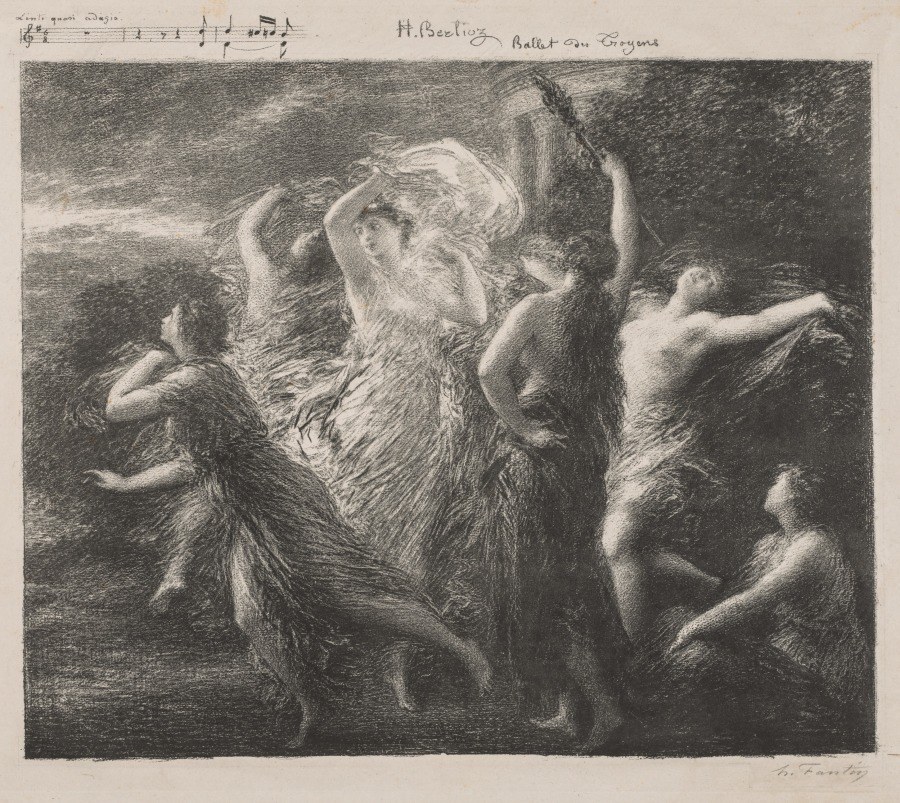
Ballet du Troyons
Henri Fantin-Latour (French, 1836–1904)
- Medium:
- lithograph
- Collection:
- Prints
- Source:
- Cleveland Museum of Art
- Rights:
- Public domain — free to use, share and adapt.
- Recorded as:
- CC0
Fantin-Latour was a significant painter and printmaker whose work commanded respect in avant-garde circles, yet he devoted considerable attention to ballet and theatrical subjects. This lithograph shows how serious artists of the Symbolist and Post-Impressionist era treated dance not as decorative spectacle but as a subject worthy of formal investigation and expressive power—a moment where the human body becomes a vehicle for classical ideals and emotional transcendence.
What you are looking at
A bearded male figure dominates the center of this lithograph, his body twisted in dynamic movement as he dances with attendant figures around him. His long, flowing drapery—suggesting classical or mythological dress—swirls around his legs and torso in a manner that emphasizes the energy and abandon of the movement. His arms are raised and extended, with one hand touching or steadying his head in a pose of exuberant release. Surrounding him are at least three slighter figures, depicted with less substantial form, who appear to be putto or attendant spirits: their bodies curve and extend in complementary rhythms, their own lighter drapery echoing the swirling composition. The scene is rendered in soft charcoal tones against a darker background that creates atmospheric depth, with the figures emerging from shadow. The lithographic medium has allowed Fantin-Latour to create rich gradations of gray that suggest both volume and the fluidity of movement.
The dancing
The central male dancer moves with his weight shifted and his torso in marked contra-posture, his upper body twisting away from his lower body. His head is tilted back; one arm is raised toward his face while the other extends outward. The attendant figures are rendered with less anatomical emphasis, their bodies more linear and ethereal, positioned around him in a composition that suggests either circular movement or a moment of ecstatic solitude amid attending spirits. None of the dancers appear to touch in formal dance hold; the spatial relationships suggest freeform or processional movement rather than partnered technique.
The dance depicted
The work depicts what the title identifies as a 'Ballet de Troyens'—a ballet of Trojans, likely referencing a classical or mythological theme of ancient Troy. The central figure's costume, pose, and the attendant spirits suggest this is a scene from a theatrical ballet drawn from classical antiquity. The uninhibited, expansive gesture—the raised arms, the back-tilted head, the swirling drapery—suggests a moment of ecstatic or triumphant movement rather than the precise geometric vocabulary of academic ballet. This appears to represent either a moment of inspired solo dancing or a bacchanal scene in which the formal strictures of classical ballet technique give way to a more expressive, romantic interpretation of antique material.
How it was made
This is a lithograph, a technique that allows the artist to work in tonal gradations rather than line alone. Fantin-Latour's use of lithography here creates a soft, atmospheric quality well suited to the ethereal nature of the attendant figures and the sculptural weight of the central dancer's form. The medium allows for subtle modeling of the drapery and musculature and for the creation of atmospheric recession through tone rather than perspective. As a lithograph, this work circulated as a print, making it accessible to a middle-class audience interested in both classical subject matter and theatrical imagery.
About this work
This lithograph documents a moment from a classical ballet, likely from the late 19th-century theatrical tradition of ballets based on Homeric and mythological subjects. Fantin-Latour captures not a formal academic pose but an instant of passionate, embodied movement—a dancer transported by the music and the drama of the moment. The work sits at the intersection of printmaking, dance documentation, and romantic idealization of the classical body in motion. It represents the way late 19th-century artists imagined and recorded the theatrical ballet of their time, particularly in scenes of mythological or antique grandeur where dancers were expected to suggest both technical mastery and emotional abandon.
How to look at it
Attend to the moment Fantin-Latour has chosen to freeze: not a posed or geometric instant but one of maximum physical and emotional release. The dancer's back-tilted head and the swirling drapery suggest climactic movement—a peak moment of the dance rather than a transitional step. Notice how the attendant figures are rendered with less substance, more ethereal in line and form; this technique of differential emphasis draws attention to the central figure's ecstatic abandon while maintaining a sense of the mythological or dreamlike context. The use of shadow and tone creates the impression of a moment glimpsed in theater lighting, partial and charged with emotion.
The artist
Henri Fantin-Latour (1836–1904) was a French painter and lithographer known for his refined technique, his attention to light and atmosphere, and his wide range of subjects from portraiture to historical and allegorical scenes. Though he is sometimes remembered primarily for his still lifes, Fantin-Latour maintained a consistent interest in theatrical and mythological subjects throughout his career. His lithographs, which he began producing in earnest in the 1880s, show his ability to translate his painterly sensibility into the black-and-white medium, using tone and shadow to create atmospheric depth and emotional resonance.
The period
In the 1890s, European ballet was dominated by the Russian Imperial Ballet and the French traditions of romantic and classical ballet. Ballets based on classical antiquity—particularly the Homeric cycle—remained popular subjects, fed by 19th-century fascination with archaeology, classicism, and historical reconstruction. At the same time, the symbolic and aesthetic movements in painting and printmaking encouraged artists to move beyond literal representation toward mood, suggestion, and the capture of a subjective moment. Fantin-Latour's work sits within this period's broader project of elevating dance and the theater to the status of serious aesthetic concern.
Where it lives
This lithograph is held in the Prints collection of the Cleveland Museum of Art, listed as a print work in their records. It is catalogued simply as 'Ballet des Troyens' with minimal additional documentation, though the inscription at the top of the sheet credits it to H. Fantin-Latour.
Dance in this work
Questions about this work
Is this from a real ballet, or is it Fantin-Latour's invention?
It is likely based on an actual ballet performed in Paris in the 1880s or 1890s, though the specific production has not been conclusively identified from available records. The title 'Ballet du Troyens' (Ballet of the Trojans) suggests a classical mythological subject of the kind that was popular in French theater at the time. Fantin-Latour typically worked from theatrical performances he attended, but this print may also represent a generalized classical scene rather than documentation of a specific production.
What makes this ballet 'classical' if the dancer looks so wild and uncontrolled?
The 'classical' refers to the mythological subject matter (Trojans, ancient Greece and Rome) rather than to strict adherence to academic ballet technique. By the Romantic era and into the late 19th century, dancers were expected to be technically accomplished but also to convey emotion and abandon when the drama called for it. This appears to be a moment of ecstatic or triumphant movement within a narrative ballet—the kind of expressive instant that would have followed more formal passages of technique.
Why did Fantin-Latour make lithographs of theater subjects?
Lithography was an important medium for serious artists in the 19th century, allowing them to reach a broader audience than paintings alone. For Fantin-Latour, printmaking was not secondary or commercial; it was a way to explore subjects and techniques he cared about. Ballet and theatrical spectacle were increasingly recognized as worthy subjects for fine art, and lithography was well suited to capturing the atmosphere and movement of the stage.
More dance artwork