49 works in this view — arrow keys or swipe to move between them.
Dance in Art
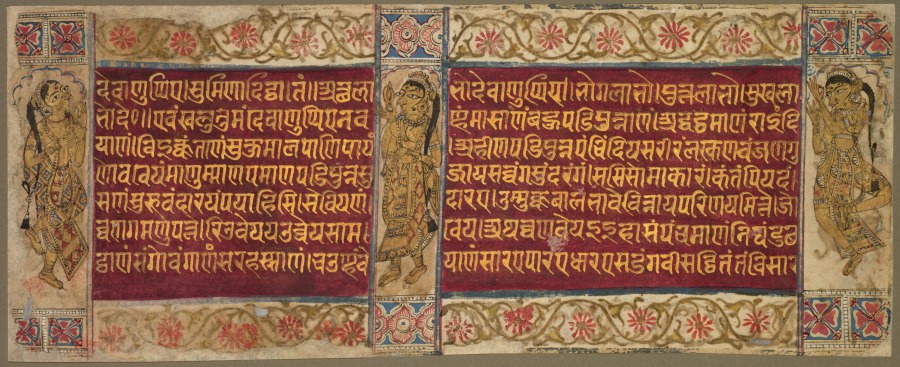
Celestial Dancers, folio 5 (recto), from Brahman Rishabhadatta's speech, from a Kalpa-sutra
Unknown artist
- Medium:
- gum tempera and gold on paper
- Collection:
- Indian and Southeast Asian Art
- Source:
- Cleveland Museum of Art
- Rights:
- Public domain — free to use, share and adapt.
- Recorded as:
- CC0
This work shows how dance functioned in non-Western sacred contexts as a language of devotion and cosmic order. For dancers and dance historians, it demonstrates that the aesthetics of celestial movement—the extended limbs, the arched posture, the sense of weightlessness—were not incidental to religious art but central to how the sacred was visualised. The image also reveals that the figure of the dancing celestial being is not unique to one tradition; it appears across Hindu, Jain, and Buddhist art as a symbol of divine joy and the response of heaven to spiritual significance on earth.
What you are looking at
This is a folio from a Jain sacred manuscript, the Kalpa-sutra, divided into two facing pages. The right page shows text in Sanskrit written in a brown script against a deep crimson ground, enclosed by a decorative border of interlocking geometric and floral motifs in gold and mineral pigments. Above and below the text panel are ornamental bands featuring red flowers and scrollwork. The left page mirrors this arrangement. What arrests the eye are the four celestial figures positioned at the outer edges of the composition—one in each corner. These are rendered in gold leaf with fine linear detail, standing within cusped (scalloped) arches. The figures are slender, graceful, and elevated; they appear to float or dance rather than stand. Each wears the elaborate costume of a heavenly being: pleated skirts or dhotis, ornamental jewelry, and elaborate headdresses with attendant curls. The figures strike dynamic poses—legs bent, arms raised or extended, bodies angled—suggesting movement or celebration. This is not a narrative scene but a devotional object; the dancers are positioned as witnesses and celebrants of the sacred text itself.
The dancing
The four celestial dancers are rendered as slender, elongated figures with a consistent geometric elegance. Each stands within an arched frame, suggesting they inhabit a celestial realm distinct from the earthly. The postures are characterised by asymmetry: one leg often bent, the torso curved, arms raised and extended outward in attitudes of joy or worship. The weight appears to rest on one leg, creating a sense of suspension or imbalance that reads as lightness. The arms frame the body rather than press against it; there is significant space between limbs and torso. The dancers wear skirts with vertical pleating, suggesting volume and motion even in stillness. The presence of jewelry—visible at wrists, neck, and ears—emphasises the celestial status and the formality of the moment.
The dance depicted
This is not a depiction of a specific named dance style in the tradition of Indian classical or folk dance, but rather the visualization of divine celebration within Jain cosmology. The Kalpa-sutra is a Jain sacred text describing the birth and life of the Tirthankaras (spiritual teachers). According to Jain belief, the birth of a Tirthankara is celebrated in the heavens by celestial beings who dance and perform. These figures represent that celestial choreography—the manifestation of devotion and joy in response to spiritual significance. The dancing bodies here communicate reverence rather than technique; they are instruments of the sacred rather than demonstrators of a dance form. The specific vocabulary—arched postures, lifted arms, pleated garments—belongs to the visual conventions of Jain manuscript art rather than to a defined movement system.
How it was made
The work is executed in gum tempera and gold leaf on prepared paper, techniques standard in 15th-century Indian manuscript production. The gold is applied as a metal leaf and then burnished to a reflective shine, making the celestial figures luminous against the darker ground. The tempera pigments—the deep crimson of the text ground, the mineral-based blues, reds, and ochres of the decorative borders—are applied in flat, unmodulated washes, creating a surface that reads as pure colour rather than illusionistic depth. This technique is labour-intensive and expensive, demanding skilled artisans and high-quality materials. The flatness and frontal orientation of the figures reflects the conventions of Jain and other South Asian manuscript traditions rather than the emerging perspective of Renaissance Europe. The precision of the geometric borders and the fineness of the figure drawing suggest a workshop trained in meticulous execution across multiple disciplines—calligraphy, geometric design, and figure work.
About this work
This is a sacred manuscript folio—specifically, a page from a 15th-century Jain Kalpa-sutra—in which celestial dancers frame and honour the spiritual text at the centre. The four figures positioned at the corners are not characters in a narrative but rather celestial beings whose dancing is an act of devotion. In Jain cosmology, such beings celebrate the births of the Tirthankaras (the enlightened teachers) with divine performances; here, their presence sanctifies the written word itself. The manuscript belongs to a tradition in which the physical object—the painting, the calligraphy, the gold—was understood as a spiritual act, and the commissioning of such a work was believed to confer spiritual benefit on the patron. These dancing figures are part of that sanctification; they testify that the text is worthy of celebration. The work demonstrates how in 15th-century India, dance imagery was integrated into devotional practice not as entertainment or narrative illustration but as a visual form of worship.
How to look at it
Observe the poses of the four celestial dancers and note that they do not occupy a single moment of action or a coherent narrative—rather, each is suspended in an attitude of celebration. The artist has chosen to show bodies in asymmetrical balance: weight shifted, limbs extended, creating a sense of perpetual motion even though the figures are frozen in paint. The arches that frame each figure are a formal device that lifts them out of earthly space and signals their divine status. Pay attention to how the pleating of the garments echoes the vertical rhythms of the text columns and how the gold of the figures and borders creates a visual continuity that binds the dancers to the sacred text.
The period
The 15th century saw a flourishing of Jain manuscript production in western India, particularly in Gujarat and Rajasthan. This period coincided with the patronage of wealthy merchant families whose support of sacred manuscript commissioning brought both spiritual merit and social prestige. The Kalpa-sutra was among the most frequently copied texts, and manuscripts of this era are notable for their consistent style and high technical quality. The use of gold leaf and the elaborate geometric borders are hallmarks of the period. In the broader context of South Asian art, this was an era before sustained European contact had altered aesthetic conventions; the flatness, the gold ground, and the frontal poses of figures reflect local traditions of painting that had developed over centuries without reference to perspective or illusionistic space.
Where it lives
This folio is held in the Indian and Southeast Asian Art collection, and is documented as a page from a Kalpa-sutra manuscript dated to 1450. The page number (folio 5, recto) and its attribution to Brahman Rishabhadatta's speech suggest it is part of a larger, carefully catalogued manuscript that may survive in other collections or institutions.
Dance in this work
Questions about this work
Why are there dancers on the edges of a text page?
In Jain manuscripts, celestial dancers frame sacred texts as a form of visual devotion. Their presence signifies that the text is worthy of heavenly celebration. The dancers are not illustrating a story but sanctifying the word itself. This practice reflects the Jain belief that commissioning and venerating a sacred manuscript confers spiritual benefit on all involved.
What dance is being performed?
This is not a depiction of a specific named dance style. Rather, it visualises a celestial or divine mode of movement that exists in Hindu, Jain, and Buddhist cosmology as the response of heaven to spiritual significance. The vocabulary—arched postures, lifted arms, pleated garments—belongs to the visual conventions of South Asian sacred art and conveys celebration and devotion rather than a particular technique or form.
How do we know these are dancers and not just decorative figures?
The asymmetrical poses, the extended and lifted limbs, the bent legs, and the sense of suspension all communicate movement rather than static rest. The arches that frame them are a formal device suggesting they occupy a liminal, celestial space. In the context of Jain manuscripts, such figures are explicitly understood as celestial beings who dance in response to sacred moments.
Who would have seen this manuscript?
Jain manuscripts of this period were commissioned by wealthy patrons, often merchant families, and were used in domestic and temple worship. The manuscript would have been handled by patrons, priests, and scholars; it was a precious, hand-made object kept within a community rather than published for a mass audience. The high cost of materials and labour meant that such manuscripts signalled the patron's wealth and piety.
More dance artwork





