49 works in this view — arrow keys or swipe to move between them.
Dance in Art
Russian Dancer
Alexander Blazys (American, born Russian Empire [now Lithuania], 1894–1963)
- Medium:
- bronze
- Collection:
- American Painting and Sculpture
- Source:
- Cleveland Museum of Art
- Rights:
- Public domain — free to use, share and adapt.
- Recorded as:
- CC0
This work is crucial evidence of how modernist sculpture absorbed lessons from dance and theatrical reform. The pose—extreme, emotionally charged, and formally distorted—shows that dancers and sculptors were collaborating across mediums to express new ideas about the body and feeling. For dancers and dance historians, it demonstrates how avant-garde visual artists understood and valued dance as a fundamental modern art form, not a decorative or illustrative subject.
What you are looking at
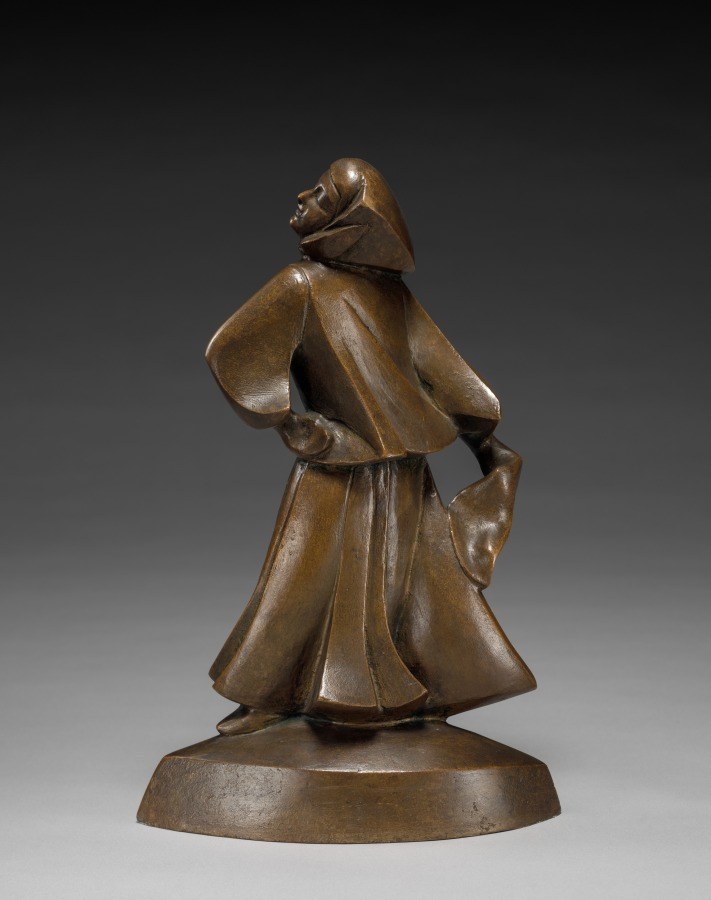
A solitary bronze figure stands on a circular base, captured mid-movement in a pose that suggests dynamic motion frozen in time. The dancer wears voluminous, draped clothing—a long skirt with pronounced vertical pleats and a jacket or coat with substantial, rounded sleeves that extend away from the body. The head is tilted sharply upward and back, creating a sense of abandon or ecstatic release. The figure's weight appears shifted, with the body angling forward slightly while the head and upper torso arch back, creating a serpentine line through the form. The surface is burnished bronze with warm highlights that catch the light, emphasizing the muscularity and geometry of the underlying form. The sculptor has rendered the figure with simplified, faceted planes that give the drapery an almost architectural quality—folds are broad and decisive rather than naturalistic.
The dancing
A single standing figure in a pose of extreme backward arch, with the head dropped far back and the body's center of gravity shifted forward. The arms are not clearly extended but appear tucked or held close to the torso beneath the voluminous coat. The stance suggests weight on one foot with a slight lunge or forward step. The sharply upturned head and the tilt of the shoulders create tension through the spine that reads as either passionate release or an acrobatic extreme. The overall frame is not a classical dance posture but rather an expressive, irregular shape—what a modern or avant-garde choreographer might choose rather than what ballet or ballroom technique would produce.
The dance depicted
This work most likely depicts Russian imperial ballet or a modernized interpretation of Russian dance tradition, consistent with the title and the artist's Lithuanian-Russian background. The extreme arch and head-back position recall late Romantic or early twentieth-century ballet vocabulary—particularly the vocabulary of Léon Fokine or later expressionist choreography that broke with strict classical technique. The pose could represent a moment of emotional climax or abandon, the kind of ungoverned passion that early Soviet dance and Western modernism celebrated as a rejection of Tsarist formality. Without notation or context, the specific ballet or dance tradition cannot be definitively named, but the silhouette reads as theatrical and emotionally charged rather than social.
How it was made
This is a bronze sculpture, likely cast using the lost-wax or direct casting method typical of modernist sculpture in the 1920s. The faceted, geometric handling of the drapery and the simplified musculature suggest the artist worked with deliberate stylization rather than naturalism—the planes catch and hold light in a way that emphasizes form over surface detail. Bronze casting allowed for fine detail in the face and hands while maintaining the bold simplification of larger forms. The warm patina visible here is characteristic of early twentieth-century American foundry practice and suggests this work was cast and finished in the United States, consistent with the artist's arrival in Cleveland in 1925.
About this work
Blazys's *Russian Dancer* is a bronze figurative sculpture that merges the vocabulary of Russian imperial and early Soviet dance with the geometric abstraction of Cubism and European modernism. The work is a direct response to the avant-garde collision between dance reform and visual art that defined the 1920s—a moment when Russian choreographers like Fokine and Nijinsky had already disrupted classical ballet, and when visual artists across Europe were discovering how to represent movement and emotion through distorted, faceted form. For a Lithuanian immigrant arriving in Cleveland in 1925, the image of the Russian dancer carried cultural and political weight: it was simultaneously a marker of Eastern European identity, a symbol of artistic freedom and emotional authenticity, and a subject that allowed the sculptor to demonstrate his command of modernist formal language.
How to look at it
Pay attention to the severe backward arch: the artist has chosen the moment of maximum emotional and physical intensity, not a moment of repose or symmetry. The head is not simply tilted but dropped far back, which would be impossible in classical ballet but is central to expressionist or free-dance vocabularies. Notice how the drapery is not treated as soft fabric but as a series of hard, geometric planes that create a silhouette as important as the body itself. The faceted approach is Cubist—the coat and skirt become architectural elements—yet the overall pose reads as deeply emotional and human. This is the key tension in the work: a mechanized, abstracted formal language applied to a subject of apparent passion or abandon.
The artist
Alexander Blazys (1894–1963) was born in the Russian Empire in what is now Lithuania and immigrated to the United States, arriving in Cleveland in 1925. He was trained in European sculptural tradition and brought with him a sophisticated understanding of Cubist and modernist formal language. His work in Cleveland introduced early twentieth-century European modernism to an American industrial city not yet saturated with avant-garde aesthetics. Blazys remained active in Cleveland for the rest of his career, working primarily in figurative sculpture and demonstrating a consistent interest in theatrical and literary subjects—the human figure in extreme emotional or narrative states.
The period
In 1925, when Blazys created this work, the European and Russian dance world was undergoing profound transformation. The Ballets Russes, led by Sergei Diaghilev, had fundamentally altered how dance was conceived and presented; Russian choreographers had already challenged classical ballet vocabulary. Early Soviet dance was experimenting with abstraction and political allegory. Simultaneously, European visual artists—particularly Cubists and Expressionists—were finding in dance and the moving body a perfect subject for exploring how to represent time, emotion, and dynamism in static visual form. Blazys arrived in America at the moment when American sculptors were beginning to absorb these European modernist lessons. The stylization of drapery and the faceted treatment of form place this work squarely in the conversation between sculpture and dance modernism that engaged artists across the Atlantic in the 1920s.
Where it lives
The work is held in the American Painting and Sculpture collection at the Cleveland Museum of Art, indicating its significance in American modernism and the cultural history of Cleveland's art institutions.
Dance in this work
Questions about this work
What is the pose in this sculpture? Is it a real dance move?
The extreme backward arch with the head dropped far back is not part of classical ballet vocabulary, but it does appear in early twentieth-century modern and expressionist dance forms, including Russian theatrical dance and avant-garde choreography that deliberately rejected strict technique. The artist may have observed or imagined such a pose as emotionally expressive rather than technically codified. In sculpture, the pose also serves formal purposes—it creates a dramatic silhouette and demonstrates the artist's mastery of the human form under extreme strain.
Why is the drapery carved as geometric planes rather than soft folds?
This is Blazys's application of Cubist principles to figurative sculpture. By treating the clothing as faceted, abstract forms rather than naturalistic drapery, he elevates the composition into a conversation with European modernism. The geometric approach also emphasizes the sculpture's formal properties and its ability to catch light. It suggests the dancer's costume is part of an artistic statement, not merely clothing—the geometric planes become as important to the work's meaning as the body itself.
Is this sculpture based on a specific dancer or ballet?
The catalogue record provides no documentary evidence of a specific ballet or dancer. The title *Russian Dancer* is generic, referring to a cultural identity and dance tradition rather than a particular performance. Blazys may have been responding to broader impressions of Russian theatrical dance, including the influence of the Ballets Russes, rather than transcribing a specific moment. The work is thus better understood as a response to an aesthetic and cultural idea than as a portrait of an individual performer.
What does 'merging rhythmic movement inspired by music with faceted, geometric planes derived from Cubism' mean in practice?
The curved, flowing lines and the upward arc of the body suggest bodily motion and the continuity of movement—the suggestion that this pose is part of an ongoing action, a moment in time. The geometric faceting of the drapery and the simplified musculature introduce Cubist abstraction, breaking the body into planes and angles. Together, these create tension: the organic movement of dance pulling against the analytical geometry of modernist art. The sculpture asks the viewer to hold both the immediacy of physical expression and the intellectual order of formal abstraction in mind at once.
More dance artwork





