49 works in this view — arrow keys or swipe to move between them.
Dance in Art
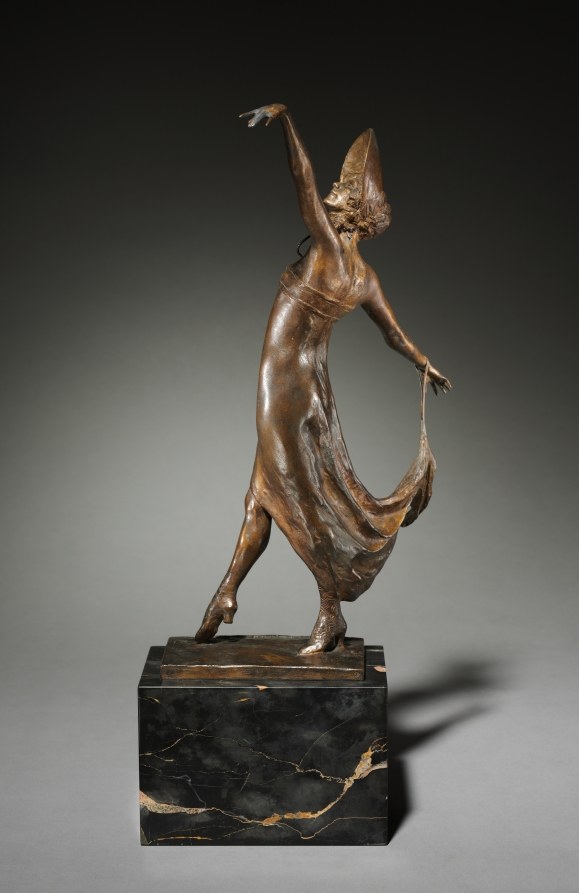
Pavlova Dancing the Gavotte
Malvina Hoffman (American, 1887–1966)
- Medium:
- bronze
- Collection:
- American Painting and Sculpture
- Source:
- Cleveland Museum of Art
- Rights:
- Public domain — free to use, share and adapt.
- Recorded as:
- CC0
This sculpture is documentary evidence of Pavlova's interpretation of historical dance material, and proof that even a folk dance adapted for the ballet stage in 1915 could inspire serious artistic treatment. It also marks one of the rare moments when a sculptural record was made of a living, working dancer in performance—a practice more common in photography than in the permanent arts.
What you are looking at
A bronze sculpture depicts a single female figure in a dramatic, airborne pose frozen mid-movement against a neutral background. The dancer is caught in a moment of exuberant elevation: one long leg extends upward while the other is bent, the torso arches backward in a pronounced curve, and both arms are flung outward in a broad, expansive gesture. The figure wears a floor-length classical tunic or chiton cinched at the waist, the fabric rendered in bronze with deep folds and linear detail that suggest motion. The headdress is ornate—a tall, pointed form suggesting either a Phrygian cap or theatrical crown. The figure stands on a rectangular black marble base, her weight seemingly captured at the instant of maximum lift. The patina of the bronze is warm golden-brown, darker in the shadows of the folds and face. The sculpture is photographed from a three-quarter angle that emphasizes the spatial extension of the pose.
The dancing
The dancer's body is in a balletic arabesque or attitude position, with pronounced épaulement—a turning of the shoulders and torso that creates visual drama. The raised arm sweeps upward and outward from the shoulder; the lower arm reaches in a different direction, creating a complex spatial envelope. Both legs are engaged in a traveling leap or jump, suggesting forward momentum. The posture conveys supreme control within apparent abandon: despite the dynamism, the alignment and extension of the limbs reveal the disciplined technique of a trained classical dancer.
The dance depicted
The catalogue identifies this as Pavlova performing the gavotte—a French folk dance that by the early twentieth century was primarily a historical or theatrical reference. Pavlova's 1915 Russian version would have been a stylized solo, likely set to baroque or neoclassical music, and executed in the idiom of Imperial Russian ballet. The pose shown here is not the contained, elegant stepping of a historical gavotte but rather a ballet interpretation: the elevated leap, the elongated line, and the ornamental headpiece all point to the theatrical conventions of classical ballet circa 1915. The figure's age and training are evident in the command of the position.
How it was made
This is a bronze sculpture, cast from a modeled or carved original, likely made using the lost-wax or sand-cast process standard in the early twentieth century. Bronze allows the artist to capture fine detail—the linear folds of the drapery, the anatomical precision of the limbs, the articulation of the face—while the warm patina reads as both classical and alive. The monumental base grounds the figure; the photograph is lit from the upper left, creating shadow play that emphasizes musculature and the trajectory of the leap. The medium implies a work intended for display in a gallery or garden setting, distributed to collectors as an edition or unique casting.
About this work
Malvina Hoffman created this bronze in 1915, the year after meeting Anna Pavlova during her New York season. The sculpture captures Pavlova not in a conventional portrait pose but in a moment of dance—a celebration of the ballerina's signature athleticism and artistry. Hoffman was one of the leading figurative sculptors of the early twentieth century, known for her studies of human form in motion, and this work exemplifies her interest in the dancing body as a subject worthy of permanent, monumental treatment. The sculpture belongs to a tradition of dance-inspired sculpture that reaches back through Rodin and forward to modern dance documentation, but stands out for its specificity: this is not an allegory or invention but a record of a particular artist's particular choreography, made by someone who knew her.
How to look at it
Observe the moment Hoffman chose: not a static pose but the absolute apex of the leap, when the dancer appears weightless and fully extended. Note how the arms and legs create a dynamic asymmetry that enlivens the figure and suggests forward motion despite the sculpture's stillness. The headdress and drapery style it as classical and elevated, yet the anatomical precision and the modern photographic lighting strip away any nostalgic softness. The sculpture asks: what does a dancer's body reveal about her training, her artistry, and her culture? And what does it mean to preserve that revelation in bronze?
The artist
Malvina Hoffman (1887–1966) was an American sculptor trained in Paris under Rodin and other modernists. She became known for figurative bronze work depicting human subject matter with anatomical precision and psychological presence. In addition to portrait busts and monumental work, she maintained a lifelong interest in the dancing body: she studied with dancers, attended performances, and created numerous sculptures of ballet dancers, including several of Pavlova. Her work bridged academic tradition and modernist innovation; she was elected to the National Academy of Design and received major public commissions. This sculpture exemplifies her practice of moving beyond portraiture to capture the essence of a person through their work.
The period
In 1915, classical ballet was undergoing rapid evolution and internationalization. The Ballets Russes under Diaghilev had been in Paris since 1909, causing a sensation; Pavlova had separated from the company and was touring the world, performing a repertory that mixed classical pieces with experimental new work and historical pastiches. The gavotte, an eighteenth-century court dance, was experiencing a minor revival in artistic circles as modernists and traditionalists alike looked to past forms. Simultaneously, early twentieth-century sculpture was increasingly interested in movement and the body in action—Rodin's Gates of Hell and studies of dancers were influential, and there was growing interest in capturing the essence of motion in permanent form.
Where it lives
The work is held in the American Painting and Sculpture collection at the Cleveland Museum of Art (CMA). It is a bronze casting, part of the permanent collection, and exemplifies the museum's holdings in early twentieth-century figurative sculpture.
Dance in this work
Questions about this work
Who was Anna Pavlova?
Anna Pavlova (1881–1931) was a Russian prima ballerina trained at the Imperial Ballet Academy in St. Petersburg. She became one of the most famous dancers of the early twentieth century, known for her performances in classical roles and for creating her own works, most famously the solo 'The Dying Swan' choreographed for her by Michel Fokine. She toured worldwide, bringing ballet to audiences outside the European capitals, and was celebrated for her technical precision and dramatic intensity.
What is a gavotte?
The gavotte is a moderate-tempo French court dance from the seventeenth and eighteenth centuries, typically in duple meter (2/4 time), with a characteristic half-beat anacrusis. By Pavlova's era, the dance was primarily historical, but it remained a stock reference in classical ballet pedagogy and was occasionally choreographed as a historical divertissement. Pavlova's version adapted it to the balletic idiom, making it a virtuosic solo rather than a social dance.
How did Malvina Hoffman capture movement in bronze?
Hoffman did not attempt to freeze a naturalistic moment of motion; instead, she chose a single, acutely observed pose—the apex of a leap—that contains the energy and line of the whole phrase. By attending closely to anatomy, weight distribution, and the orientation of the limbs, she created a figure that reads as both momentary and timeless. The elevated perspective and dramatic lighting of the photography reinforce the sense of defiance of gravity.
Why does the sculpture have a base with an inscription or mark?
The black marble base is characteristic of early twentieth-century bronze sculpture; it serves both a practical function (it provides stability and a visual ground) and an aesthetic one (the dark stone frames and elevates the golden-brown figure). The base may bear a signature or foundry mark on its underside or rear face, though that would not be visible in this three-quarter view.
More dance artwork





