49 works in this view — arrow keys or swipe to move between them.
Dance in Art
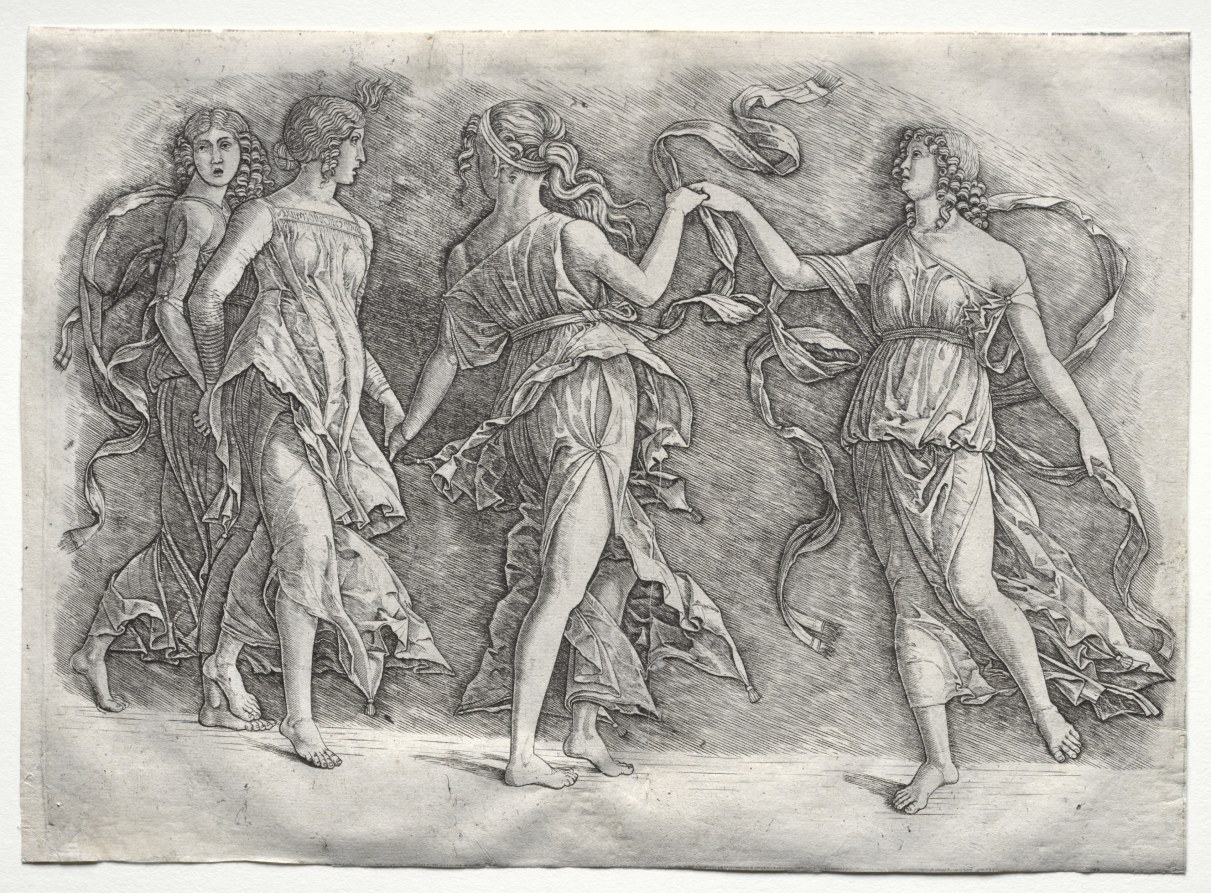
Four Dancing Muses
Premier Engraver (Italian, active about 1500)
- Medium:
- engraving
- Collection:
- Prints
- Source:
- Cleveland Museum of Art
- Rights:
- Public domain — free to use, share and adapt.
- Recorded as:
- CC0
This print preserves the only visual evidence most of us have of how Renaissance Italians actually danced and how they wanted to be seen dancing. It demonstrates that Renaissance dance was acrobatic, sculptural, and physically demanding—not merely the stately processes we sometimes imagine—and that women were active, virtuosic participants. For historians and choreographers seeking to reconstruct or understand Renaissance movement vocabulary, this image is invaluable.
What you are looking at
Five female figures occupy a shallow stage-like space defined by hatched shading in the background. They wear classical drapery—flowing, loosely belted garments that expose legs and leave shoulders bare—and have their hair arranged in Renaissance curls. Three figures in the left and center of the composition are actively dancing: two are paired together in animated posture, one with her body twisted and arms raised, while a third dances solo nearby with raised arms and dynamic leg position. Two additional figures, one at far left and one at far right, appear to be observers or participants awaiting their turn, standing with more composed poses. The entire group is arranged in a frieze-like composition across the picture plane. The engraving is executed in fine parallel hatching lines that model form and create atmospheric recession. The technique is precise and controlled, with particular attention to the articulation of limbs and the fall of drapery.
The dancing
The dancers display high arm positions with elbows raised away from the body, creating open, expansive shapes. Bodies are in various degrees of rotation and inclination—one figure arches her torso while lifting both arms; another lunges with extended leg; others stand with weight distributed and arms gesturing outward. The poses suggest continuous movement rather than static positions. Footwork is not clearly visible, obscured by the flowing drapery, but the leg positions indicate weight transfer and momentum. The five figures relate to each other through spatial proximity and directional focus, creating the sense of a group activity or social participation rather than formal partnering.
The dance depicted
This is most likely a representation of Renaissance courtly dance, possibly a brando, galliard, or group danza of the kind performed in Italian court entertainment. The flowing classical drapery, the high arm positions, the animated leg work, and the narrative frieze composition all point to early Renaissance dance practice. The figures appear to depict the active, acrobatic qualities of the galliard—known for its elevation and turning—while the group arrangement suggests the social, participatory context of Renaissance court dancing. The title "Four Dancing Muses" invokes classical mythology and artistic inspiration, typical of humanist court culture where contemporary dance was framed through classical allusion.
How it was made
This is an engraving, a process in which lines are incised into a metal plate (likely copper) with a burin and then inked and printed. The fine, parallel hatching visible throughout the image is characteristic of Renaissance engraving technique and allowed for the precise tonal modeling and detail visible here. Engravings were portable, reproducible, and relatively affordable, making them a primary vehicle for disseminating images of courtly practice and artistic invention throughout Renaissance Europe. This print would have circulated among educated audiences—humanists, courtiers, artists, and collectors—as a model of both classical knowledge and contemporary court behavior.
About this work
This engraving depicts five graceful female figures in classical drapery engaged in animated social dance, likely representing the kind of courtly dances performed in Italian Renaissance courts. The composition is a frieze—a horizontal band of figures—organized in the classical manner but activated by poses of genuine movement and interpersonal engagement. The work sits at the intersection of humanism (invoking the Muses and classical antiquity), courtly culture (dancing as a mark of education and refinement), and printmaking (making the image reproducible and teachable). It belongs in a gallery of dance because it is documentary evidence of how educated Renaissance audiences understood dance—as an art form worthy of classical allusion, as a marker of social status, and as a choreographed spectacle of the human body in motion.
How to look at it
Attend to the individual moments captured in each body: one dancer mid-leap or lunge, another in a twisted position suggesting rotation, a third with arms raised in preparation or flourish. The artist has not frozen a single instant but rather layered multiple moments of the dance sequence into a single image, which was a common Renaissance printmaking practice for conveying the idea of movement and virtuosity. Notice the careful articulation of the hands and arms—these are not generic gestures but specific positions that communicate grace and control. The fluttering, windblown quality of the drapery, rendered through fine parallel lines, suggests movement in space and enhances the sense of liveliness and animation.
The artist
The "Premier Engraver" is an attribution name applied to an unknown Italian engraver active around 1500. No signed works by this hand have been definitively identified, so understanding of the artist's practice comes from stylistic analysis and thematic patterns across attributed prints. The work shares characteristics with Marcantonio Raimondi's circle—the precise burin work, the classical subject matter, the circulation through court contexts—but the artist remains unidentified. Such anonymity was not unusual in Renaissance printmaking, where engravers often worked for publishers or court patrons without formal credit.
The period
In the last years of the 15th century and opening decades of the 16th, Italian courts—particularly those of Milan, Mantua, and Urbino—were centers of intense cultural innovation. Court dance was being formalized and theorized by dancing masters like Guglielmo Ebreo and others who wrote treatises codifying steps and aesthetic principles. Simultaneously, the print medium itself was becoming a tool for humanist education and the dissemination of classical knowledge. The engraving of courtly dance fits squarely within this moment: it makes visible the humanist project of recovering classical antiquity (through the Muses), documents the emerging professionalization of dance, and uses the new reproducible medium to circulate courtly values and practices. Dance was understood as one of the liberal arts, a demonstration of education, nobility, and refined taste.
Where it lives
The print is held in the Cleveland Museum of Art's Prints collection. This cataloging indicates it entered an institutional collection at some point, where it was valued as an example of Renaissance printmaking and courtly culture rather than specifically as dance documentation. The spare record suggests it may not have been previously studied as a primary source for dance history.
Dance in this work
Questions about this work
What kind of dance are these women doing?
The exact dance is difficult to name from the image alone, but the style is consistent with early Renaissance court dances such as the brando or galliard—energetic, acrobatic dances with high leg work and elevated arm positions. The group format and the classical allusion in the title suggest this represents the kind of social, participatory dance performed at Italian courts to celebrate occasions and entertain guests.
Why are they dressed like classical statues?
Renaissance courtly culture was built on humanist ideals of recovering and imitating classical antiquity. Dressing dancers in classical drapery was a way of elevating contemporary dance practice by linking it to noble, ancient precedent. The title "Muses" makes explicit this classical framing—the Muses were patrons of the arts in ancient mythology, and by invoking them, the artist positions these dancers as embodiments of artistic inspiration and virtue.
Is this a reliable record of how Renaissance people actually danced?
Partially. The image shows real knowledge of Renaissance dance—the arm positions, leg work, and body inclinations match descriptions in surviving dance treatises. However, the classical drapery and mythological framing are artistic choices that idealize and elevate the dance. This is how educated Renaissance audiences wanted to see dance represented, which is itself historically valuable information, even if it is not a documentary photograph. Paired with written treatises, such images help reconstruct the physical reality of Renaissance dance practice.
More dance artwork





