49 works in this view — arrow keys or swipe to move between them.
Dance in Art
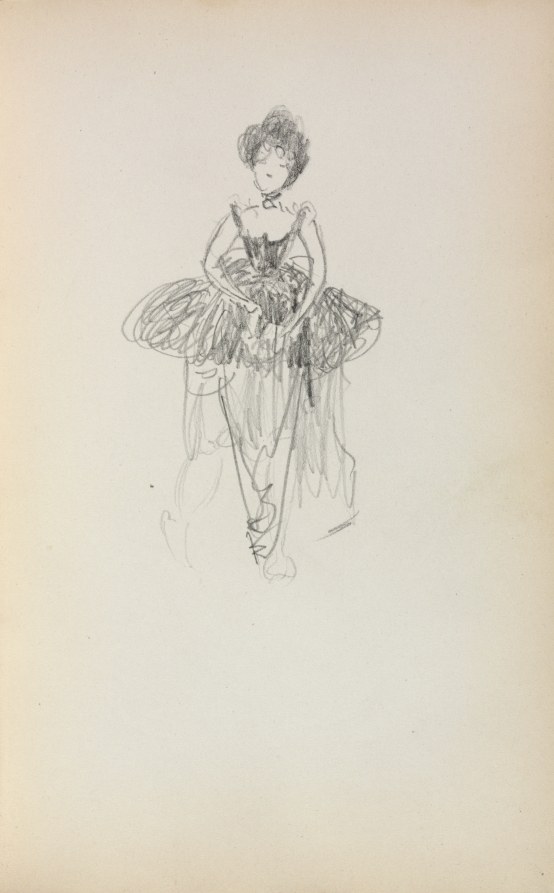
Italian Sketchbook: Ballerina (page 231)
Maurice Prendergast (American, born Newfoundland [now Canada], 1858–1924)
- Medium:
- pencil
- Collection:
- Drawings
- Source:
- Cleveland Museum of Art
- Rights:
- Public domain — free to use, share and adapt.
- Recorded as:
- CC0
This sketch provides direct visual evidence of how a professional ballet dancer of the 1890s dressed, held herself, and was understood by a contemporary visual artist. It is a document of lived performance practice—not a description or a memory, but a drawing made in the presence of the subject or immediately after. For historians of dance and costume, it is an invaluable record of the actual silhouette and presentation of classical ballet at the moment just before the 20th century.
What you are looking at
A single female figure is drawn in graphite pencil in a three-quarter stance, facing slightly left. She wears a voluminous tutu with a fitted bodice and a decorative choker or collar at her neck. Her hair is styled in a high, elaborate updo typical of the late 19th century. The tutu is rendered with delicate, sketchy linework suggesting layers of tulle; the artist has paid particular attention to the play of fabric and the silhouette created by the garment's bell shape. Her posture is upright and refined, with one leg appearing to bear her weight while the other is lightly placed. The drawing is spare and economical—the background is entirely blank white paper, drawing all attention to the figure's costume and bearing. The pencil line is confident but not heavily worked, giving the sketch an immediacy and spontaneity.
The dancing
The dancer stands in a classical ballet pose with an elongated neck and shoulders drawn back in the manner of academic ballet training. Her arms appear to rest at her sides or held softly forward, one possibly extended slightly. The weight distribution suggests a standing position rather than active movement—she is posed for presentation rather than caught mid-motion. The proportions emphasize the length of her torso and the volume of her skirt, which extends from a narrow waist to a full, layered hem. There is a single figure only.
The dance depicted
This is a classical ballet figure, most likely a romantic-era or late-19th-century ballerina. The tutu, bodice, and upright carriage are unmistakable markers of theatrical ballet training and performance. The artist has captured the formal presentation pose typical of portrait studies of professional dancers from this period—she is shown not in motion but in the idealized stance of a prima ballerina. The sketch suggests study from life or from performance, documenting a specific dancer's costume and appearance rather than a narrative dance scene.
How it was made
This is a pencil sketch on paper, executed with light to medium pressure and considerable economy of line. The artist has used brief, sketchy marks to suggest the volume and texture of the tutu, relying on the viewer's familiarity with the garment to read its construction. The bodice and choker are defined with more deliberate linework, while the face is rendered with careful attention to proportion and expression. The technique is that of a working sketch or study rather than a finished drawing—it captures the essential information about costume, pose, and character without elaborate shading or detail work. This type of sketch was common practice among artists documenting theatrical or social subjects of the period.
About this work
This is a preliminary study of a late-19th-century ballet dancer, drawn from the Italian Sketchbook of American artist Maurice Prendergast. It documents the costume and presentation style of a professional dancer of the period—specifically the silhouette of the classical tutu, the fitted bodice, and the refined posture that defined theatrical ballet in the Romantic and post-Romantic eras. The sketch is not a narrative scene but a figure study, the kind of visual note an artist might take to record a performer's appearance and costume for later reference or simply as a record of something observed. The drawing sits within a long tradition of artist-observers documenting dance and dancers as subjects of contemporary life and theatrical culture.
How to look at it
Look at the way Prendergast has constructed the tutu with rapid, parallel lines that suggest layers and volume without describing each one. Notice how the pencil pressure and line weight change to define the bodice more heavily than the skirt—the artist is using visual hierarchy to direct attention to the torso and the dancer's upright, dignified carriage. The drawing captures a single moment of stillness, the dancer presented as an object to be looked at rather than as a body in motion. This is portraiture, not action: attend to the elegance of the pose and the precision of the costume, which tell you everything about how ballet dancers were valued and displayed.
The artist
Maurice Prendergast (1858–1924) was an American painter and printmaker known for his color woodcuts and oils depicting contemporary leisure and urban life. Though he is remembered chiefly for his colorful, almost Fauvist landscapes and crowd scenes, he was a keen observer of performance and social spectacle, and often sketched or painted dancers, circuses, and theatrical subjects. His work bridges Post-Impressionism and early modernism; he traveled extensively and kept detailed sketchbooks. This drawing comes from his Italian travels and reflects his habit of rapid, observational notation.
The period
In the 1890s, classical ballet was undergoing significant transformation. The Romantic era (c. 1830s–1840s) had established the pointe shoe, the ethereal tutu, and the aesthetic of the ballerina as a otherworldly figure; by the 1880s–1890s, these conventions were codified into the vocabulary of academic ballet. Prendergast was sketching at a moment when the Russian Imperial Ballet under Marius Petipa and Tchaikovsky was reaching its height, and when ballet was becoming a subject of intense interest to European and American artists. The tutu shown here reflects the full, bell-shaped classical form that would remain standard through the early 20th century, before modern and contemporary ballet would radically simplify or eliminate it.
Where it lives
This drawing is part of the Italian Sketchbook held in the collection at the Cleveland Museum of Art. It is one page (231) in a larger bound sketchbook, suggesting it was one of many drawings Prendergast made during or after Italian travels. Sketchbooks of this kind served as working documents for artists—repositories of observations, studies, and ideas to be consulted later.
Dance in this work
Questions about this work
Can you identify which dancer this is?
No. The sketch is a study of a ballet dancer in classical costume, but it does not identify the performer by name or context. It may have been drawn from life, from memory, or from a photograph. Prendergast's Italian travels place it in the 1890s, but no further specificity is available from the image alone.
Why is the dancer not moving?
This is a portrait study, not a narrative or action scene. The artist has chosen to capture the dancer's formal presentation pose—the way she would stand for a photograph or before an audience. This was a common approach for artists documenting performers: a still, composed figure that showed off costume and training.
What is that garment she's wearing?
A classical ballet tutu—the signature skirt of theatrical ballet. It consists of multiple layers of stiffened tulle or silk arranged to create a bell or bell-shaped silhouette that extends outward from the waist. The tutu became standard in the Romantic era and remained the costume for classical ballet roles through the 20th century and beyond.
How do you know this is ballet and not another kind of dance?
The tutu, the fitted bodice, the pointe-work stance, the upright carriage, and the refined, elongated proportions of the figure are all unmistakable markers of classical ballet training and aesthetic. No other dance form of the period used this exact combination of costume and presentation.
More dance artwork





