49 works in this view — arrow keys or swipe to move between them.
Dance in Art
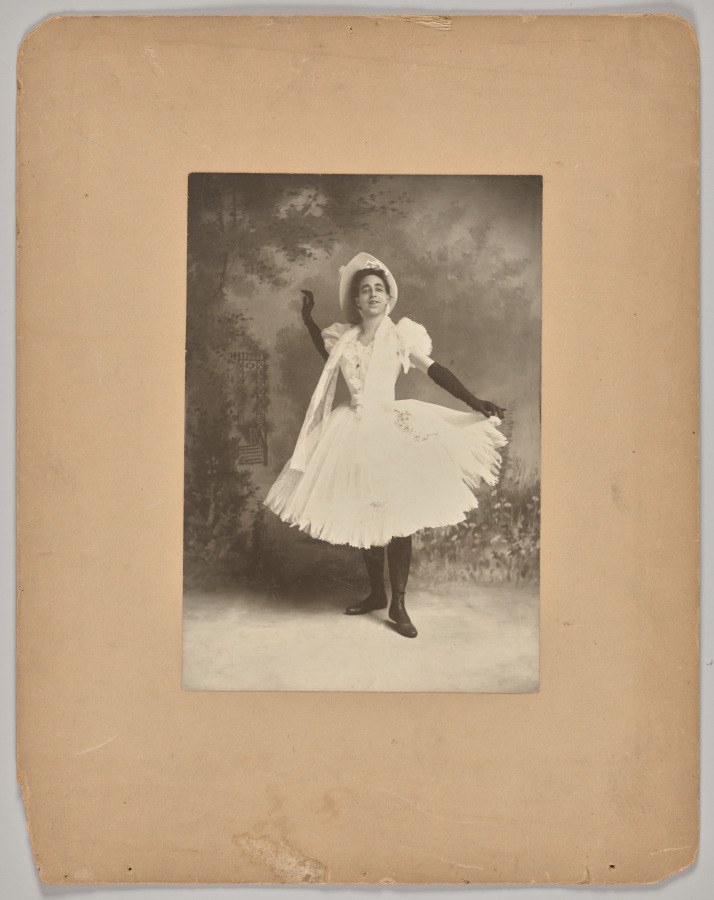
Untitled (man posing as a ballerina)
Unknown artist
- Medium:
- woodburytype or gelatin silver print
- Collection:
- Photography
- Source:
- Cleveland Museum of Art
- Rights:
- Public domain — free to use, share and adapt.
- Recorded as:
- CC0
This image is a rare photographic document of gender-transgressive performance in nineteenth-century dance theatre, showing how the codes of Romantic ballet could be inhabited by bodies outside the expected category. It demonstrates that male cross-dressed performance in balletic costume was practiced and recorded seriously enough to warrant studio portraiture, suggesting a documented (if now largely forgotten) theatrical tradition.
What you are looking at
A single figure in a white ballet skirt and matching bonnet stands center stage against a painted backdrop of foliage and sky. The dancer is captured mid-gesture, with one arm raised expressively while the other extends to the side, the body angled in a classical contrapposto stance. The white ensemble—a short pleated skirt, fitted bodice with puffed sleeves, and a close-fitting bonnet tied under the chin—is the costume of a Romantic-era ballerina. The figure wears dark tights and heeled shoes. The setting is a studio or stage floor rendered in pale tones, with drapery suggested in the background. The photograph is mounted on heavy tan board stock, typical of mid-nineteenth-century presentation.
The dancing
A single performer, photographed at approximately three-quarter length. The dancer's weight appears to shift to one leg while the other remains extended or ready to move. Both arms are held aloft in a Romantic-era arm carriage—curved, open to the audience, suggesting grace and elevation rather than the turned-out precision of Classical technique. The torso is upright and elongated; the head tilts slightly, gazing upward in the conventional pose of Romantic reverie. The proportions and anatomical construction are those of an adult male body.
The dance depicted
This is a male dancer posing in the costume and pose of a female Romantic-era ballerina—a deliberate cross-gender performance or satirical commentary that was part of nineteenth-century theatre culture. The costume, pose, and aesthetic directly reference the Romantic ballet style (c. 1830s–1860s), particularly the sylph or maiden roles associated with works like *La Sylphide* and *Giselle*. Male performers did occasionally dance in female dress as part of pantomime, vaudeville, or burlesque traditions, or as comic parody. The image documents this practice without indicating a specific named dancer or documented performance.
How it was made
This is a woodburytype or gelatin silver print mounted on card—a photographic process capable of fine tonal gradation and detail. The woodburytype, developed in 1864, was a premium process that used gelatin relief and printing ink to produce stable, gallery-quality prints, common for artist and theatrical portraits. The mounting on board and the careful studio presentation suggest this was a formal theatrical or promotional image, intended for circulation and display. The photographic medium allows documentary clarity: we see the exact construction of the costume, the dancer's actual body beneath it, and the studio setting with unusual frankness.
About this work
This photograph documents a cross-gender performance: a male dancer dressed and posed as a female Romantic-era ballerina. It belongs to the history of theatrical cross-dressing and gender play in nineteenth-century entertainment—a practice found in pantomime, burlesque, and music hall alongside serious ballet. The image is notable for its photographic honesty; unlike painted portraits, the photograph does not disguise the performer's actual anatomy, yet the costume and pose fully enact the Romantic ballet aesthetic. It raises questions about performance identity, audience expectations, and the relationship between photographic evidence and theatrical convention in the 1870s.
How to look at it
Attend to the contrast between the costume and the body beneath it. The bonnet, the pleated skirt, the bodice, and the arm carriage all faithfully reproduce the visual language of Romantic ballet—yet the viewer can observe the male physique, the shoulder breadth, and the bone structure that photographic objectivity does not conceal. The pose itself is the conventional one of Romantic reverie: the upturned gaze, the open arms, the suggestion of weightlessness. The photograph asks: does the costume and pose constitute the role, or does the body's sex? The studio setting and formal mounting suggest this was a legitimate, perhaps even celebrated image at the time.
The period
The 1870s were the height of the Romantic ballet revival and also a period of intense interest in photographic documentation of theatre and performance. The Romantic ballet itself—with its ethereal women in white tutus and pointe shoes—was well established by this date, codified through works like *La Sylphide* (1832) and *Giselle* (1841). Male roles in ballet during this period were typically those of princes or cavaliers; male dancers in female dress appeared instead in the context of pantomime, burlesque, and music-hall comedy. Photography was increasingly used to promote performers and preserve images of celebrated roles. The decision to photograph this performer in full Romantic costume suggests either a documented theatrical role or a deliberate artistic pose for the camera.
Where it lives
The photograph is held in the Photography collection of the Cleveland Museum of Art. It is mounted on period card stock in a format typical of theatrical or artist portraiture from the 1870s, suggesting it was intended for circulation among theatre patrons, other performers, or collectors of photographic art.
Dance in this work
Questions about this work
Is this a joke or a serious performance?
That distinction is not clear from the image alone. Cross-dressing roles existed in both comic and serious contexts in nineteenth-century theatre. The professional quality of the photograph and its formal mounting suggest the performance was documented with the same gravity as any other theatrical role. It may have been understood as satire, parody, comedy, or gender-play depending on the specific theatrical context and audience.
What is the dance costume?
It is the costume of a Romantic-era ballerina, c. 1830–1870: a white muslin skirt, fitted bodice with short puffed sleeves, bonnet, tights, and heeled slippers. This costume type was associated with roles like the Sylph in *La Sylphide* and Giselle in *Giselle*. The style is distinctly Romantic, not Classical (which would show a different silhouette) or modern.
When and where was this photographed?
The image is dated to 1870 in the catalogue record. The exact location, performer, and theatrical context are not recorded. The photographic technique (woodburytype or gelatin silver print) was available from the mid-1860s onward, consistent with the date.
More dance artwork





