49 works in this view — arrow keys or swipe to move between them.
Dance in Art
Ballet Dancers
Henri de Toulouse-Lautrec (French, 1864–1901)
- Medium:
- Oil on plaster, transferred to canvas
- Collection:
- Painting and Sculpture of Europe
- Source:
- Art Institute of Chicago
- Rights:
- Public domain — free to use, share and adapt.
- Recorded as:
- CC0 (Public Domain)
Toulouse-Lautrec's paintings of ballet are crucial primary sources for understanding how late-19th-century Parisian dance was perceived and valued by artists: as a subject of beauty and grace rather than technical spectacle. His shift from academic to impressionistic rendering—his refusal to render the dancers with hard outlines or careful anatomy—reflects a shift in how modern art engaged with movement itself. For anyone studying the intersection of Romantic ballet aesthetics and early modern visual culture, this work is essential.
What you are looking at
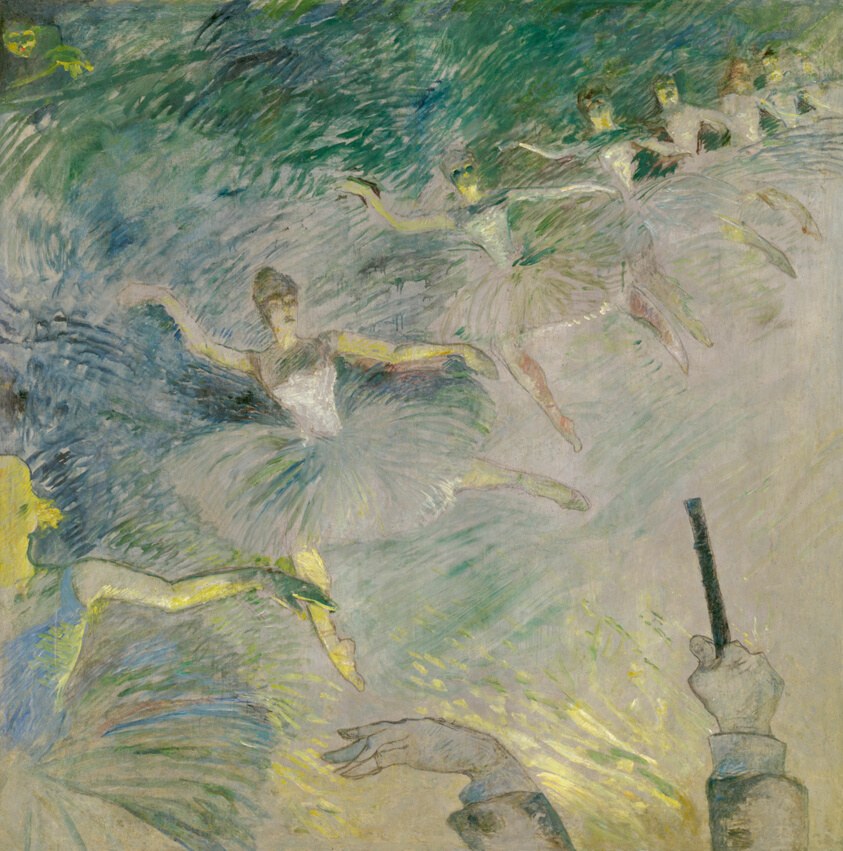
A rehearsal or performance of ballet dancers in ethereal motion, captured mid-movement against a luminous, atmospheric background rendered in soft greens, whites, and pale yellows. The composition shows multiple figures in classical tutus at various depths—some foreground, others receding into the background—creating a sense of space and ongoing choreography. The brushwork is loose and gestural, with rapid directional strokes that suggest the swirl of skirts and the fluidity of movement. A single dark vertical element in the lower right—possibly a cane or conductor's stick—anchors the composition and implies the presence of an unseen musician or maitre de ballet. The lighting is diffuse and soft, without strong shadows, creating an impression of stage light or the hazy quality of memory.
The dancing
The dancers are rendered with minimal anatomical detail, their bodies simplified into elegant curves that emphasize the lift and extension of classical ballet. Arms are raised and extended; legs are turned out and elongated. The figures in the foreground are larger and more defined, while those receding register as barely-sketched presences. One prominent figure in the lower left extends her arm with balletic grace; another in the middle distance appears to be turning or spiraling. The poses suggest controlled, formal movement rather than naturalistic action—the characteristic turnout, port de bras, and uplifted carriage of classical training.
The dance depicted
This is unambiguously a ballet scene, most likely representing either a rehearsal or a performance. The tutus, the balletic postures, the theatrical setting, and Toulouse-Lautrec's focus on the Paris ballet world of the 1880s all point to this. The loose, impressionistic handling suggests he was interested in capturing not the technical precision of individual steps but the overall grace and weightlessness the dancer aspired to—the illusion of effortless floating. The work belongs to the Romantic ballet tradition in subject, with its emphasis on ethereal, otherworldly femininity, though rendered with a modern (late-19th-century) aesthetic.
How it was made
Oil on plaster transferred to canvas—an unusual and technically demanding medium that suggests a work originally painted on a wall or architectural surface and later moved to preserve it. The transfer process would have required careful removal and mounting, indicating the work's value was recognized early. The loose, sketch-like paint application and the soft color palette (dominated by earth tones, greens, and pale yellows) are consistent with oil painting. The technique of broad, directional brushstrokes and avoidance of sharp outlines is distinctly Impressionist in influence, allowing light and movement to emerge through color and texture rather than linear definition.
About this work
This is a ballet study by Henri de Toulouse-Lautrec, the Parisian artist whose fascination with entertainment and performance made the Opera, the Moulin Rouge, and the rehearsal studios his primary subject matter from the 1880s onward. The work captures the grace of classical ballet as a visual and kinetic spectacle, rendered not in polished academic style but in the looser, more subjective language of modern painting. It sits within a rich tradition of 19th-century art about dance—one that includes Degas, Renoir, and others who found in ballet an ideal subject for exploring movement, light, and the human form in space. For a dance historian or practitioner, it documents both the aesthetic values of the period (the ethereal, weightless ideal) and how artists of the time chose to represent dance—not with technical precision but with atmospheric impression.
How to look at it
Attend to the way Toulouse-Lautrec has rendered the dancers' weight and presence through color and direction of brushstroke rather than through line. Notice how the figures in the background are almost entirely dissolved into the hazy atmosphere—they register as sensations of movement rather than defined bodies. The foreground dancers are more solid, but even they are built from directional marks that follow and suggest the movement of limbs and fabric. Look at how the tutus are handled: they are not rendered as garment detail but as shapes of swirling white and pale color that echo the dancers' own lift and extension. The vertical dark form in the lower right (possibly a conductor's baton or the edge of a musical instrument) is a reminder that this movement is synchronized with sound, even though sound is invisible.
The artist
Henri de Toulouse-Lautrec (1864–1901) was a French Post-Impressionist painter, printmaker, and draughtsman of aristocratic birth who spent much of his career documenting the entertainment venues and performers of Paris, particularly Montmartre. His physical disability (congenital hip dysplasia) may have contributed to his empathetic, unflinching observation of bodies in motion and at rest. He was prolific in his depiction of the Moulin Rouge, the Opéra, and the rehearsal studios, making dance and performance central to his artistic project. His work combined fine art ambitions with the subject matter of popular entertainment, collapsing hierarchies between high and low culture.
The period
The 1880s in Paris saw the dominance of Romantic ballet aesthetics even as the form itself was being questioned and reinvented. Classical technique was paramount, but the ethereal, supernatural, weightless ideal—established in works like La Sylphide and Giselle earlier in the century—remained the visual standard. At the same moment, Impressionist and Post-Impressionist painters were developing new vocabularies for representing movement, light, and ephemeral experience. Toulouse-Lautrec's interest in ballet coincided with his work in color lithography and printmaking, techniques that allowed rapid, gestural mark-making—formal innovations that matched the subject's own demands for capturing the evanescent.
Where it lives
The work is held in the Painting and Sculpture of Europe collection at the Art Institute of Chicago. It was originally oil on plaster and has been transferred to canvas—a conservation measure that speaks to its recognition as a significant work worthy of preservation beyond its original architectural or decorative context.
Dance in this work
Questions about this work
Why is this painting so loose and sketchy if it shows professional ballet dancers?
Toulouse-Lautrec was not interested in documenting technique or anatomical accuracy. Instead, he captured the overall impression of grace, light, and movement that ballet created—using rapid, directional brushwork to suggest rather than delineate. This approach reflects Impressionist influence and his belief that movement itself was best captured through color and gesture rather than line. The 'sketchiness' is intentional and sophisticated, not unfinished.
What does the stick or cane in the lower right represent?
It is most likely either a conductor's baton or a rehearsal stick used by the ballet master to direct and correct dancers. Its presence anchors the composition and reminds us that this scene of spontaneous-seeming grace is actually highly controlled and organized by an authority figure—a common feature of ballet rehearsal and performance in the era.
Is this a real performance or a rehearsal?
The atmospheric background and the way the dancers are scattered across the composition suggest either a rehearsal or an impression of performance rather than a documentary record of a specific event. Toulouse-Lautrec often conflated these settings in his work, interested less in accuracy than in capturing the visual essence of ballet as an art form.
How do we know these are classical ballet dancers and not some other form of dance?
The tutus, the turned-out legs, the lifted posture, the port de bras (arm carriage), and the theatrical setting all indicate classical ballet. The style and period of the tutus (mid-length, full skirts) also narrow it to classical ballet of the Romantic tradition, which would have been standard in Paris in 1885.
More dance artwork





