49 works in this view — arrow keys or swipe to move between them.
Dance in Art
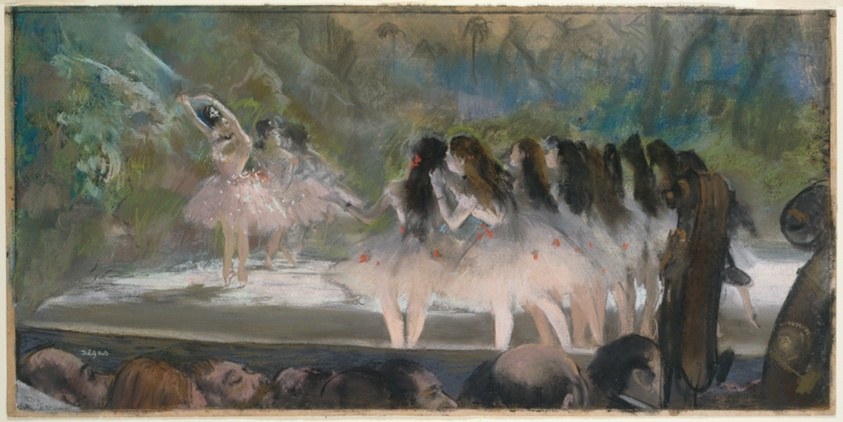
Ballet at the Paris Opéra
Edgar Degas French, 1834-1917
- Medium:
- Pastel over monotype on cream laid paper
- Collection:
- Prints and Drawings
- Source:
- Art Institute of Chicago
- Rights:
- Public domain — free to use, share and adapt.
- Recorded as:
- CC0 (Public Domain)
This work documents the actual technique and training of 1870s Romantic ballet at its most prestigious venue, and it does so with an unsentimental eye that values the unglamorous reality of rehearsal and fatigue. For dance historians, it is evidence of how ballet was taught and practiced at the Opéra during a critical moment in the transition from Romantic to modern dance. For art historians, it exemplifies Degas's revolutionary approach to composition and his use of new graphic media to capture the ephemeral and the ordinary.
What you are looking at
A stage scene depicts a ballet rehearsal or performance at the Paris Opéra, viewed from the auditorium. Center stage stands a single dancer in a pale pink tutu and pointe shoes, arms raised in a classical pose, facing toward the wings. To her right, a line of dancers in dark practice clothes or street dress sits or reclines on the stage floor, watching. The foreground is dominated by the silhouetted heads and shoulders of audience members or orchestra musicians, their forms rendered in dark browns and blacks. The stage itself glows with warm light, while the background scenery—suggested in soft greens and blues—depicts a landscape or forest. The contrast between the solitary, formally dressed dancer under spotlight and the casually posed onlookers creates a candid, almost voyeuristic intimacy unusual in official dance imagery.
The dancing
The central dancer stands in a classical ballet frame with arms elevated, weight centered and elongated through the torso—a pose consistent with Romantic-era technique. Her body is poised and formal despite the informality of the setting. The seated and reclining figures stage-left are loose-limbed and inattentive, their bodies draped across the floor in ungainly postures that contrast sharply with the central dancer's discipline. The composition creates a visual hierarchy: the trained, corseted body of the principal dancer versus the undressed, resting bodies of the corps.
The dance depicted
This is almost certainly a Romantic ballet, likely from the 1870s repertory danced at the Opéra. The pale tutu, pointe work, and classical arm carriage are definitive markers of mid-to-late nineteenth-century theatrical ballet. The scene captures a moment between rehearsal and performance—or perhaps the boundary between the public spectacle of the stage and the private labor of dancers. The reclining figures suggest backstage reality or rehearsal, while the solitary, illuminated dancer suggests the artifice of performance. This kind of image became particularly important to avant-garde artists of the 1870s–1880s as a way to depict the gap between the fantasy of ballet and the exhausted bodies that sustained it.
How it was made
This is a pastel over monotype, a technique that allowed Degas to combine the spontaneity of a printed base with the richness and finish of pastel drawing. The monotype—a one-off print—provided a foundation of tone and composition; the pastel allowed him to rework highlights, refine contours, and add luminosity without the constraints of either medium alone. The technique is visible in the soft, almost impressionistic treatment of the background scenery and the crisp definition of the figures achieved through pastel over the warmer undertones of the print. This hybrid method enabled the artist to work quickly while maintaining a high degree of finish, ideal for capturing the fugitive quality of stage light and the variety of fabrics and textures in a theater interior.
About this work
This is one of several images Degas created of the Paris Opéra ballet in the 1870s, a subject that fascinated him throughout his career. The work combines his interest in modern life, contemporary performance, and the human figure in unstudied moments. Unlike conventional ballet paintings that celebrate the illusion of weightlessness and grace, Degas's theater scenes privilege the actual labor, exhaustion, and informal social reality of dancers. The composition—with its high viewpoint, cropped figures, and asymmetrical framing—shows the influence of Japanese prints and photography, modern ways of seeing that Degas adapted to traditional subjects.
The work sits at the intersection of several artistic concerns of the 1870s: the rise of pastel and monotype as serious fine-art media (rather than preparatory techniques), the influence of photography and graphic arts on composition, and the representation of modern urban leisure and labor. For the history of dance imagery, it represents a watershed moment when artists began to depict dancers as workers and bodies rather than as idealized symbols.
How to look at it
Look first at the contrast between the two groups of bodies: the isolated, lit, trained body of the soloist against the dark, sprawled, unguarded bodies of the watchers. This contrast is the subject. The artist has chosen the moment not of performance but of in-between—neither full rehearsal nor final spectacle. Notice how the silhouettes of the audience members in the foreground anchor the viewer in a specific place (the auditorium seats or orchestra pit) and create a frame-within-frame effect that is characteristic of Degas's compositional method. Look at the handling of the pastel: it is thickest and most opaque around the central dancer and the faces of the foreground figures, and more suggestive in the background scenery, creating depth and focus. The work asks you to look at ballet as theater—a social space, a labor practice, and a site of visual spectacle—rather than as the representation of an ideal.
The artist
Edgar Degas (1834–1917) was a French painter, draughtsman, and sculptor trained in the academic tradition but profoundly shaped by his encounter with Japanese prints, photography, and the modern visual culture of Paris. He was obsessed with the ballet, attending rehearsals and performances at the Opéra, making hundreds of drawings and pastels of dancers in studios, wings, and on stage. Unlike his Impressionist peers, Degas did not paint outdoors or focus primarily on light; instead, he was interested in structure, movement, anatomy, and the social reality of modern bodies—workers, performers, bathers, horses. He pioneered the use of pastel and monotype as primary media, treating them with the ambition and finish previously reserved for oil painting. His late work, including most of his ballet scenes, was made with failing eyesight and became increasingly bold in color and abstraction.
The period
The 1870s marked both the apex and crisis of Romantic ballet at the Opéra. The ballets of the 1830s–1850s—*La Sylphide*, *Giselle*, *La Péri*—remained in the repertory but were now performed by a new generation using evolved technique. The role of the coryphée (corps dancer) was changing; dancers were increasingly specialized and stratified by rank and skill. At the same time, Degas's generation of artists was rejecting academic convention in favor of subjects drawn from modern urban life. The ballet, with its mixture of artifice, physical labor, and contemporary performance technology (gas lighting, stage machinery), perfectly embodied the paradoxes of modernity that fascinated avant-garde artists. Photography had begun to document movement, challenging painters to find new ways to represent the body; Degas's compositions, with their cropped frames and unusual viewpoints, show his engagement with these new visual technologies.
Where it lives
This work is held in the Prints and Drawings collection of the Art Institute of Chicago, where it is catalogued as a pastel and monotype on laid paper. It is one of approximately 1,500 works by Degas in American public collections, concentrated in major museums. The medium and technique suggest it was created as a finished work on paper rather than as a study, though the distinction between study and finished work is often unclear in Degas's practice.
Dance in this work
Questions about this work
Is this a real scene Degas witnessed, or is it composed?
Degas made numerous drawings at the Opéra from direct observation, and he composed larger pastels in his studio using those studies and his memory. This image combines observed detail—the exact cut and color of the tutu, the posture of the dancers—with artistic arrangement. The high viewpoint and cropped composition show Degas's hand as a composer, not a documentarian. It is a representation of the ballet studio as Degas understood it.
What is a monotype?
A monotype is a printmaking technique in which an image is painted or drawn on a flat metal or glass plate and then transferred to paper under pressure. Unlike other prints, a monotype yields only one or two impressions, making it closer to painting than to the reproducible nature of engravings or lithographs. Degas used monotype extensively because it allowed him to work quickly and to rework impressions with pastel.
Why are the dancers in the background sitting down?
The seated figures are likely rehearsal dancers or corps members waiting for their turn, or resting between scenes. Degas was interested in capturing the unglamorous reality of theater—the waiting, the fatigue, the social hierarchy. This detail makes the image valuable as evidence of how ballet training and performance were actually organized at the Opéra.
What is the setting—is this the stage or backstage?
It appears to be the stage itself, lit by stage lighting, with scenery visible in the background. The foreground figures are audience members or orchestra members whose heads frame the stage. Degas may also be depicting a rehearsal on the Opéra stage, which was a common practice. The ambiguity is intentional and characteristic of his approach.
More dance artwork





