49 works in this view — arrow keys or swipe to move between them.
Dance in Art
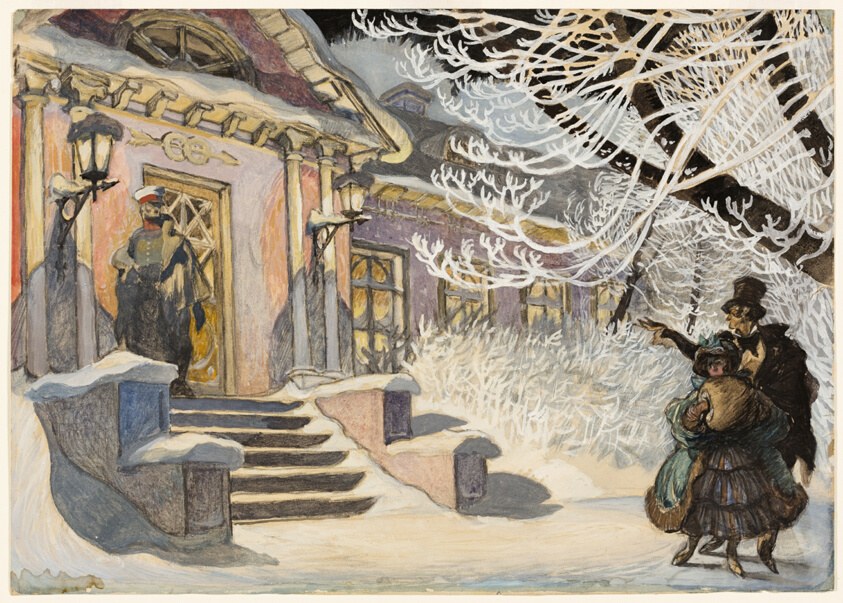
Winter Scene: Design for a Ballet
Nicolai Remisoff American, born Russia, 1887-1975
- Medium:
- Gouache with watercolor, over traces of black chalk, on cream wove paper
- Collection:
- Prints and Drawings
- Source:
- Art Institute of Chicago
- Rights:
- Rights reserved by the holding institution — do not reuse without permission. Source record ↗
- Recorded as:
- AIC — rights reserved
This work documents how early twentieth-century theatrical designers understood the relationship between dance and narrative, using setting and atmosphere to create the dramatic frame in which movement would occur. For historians of ballet, it reveals the importance of scenic design to the Romantic tradition and shows Remisoff's working method—a designer whose visual imagination shaped the experience of watching dance as much as the choreography itself.
What you are looking at
A winter street scene at dusk or twilight, with heavy snow clinging to bare tree branches in the upper right that create an almost lacy canopy overhead. The left side shows the façade of a town house with warm lamplight spilling from tall windows; two figures in dark coats stand at the entrance. The right foreground features two elegantly dressed figures—a woman in a long skirt with fitted bodice and the man beside her in formal evening wear with a top hat—who appear to have paused mid-stroll on the snowy street. The palette is cool grays and whites for the snow and architecture, warmed by golden lamplight, creating strong shadows and silhouettes. The composition captures a moment of social encounter in an aristocratic winter setting, with careful attention to the play of light, shadow, and the delicate tracery of frost-laden branches.
The dancing
The couple on the right stand in close proximity, the woman slightly turned toward the man, her posture open and receptive; the man leans subtly toward her. Both wear formal evening dress—the woman in a full-skirted gown with apparent corseting, the man in a tailcoat and top hat. Their stance suggests a moment of intimate conversation or courtship rather than active dance movement; the bodies are upright and controlled, weight evenly distributed, no weight transfer or footwork visible. The figures at the house entrance are more static sentries, framing the social world these promenaders inhabit.
The dance depicted
This is not a scene of active dancing but of ballroom-society courtship in a winter setting, likely drawn for a ballet scenario rather than depicting ballet movement itself. The image captures the social context and dramatic moment that would frame or precede dance—the chance meeting, the romantic encounter. If this is a design for a ballet, it establishes mood and narrative rather than choreographic detail. The formal evening dress and aristocratic setting suggest the Romantic ballet of the mid-to-late nineteenth century, when such scenes of courtship in snow were part of the dramatic apparatus (compare the winter settings in works like Giselle or La Sylphide), though no active dance technique is evident.
How it was made
The work is executed in gouache with watercolor over traces of black chalk on cream wove paper—a technique suited to rapid scenic design and color study. Gouache's opacity allowed the artist to build luminous highlights (the snow, the lamplight) over darker underpainted areas, while the watercolor adds translucent glazes and subtle modeling. This is a preliminary or presentation design rather than a finished painting; the combination of media and the paper support are typical of theatrical design practice in the early twentieth century, allowing quick revision and easy reproduction for theater archives or costume design consultation.
About this work
This is a stage design by Nicolai Remisoff dated 1907, created to establish the setting and mood for a scene in a ballet variously titled Winter Scene. Remisoff, an émigré Russian designer who worked extensively for the Ballets Russes and American theater, was known for dramatic use of light and atmospheric effect. The image shows not a moment of dance but the romantic and social world in which dance takes place—the aristocratic street encounter that would motivate or frame the choreography. It exemplifies the Romantic ballet tradition's use of winter, snow, and chance meetings as dramatic devices, and demonstrates the theatrical designer's role in establishing narrative context and emotional tone through color, light, and setting rather than through the bodies of dancers.
How to look at it
Attend to the composition's staging of social hierarchy and romantic possibility: the bright, warm interior is separated from the cold street where the couple encounters; light and darkness, interior and exterior, define the dramatic space. The snow-laden branches create a canopy of natural beauty that frames human drama—a Romantic trope. The artist has chosen a moment of social pause, not movement; the couple's body language suggests the emotional content (attraction, restraint, formality) more than it depicts physical action. Notice how the gouache highlights—the snow, the lamplight—create the emotional tone of winter romance that would suffuse whatever choreography followed.
The artist
Nicolai Remisoff (1887–1975) was a Russian-born scenic and costume designer who became a central figure in twentieth-century theatrical design, particularly through his long association with the Ballets Russes and later work in American theater and film. He was known for dramatic atmospheric effects, rich color, and a romantic sensibility that honored the traditions of Russian imperial theater while embracing modernist principles of design economy and symbolic suggestion. His work spanned ballet, opera, drama, and cinema, and he was influential in establishing the designer as a key creative voice in theatrical production.
The period
In 1907, the Ballets Russes was not yet founded (Diaghilev's company premiered in 1909), but Russian theatrical modernism was at a height. The Romantic ballet tradition, including its signature winter scenes and supernatural encounters, remained a living repertory in Russian imperial theaters and continued to influence new creation. Early twentieth-century design was moving away from literal illusionism toward more stylized, atmospheric suggestion—precisely what Remisoff achieves here through the economy of the gouache medium and the emphasis on light and mood over architectural detail. The work belongs to a moment when theatrical design was becoming recognized as a high art form rather than mere decoration.
Where it lives
The work is held in the Prints and Drawings collection at the Art Institute of Chicago. It is a preliminary design work on paper, part of the archival record of theatrical production rather than a finished artwork for independent exhibition.
Dance in this work
Questions about this work
Is this a painting or a design sketch?
It is a formal design sketch—a gouache and watercolor work on paper created to establish the visual setting for a ballet scene. It is finished enough to communicate the designer's vision to producers, directors, and technicians, but it is made in a medium (paper, gouache) that prioritizes quick revision and clarity over permanence. Theatrical designers of this period often created designs at this level of finish for archival purposes.
Why is there no visible dancing?
This is a design for the setting and mood of a ballet, not a representation of dance movement. The scene captures the dramatic context—a winter street encounter—that would motivate and frame the choreography. Designers often focused on setting, lighting, and costume; the choreography itself was the dancer's domain.
Who was Nicolai Remisoff?
Remisoff (1887–1975) was a Russian-born theatrical designer who became one of the most influential scenic artists of the twentieth century, working for the Ballets Russes, American theater companies, and later film. He was known for atmospheric effects and a romantic aesthetic that bridged Russian imperial tradition and modernist innovation.
What was the Romantic ballet tradition?
Romantic ballet, dominant in the nineteenth century, emphasized supernatural narratives, exotic or pastoral settings, and the spectacle of the female dancer en pointe. Winter scenes, moonlit forests, and chance encounters between mortal and ethereal beings were stock devices. This design uses those conventions.
More dance artwork





