49 works in this view — arrow keys or swipe to move between them.
Dance in Art
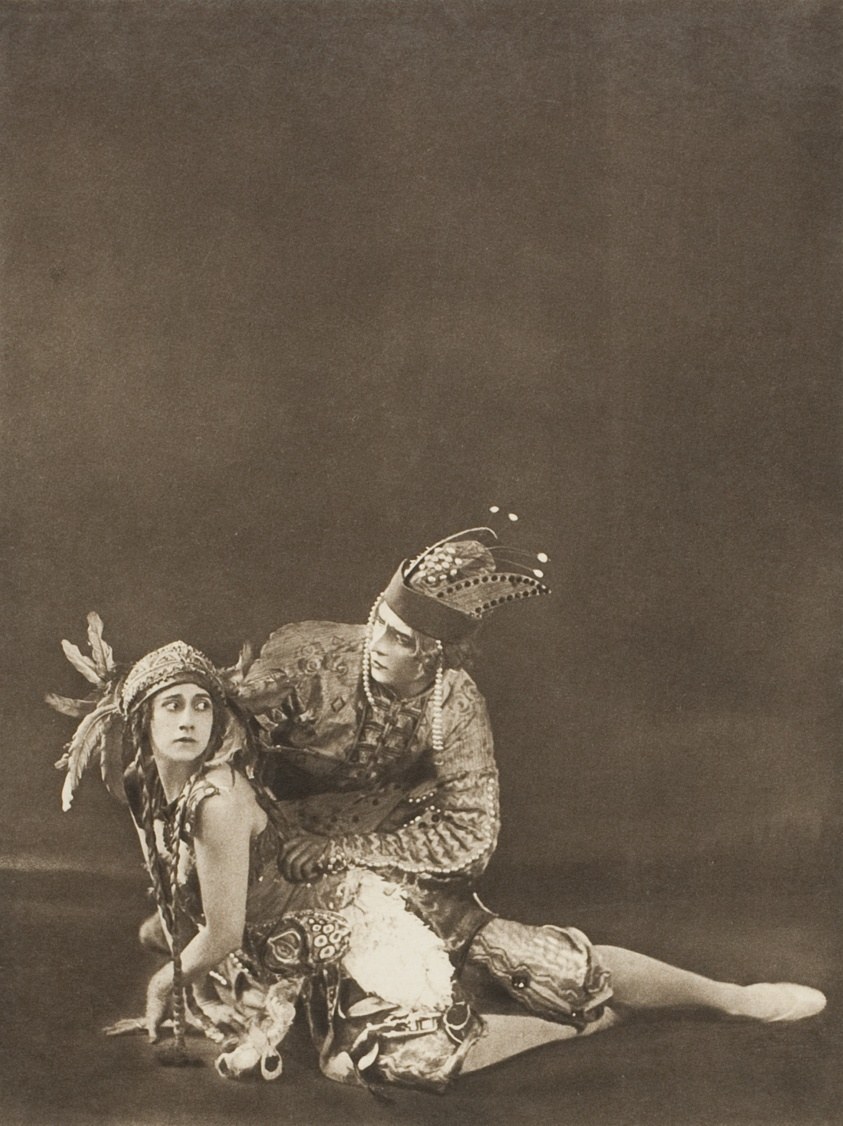
Tamara Karsavina and Adolf Bolm in the Firebird (Madame Thamar Karasavina and M. Adolph Bolm, L'Oiseau de Feu)
Emil Otto Hoppé English, born Germany, 1878–1972
- Medium:
- Photogravure, from the portfolio "Studies from the Russian Ballet"
- Collection:
- Photography and Media
- Source:
- Art Institute of Chicago
- Rights:
- Rights reserved by the holding institution — do not reuse without permission. Source record ↗
- Recorded as:
- AIC — rights reserved
This photograph documents one of the most historically significant collaborations in twentieth-century dance: the 1910 premiere of the Firebird, which announced both Stravinsky's compositional genius and Michel Fokine's break with classical ballet convention. Hoppé's photogravure is among the earliest and finest photographic records of the Ballets Russes, a company that reshaped modern dance and visual culture across Europe and America. The image shows how photography transformed the visibility and circulation of choreographic work, making the ephemeral art of dance available for sustained study and international influence.
What you are looking at
Two dancers in elaborate costume occupy a shallow stage space against a dark, neutral background. A male dancer kneels behind and to the side of a female dancer, his body angled toward her in a posture of attention or devotion. The woman sits or reclines, her torso upright, gazing away from her partner. Their costumes are richly detailed: the woman wears a headdress with tall feathered ornament and a patterned tunic or bodice with jeweled decoration; the man wears a tall, pointed headdress adorned with pearls or beads and an embroidered coat of stiff, patterned fabric with prominent jeweled buttons at the front. Both dancers' limbs are bare or nearly bare. The composition is tightly framed, with the figures occupying most of the picture plane and leaving generous dark space above them. The photograph is printed as a photogravure, creating a soft, tonal quality with warm grays and blacks.
The dancing
The male dancer's weight is on his knees, his torso upright and leaning slightly forward, his arms positioned at his sides or resting on his thighs in a formal, contained manner. The female dancer's frame is upright but her gaze is directed away from her partner, her own arms relaxed. There is no physical contact between the two dancers, though their proximity and his kneeling posture suggest an emotional relationship—either courtship, supplication, or narrative drama. The pose is static rather than caught mid-movement, suggesting either a moment of stillness within the choreography or a studio portrait of the dancers in character.
The dance depicted
This is the Firebird ballet, the 1910 Sergei Diaghilev production with music by Igor Stravinsky, choreographed by Michel Fokine. The image likely depicts a moment between the Firebird (danced by Tamara Karsavina, the ballerina shown) and Ivan the Prince (danced by Adolf Bolm, the male dancer). In the ballet's narrative, the prince captures the magical firebird and they interact through a sequence of enchantment and emotional connection before her escape. The static, frontal pose and formal costumes suggest either a sustained theatrical moment or a portrait made during rehearsal or in the studio. The Firebird of 1910 was a revolutionary work in both music and choreography—Fokine broke with the classical vocabulary of nineteenth-century ballet to create a movement language suited to Russian fairy-tale themes and Stravinsky's new compositional idiom.
How it was made
This is a photogravure, a process that transfers a photographic image onto a metal plate through chemical etching, allowing fine reproduction of tonal gradation and detail. Photogravure was among the most prestigious and durable photographic printing methods of the early twentieth century, and Emil Otto Hoppé's portfolio "Studies from the Russian Ballet" (of which this is a part) was among the first systematic photographic documents of modern choreography. The process allowed Hoppé to record the texture of fabric, the ornament of costume, and the spatial relationships of dancers with a subtlety unavailable to earlier theatrical photography. The work was intended for circulation as a fine-art print and portfolio piece, making it accessible to a wider audience than live performance.
About this work
This photogravure is one of Emil Otto Hoppé's iconic studies of the Ballets Russes, the avant-garde dance company that revolutionized European theatrical dance in the early twentieth century. The image captures Tamara Karsavina and Adolf Bolm in the Firebird, Diaghilev's 1910 production, which itself transformed ballet by marrying modernist music (Stravinsky), Fauve design, and a new, less restricted movement vocabulary. Hoppé's photograph is both a record of a historic performance and a work of portraiture and composition in its own right—the careful framing, studio lighting, and formal pose elevate the dancers from mere performers to subjects worthy of the kind of sustained attention reserved for fine art.
The work matters because it documents a pivotal moment in dance history while exemplifying how photography became, for the first time, a serious medium for capturing and preserving choreographic art. Hoppé's portfolio was instrumental in bringing the visual spectacle of the Ballets Russes to an international audience, and his photographs became as iconic as the performances themselves. The image also reveals the extent to which theatrical dance of this era depended on costume, ornament, and narrative tableau—elements that later twentieth-century dance would reject in favor of the body itself.
How to look at it
Attend first to the relationship between the two bodies: the man's kneeling posture and forward lean express supplication or enchantment, while the woman's contained frame and averted gaze suggest both power and distance. The costumes are as important as the bodies—the tall, jeweled headdresses and patterned, stiffened garments are signs of the Russian Imperial ballet tradition being transformed by modernist design. Note the careful lighting that models the textures of fabric and embroidery while keeping the background neutral and undistracting—this studio arrangement allows the viewer to examine the dancers' costume and carriage in a way live performance never could. The moment chosen is not one of climactic movement but of stillness and emotional configuration, inviting you to read narrative and character through static pose rather than kinetic flow.
The artist
Emil Otto Hoppé (1878–1972) was a German-born photographer who became one of the most celebrated portraitists and theatrical photographers of the early twentieth century, based in London. He pioneered the use of photography to document stage performance, particularly the Ballets Russes, and his "Studies from the Russian Ballet" portfolio (1911–12) was groundbreaking in treating dance as a subject worthy of fine-art photographic attention. Hoppé was known for his meticulous studio technique, sophisticated use of lighting, and ability to capture movement and character within a carefully composed frame. He worked extensively with the major performing artists of his era and his photographs shaped how dance history was visually understood and remembered.
The period
The 1910 Firebird premiere was a watershed moment for early-twentieth-century dance and visual culture. Sergei Diaghilev's Ballets Russes (founded 1909) brought together choreographers, composers, designers, and dancers from across Europe in an explicitly modernist project to reform ballet. Michel Fokine's choreography rejected the rigid codification of nineteenth-century classical ballet in favor of a more expressive, naturalistic movement vocabulary; Stravinsky's music was radically new in harmony and rhythm; and the designers (including Alexandre Benois and Léon Bakst) created costumes and sets influenced by Fauvism and Russian folk art. Simultaneously, photography was establishing itself as a medium capable of serious artistic and documentary work, and theatrical photography was emerging as a new genre. Hoppé's decision to photograph the Ballets Russes in studio settings, rather than attempting to capture live performance, allowed him to create images of sustained clarity and compositional control—establishing photography as a tool for preserving and disseminating choreographic knowledge.
Where it lives
This photogravure is from the portfolio "Studies from the Russian Ballet" (1911–12), a publication that circulated internationally as a fine-art object and made the visual spectacle of the Ballets Russes available to audiences beyond those who could attend live performances. The work is held by the Art Institute of Chicago in its Photography and Media collection.
Dance in this work
Questions about this work
Who were Karsavina and Bolm?
Tamara Karsavina (1885–1978) was a Russian prima ballerina of the Imperial Theatre and a principal dancer of the Ballets Russes throughout its early decade. Adolf Bolm (1884–1951) was a Russian dancer and choreographer who also worked extensively with Diaghilev's company. Both were central to establishing the Ballets Russes as an international artistic force. Karsavina was particularly celebrated for her roles in the company's landmark productions, including the original Firebird.
What is the Firebird ballet about?
The Firebird is a three-act ballet based on Russian fairy tales, with a libretto by Michel Fokine and music by Igor Stravinsky. It tells the story of Ivan, a young prince, who captures a magical firebird in an enchanted forest. The firebird and the prince experience a moment of enchantment and connection, but she escapes. Ivan then uses a magical feather she has given him to defeat an evil sorcerer and win the hand of a princess. The ballet was revolutionary in its fusion of modernist music and design with a narrative grounded in Russian folklore.
Why is this photograph in a collection of dance art?
This work belongs in a gallery of dance art because it is a primary historical document of choreographic practice and aesthetic innovation. It shows how a major dance work was costumed, framed, and performed; it records the bodies and training of two foundational dancers; and it exemplifies how photography became a medium for preserving and circulating dance in the twentieth century. The photograph is also a work of visual art in its own right—a composed and carefully executed studio image.
What is a photogravure?
A photogravure is a printmaking process that combines photography with intaglio printing. A photographic image is transferred onto a copper or steel plate through chemical etching, then printed on paper using the same technique as engraving or etching. Photogravure was the most tonally sophisticated and durable photographic printing method available in the early twentieth century, producing images of exceptional detail and warmth. It was the preferred method for fine-art photographic publishing.
More dance artwork





