49 works in this view — arrow keys or swipe to move between them.
Dance in Art
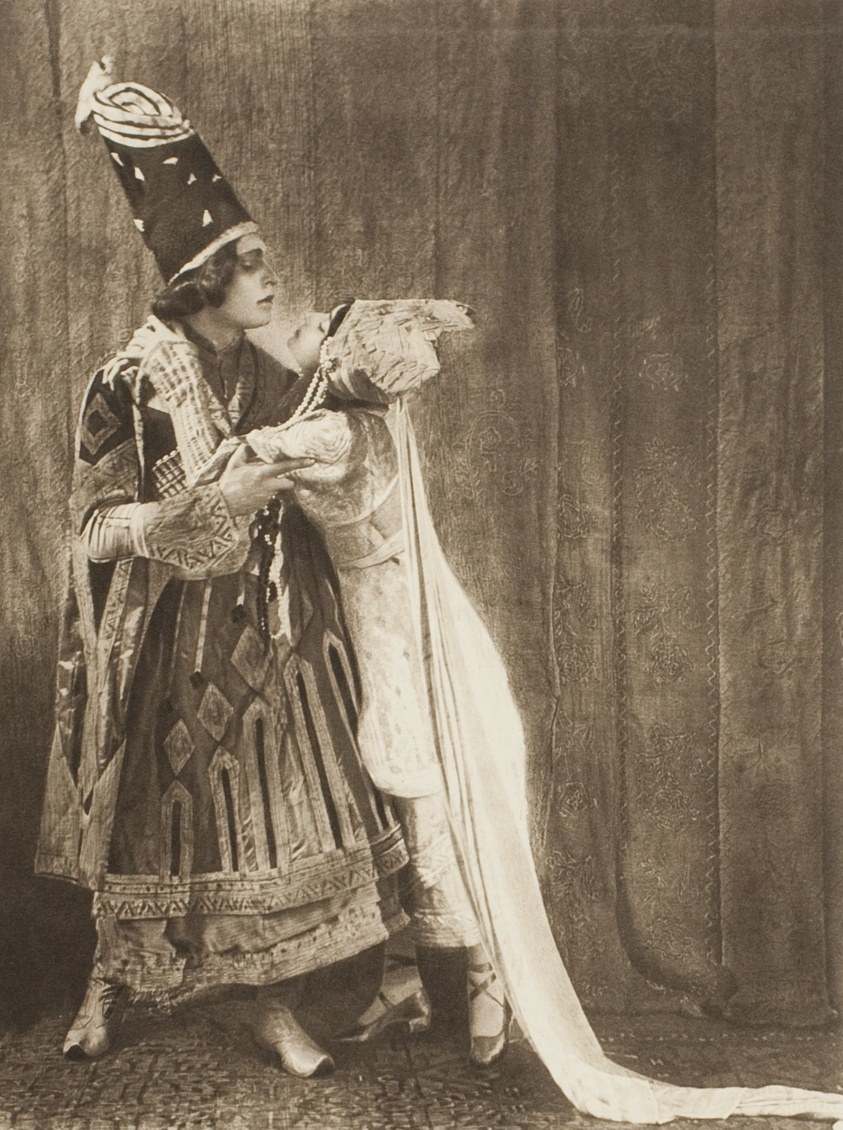
Adolf Bolm and Tamara Karsavina in Thamar (Madame Thamar Karasavina and M. Adolph Bolm, Thamar)
Emil Otto Hoppé English, born Germany, 1878–1972
- Medium:
- Photogravure, from the portfolio "Studies from the Russian Ballet"
- Collection:
- Photography and Media
- Source:
- Art Institute of Chicago
- Rights:
- Rights reserved by the holding institution — do not reuse without permission. Source record ↗
- Recorded as:
- AIC — rights reserved
This photograph documents the Ballets Russes at the height of its influence, capturing the synthesis of classical dance technique with non-European design and narrative that made the company revolutionary. For dancers and historians, it provides rare visual evidence of how early twentieth-century dancers inhabited character roles, the quality of line and stillness in the presence of elaborate costume, and the aesthetic principles Fokine applied to non-classical material.
What you are looking at
A single figure in elaborate theatrical costume stands in profile against a plain draped backdrop, posed in a moment of dramatic stillness. The dancer wears a richly patterned dark tunic or kaftan with geometric embroidery and a decorative hem band, layered beneath a flowing white garment that trails dramatically across the stage floor—a train of considerable length that dominates the lower half of the composition. The head is crowned with a tall, ornate headdress featuring white plumes or feathers that rise sharply upward, and a decorative band encircles the brow. The figure's posture is formal and dignified: the torso is upright, one arm extended with a flowing gesture, the other held close to the body. The lighting is even and cool, characteristic of studio photography, which flattens the volumetric dress into tonal ranges of cream, black, and grey. The figure's gaze is directed upward and away, suggesting either a moment of reverie or the formal address of an unseen audience—a pose that conveys nobility and emotional restraint rather than physical exertion.
The dancing
The single dancer is presented in a stationary, presentational pose rather than mid-movement. The extended arm suggests a classical ballet port de bras, though the gesture reads as measured and hieratic rather than flowing. The weight appears grounded and centered, with no indication of the dynamic turnout or lifted épaulement associated with ballet technique. The body is long and columnar, emphasized by the vertical plume. The trailing train and the formality of the stance suggest a character role—someone of rank or symbolic importance—held momentarily for the camera's regard.
The dance depicted
This is a portrait from the Ballets Russes, the revolutionary company that performed primarily in Paris and London in the early twentieth century. The costume and headdress are consistent with Fokine-era orientalist productions—likely the 1912 ballet Thamar, choreographed by Michel Fokine to music by Mily Balakirev, with designs and an Orientalist narrative drawn from Caucasian legend. The Ballets Russes melded classical ballet training with a new expressiveness and cultural eclecticism that departed sharply from the strict academic formalism of Imperial Russia. The pose—a single figure arrested in stillness rather than caught mid-step—was typical of how Fokine approached theatrical meaning: through sculptural line and emotional tableau rather than virtuosity.
How it was made
This is a photogravure, a photomechanical printing technique that translates a photograph into an etched copper plate, allowing high-quality, repeatable reproduction. The process was widely used for art photography portfolios in the early 20th century and allowed photographers to circulate their work with tonal subtlety and archival stability that offset photographic prints could not match. The portfolio Studies from the Russian Ballet from which this print derives was an ambitious documentary project, creating a permanent record of Ballets Russes productions at a moment when the company was transforming theatrical dance. The technique's precision and the portfolio format indicate this was not casual documentation but a curated artistic record aimed at a cultivated, theater-going audience.
About this work
This is a studio photograph by Emil Otto Hoppé, a German-born photographer who became one of London's most celebrated portraitists and cultural documentarians in the Edwardian and interwar periods. Hoppé created an extensive series of photographs of the Ballets Russes during its London seasons, capturing principal dancers in costume and character. This print records a moment of a major 1912 production, preserving both the visual spectacle of Orientalist design and something of the interpretive intensity that Fokine brought to early twentieth-century ballet. The image belongs to a broader turn-of-the-century investment in photography as a medium for capturing and circulating the ephemeral art of dance—a practice that would accelerate through the twentieth century as photographers became essential documentarians of theatrical innovation.
How to look at it
The photograph arrests movement entirely, asking the viewer to read the dancer's intention through costume, posture, and the direction of the gaze rather than through motion. Notice the relationship between the vertical thrust of the headdress and the horizontal flow of the train—this compositional balance suggests how Fokine's aesthetic unified ornament, line, and stillness into meaning. The formal, almost statuesque quality of the pose should be read not as a weakness in dance photography but as evidence of a choreographic principle: that in Fokine's approach, the character's emotional state and social identity could be conveyed through a held, sculptural moment rather than through rapid or technical display. This was radical in 1912.
The artist
Emil Otto Hoppé (1878–1972) was a pioneering art and fashion photographer who built his London studio into one of the most sought-after portraiture practices of the early twentieth century. He photographed dancers, actors, musicians, and society figures with a formal yet psychologically penetrating approach. His work with the Ballets Russes was part of a broader engagement with theatrical and artistic modernism; he also documented theater productions, ballet rehearsals, and avant-garde performance. His studio technique—controlled lighting, geometric composition, and careful attention to costume and adornment—gave his dance photographs a sculptural formality that elevated them beyond mere record into art objects in their own right.
The period
The Ballets Russes, under the direction of Sergei Diaghilev, revolutionized dance between 1909 and 1929 by combining the technical excellence of Imperial Russian training with experimental choreography, non-European music, and visual design by leading European modernist painters. Michel Fokine's Thamar (1912) exemplified the company's taste for exotic narrative, new musical sources, and interpretive rather than purely virtuosic movement. This period also coincided with the emergence of photography as a serious medium for documenting and promoting theater; theatrical photography became a form of artistic publicity and preservation simultaneously. The photogravure process allowed photographs to circulate in bound portfolios and exhibitions, making the ephemeral permanent and shareable.
Where it lives
This photogravure is from the portfolio Studies from the Russian Ballet, a curated collection of Hoppé's photographs from Ballets Russes productions. The work is held in the Art Institute of Chicago's Photography and Media collection, establishing it as part of a public institutional commitment to preserving dance photography as a serious artistic and historical record.
Dance in this work
Questions about this work
Who performed this role?
The catalogue record identifies this as Tamara Karsavina in Thamar, partnered with Adolf Bolm. Karsavina (1885–1978) was a principal dancer of the Imperial Ballet and the Ballets Russes, celebrated for her dramatic intelligence and her ability to inhabit character roles. She performed Thamar during the London season of 1912.
What is Thamar about?
Thamar is a one-act ballet choreographed by Michel Fokine based on a narrative poem by the Georgian Romantic writer Mikhail Lermontov. The ballet tells the story of a Georgian princess who lures travelers to their deaths. The score was composed by Mily Balakirev, a Russian nationalist composer. The ballet exemplified the Ballets Russes' engagement with non-Russian European literary sources and non-European music and design.
Why photograph dancers in costume rather than in motion?
Studio portraiture of dancers in costume served multiple purposes: it created visual promotion for the company and specific productions, it documented the design and spectacle that were integral to the Ballets Russes' vision, and it allowed both photographer and dancer to create a considered, composed image that captured something essential about the character and the dancer's interpretation. Motion photography was technically difficult in 1912, but studio portraiture also reflected a different aesthetic value—the idea that stillness and formal line could convey as much as movement.
What was the Ballets Russes?
The Ballets Russes (1909–1929) was an itinerant company directed by the Russian impresario Sergei Diaghilev. It combined classical ballet technique with innovative choreography, avant-garde visual design, and experimental music. The company performed primarily in Paris and London and became the most influential force in twentieth-century dance, attracting dancers, choreographers, composers, and visual artists of the era's highest caliber.
More dance artwork





