49 works in this view — arrow keys or swipe to move between them.
Dance in Art
Spanish Dance
Edgar Degas (French, 1834–1917)
- Medium:
- Bronze
- Collection:
- Painting and Sculpture of Europe
- Source:
- Art Institute of Chicago
- Rights:
- Public domain — free to use, share and adapt.
- Recorded as:
- CC0 (Public Domain)
Degas's sculptures reveal a modernist interest in the moving body that predates much twentieth-century dance modernism itself. For historians of nineteenth-century perceptions of Spanish dance, and for those studying how academic sculpture represented non-Western or 'exotic' movement idioms in this period, this work documents what European artists selected when they looked at Spanish performers—the emphasis on vertical lift and torsional sophistication rather than percussive groundedness.
What you are looking at
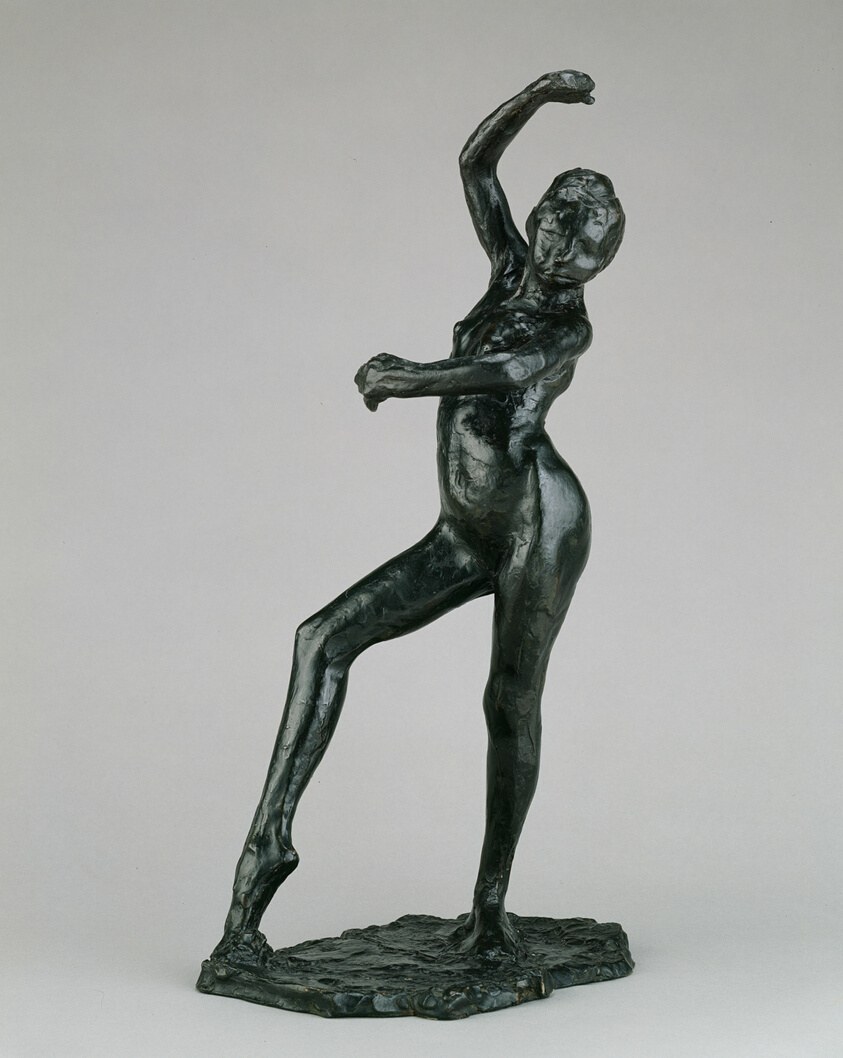
A nude male figure in contrapposto stance dominates the composition, captured in bronze. The figure stands on a roughly textured base, weight shifted onto the back leg in a classical S-curve. The raised arm extends upward and back with an elegant arc, the palm facing inward in a gesture of abandon or exuberance. The torso twists, creating tension between the shoulders and hips. The pose suggests a moment of movement—neither fully static nor in mid-stride, but poised between states. The patina of the bronze is uneven, with lighter areas suggesting wear or oxidation, giving the sculpture surface incident and depth.
The dancing
A single figure, anatomically precise in the manner of academic sculpture. The weight distribution is asymmetrical: the left leg (figure's left) bears the body's mass while the right extends slightly forward in a relaxed line. The right arm curves overhead in an open, lifted gesture; the left hangs at the side with fingers extended. The head tilts upward in the direction of the raised arm. The entire pose suggests release, joy, or the momentum of a turning movement—the torso is actively twisted, with the chest opening toward the raised arm.
The dance depicted
The catalogue title 'Spanish Dance' invokes Iberian terpsichorean tradition, but the pose does not specify a particular Spanish idiom—not the grounded, rhythmic frame of flamenco nor the structured hold of a ballroom form. The contrapposto and gesture align instead with academic ballet's vocabulary of arabesque, attitude, or the sustained lifted quality of a classical pose. The figure's gender-neutral muscularity and the emphasis on torsion and extension suggest either a male ballet dancer or a more generalised interpretation of Spanish movement filtered through European academic convention. Without costume markers or an architectural or musical setting, the specific dance cannot be confirmed from the image alone.
How it was made
This is a bronze sculpture, likely cast from a clay or plaster model. Degas was known to work in clay first, sometimes leaving models in that state; bronzes of his work were often cast posthumously from his studio materials. The uneven patina and surface texture visible here suggest an original cast rather than a later reproduction. The scale appears small—likely a statuette for an interior collection rather than a public monument. The medium allowed Degas to explore the human figure's three-dimensionality in a way drawing or painting could not, capturing the full rotational complexity of a twisted pose.
About this work
This is a bronze statuette attributed to Edgar Degas, a sculptor whose work in three dimensions remains less widely known than his pastel and oil paintings of dancers. The figure's lifted, twisted pose and the title's invocation of Spain suggest an interest in capturing the energy and physicality of Spanish theatrical dance—a subject that fascinated nineteenth-century European artists. Degas spent much of his career observing dancers in rehearsal and performance, translating their movement into sculptural form. This piece exemplifies his method: the pose is neither a frozen pantomime nor a narrative moment, but an arrested instant of mobile energy, anatomically precise yet psychologically present.
How to look at it
Attend to the asymmetry: this is not a figure at rest, but one suspended in a moment of turnout and lift. The raised arm is not merely decorative but structural—it pulls the eye upward and creates a visual arc that traces the figure's axis of rotation. Look at where the weight actually falls (lower left in the image) and how the torso responds by twisting away from it. The rough base grounds the figure not in architectural solidity but in the material reality of the studio; the patina and surface marks acknowledge the work's status as sculpture rather than attempting illusionistic finish. The pose references classical ballet vocabulary while the title insists on Spanishness—this tension between European academic form and exotic subject is the image's actual content.
The artist
Edgar Degas (1834–1917) was a French Impressionist painter best known for his studies of ballet dancers, café singers, and the theatre. Though trained in history painting, he devoted decades to observing movement—in studios, rehearsals, on stage. He sculpted throughout his career but exhibited his sculptures rarely and reluctantly; most bronzes were cast from his clay originals after his death. His approach to sculpture paralleled his painting: intimate scale, unusual viewpoints, incomplete or cropped compositions, and an anatomical precision grounded in lifelong drawing study. He was fascinated by labour, repetition, and the body in states between rest and motion.
The period
In the 1870s and 1880s, when this work likely dates, Spanish culture and aesthetics held significant allure for European artists and audiences. The vogue for Orientalism and exoticism extended to Spain, coded as both European and 'other.' Flamenco and Spanish dance were fashionable in Parisian theatres and cabarets. Simultaneously, academic sculpture was undergoing subtle shifts: while the classical ideals of balance and repose remained official doctrine, artists like Degas and Rodin were experimenting with asymmetry, torsion, and the capture of transient movement. The catalogue date of 1878 places this squarely within Degas's most productive period as a sculptor and his deepest engagement with theatrical subjects.
Where it lives
Held by the Art Institute of Chicago in the Painting and Sculpture of Europe collection. The work is a bronze cast; the original clay model may or may not survive. Given Degas's practice of rarely casting his sculptures during his lifetime, this bronze was likely cast in the years following his death in 1917, when the contents of his studio were inventoried and cast by the Paris foundry Hébrard.
Dance in this work
Questions about this work
Is this definitely Spanish dance? The pose looks like ballet.
The title asserts 'Spanish Dance,' but the image shows a figure in a pose derived from classical ballet vocabulary—the lifted contrapposto, the extended arm, the torsion. This likely reflects how European academic artists of the period understood Spanish movement through the lens of ballet training. Degas may have seen Spanish dancers in Paris and abstracted what he observed into this more formally composed figure, or the title may represent a curatorial or archival label rather than Degas's own precise intent.
Why did Degas sculpt if he was a painter?
Degas treated sculpture as a means of studying the human figure in three dimensions, with the same intensity he applied to drawing and pastel. Sculpture allowed him to understand weight, balance, and the complexity of a pose from all angles—knowledge that informed his paintings. He rarely exhibited his sculptures and was protective of them, treating the practice as research rather than public art.
How was this cast from bronze? Is it an original?
This is a cast bronze, made from a mold of Degas's original clay or plaster model. Most Degas bronzes were cast posthumously by the Hébrard foundry in Paris, beginning around 1920. Without access to the foundry records or the original model, it cannot be determined from the image alone whether this is an early cast or a later reproduction, though the patina suggests age.
What does the rough base mean?
Degas often left bases unfinished or deliberately crude, contrasting with the refined detail of the figure itself. This choice resists the ornamental pedestals of academic sculpture and asserts the work's status as studio research—a study of movement, not a polished public monument. The materiality of the base is part of the work's meaning.
More dance artwork





