49 works in this view — arrow keys or swipe to move between them.
Dance in Art
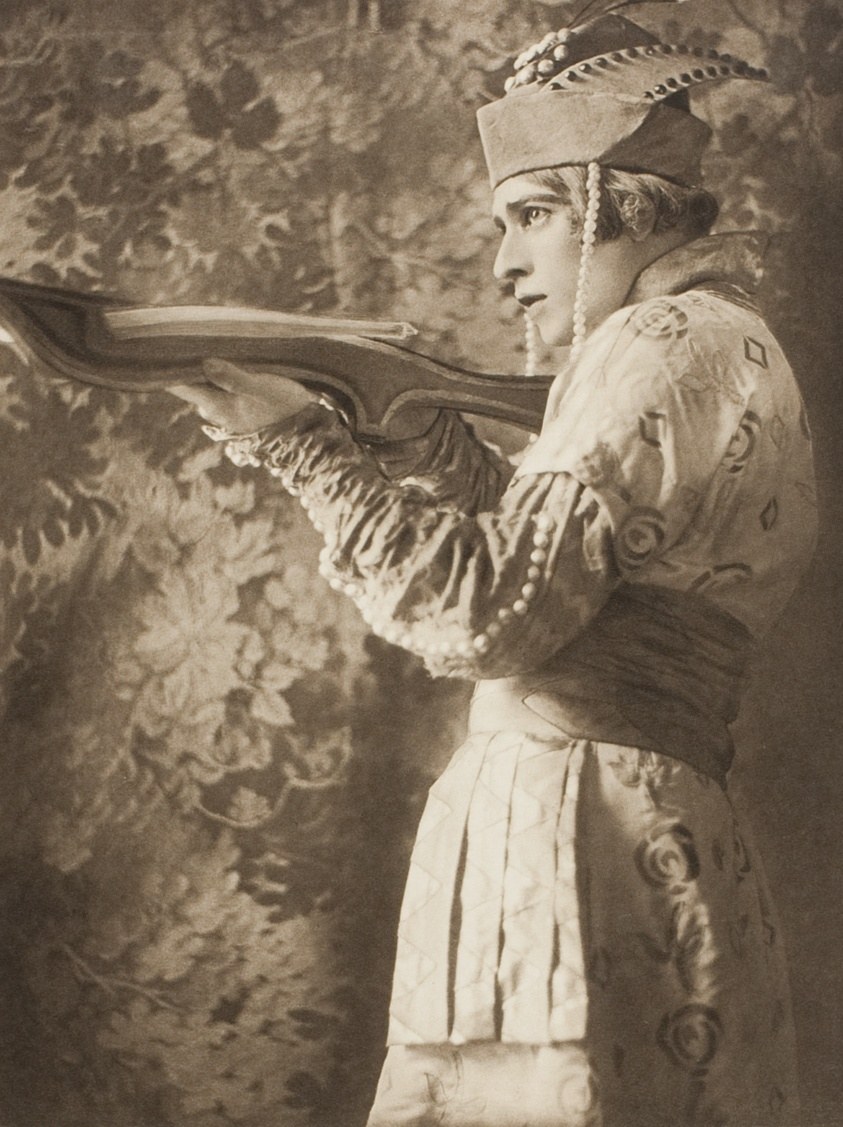
Adolf Bolm in the Firebird (Monsieur Adolph Bolm, L'Oiseau de Feu)
Emil Otto Hoppé English, born Germany, 1878–1972
- Medium:
- Photogravure, from the portfolio "Studies from the Russian Ballet"
- Collection:
- Photography and Media
- Source:
- Art Institute of Chicago
- Rights:
- Rights reserved by the holding institution — do not reuse without permission. Source record ↗
- Recorded as:
- AIC — rights reserved
Bolm was one of the original cast members of The Firebird and a principal dancer of the Ballets Russes in its formative years; this image documents his interpretation of a foundational modernist ballet role at the moment of its creation. The photogravure process and portfolio context reveal how the Ballets Russes used photography as a marketing and archival tool, establishing a model of theatrical documentation that persists today.
What you are looking at
A dancer in elaborate costume stands in profile against a richly patterned damask backdrop. The figure wears a white headdress with tall feathers rising vertically, suggesting a headdress or crown, and a loosely draped white tunic with ornate embroidery and fringe at the shoulders. The garment appears light and flowing. Across the dancer's torso is slung a large curved prop—a stylized wing or feather form with a strong, elegant sweep. The dancer's pose is upright and alert, the body held in clear profile, with the weight appearing evenly distributed. The lighting is soft and even, typical of early photographic portraiture, and the overall composition emphasizes the verticality of the headdress and the diagonal thrust of the wing prop. The background is unfocused but suggests an ornate interior or theatrical setting.
The dancing
A single male dancer, viewed in profile from the waist up. The body is held erect and poised, with an open, expansive quality—the torso vertical, the neck extended, the face looking forward with calm focus. The right arm is extended across the body, grasping or cradling the large curved prop. The left arm hangs naturally. The posture suggests controlled strength and nobility rather than active movement; this is a pose held for the camera rather than a captured mid-movement moment. The overall frame is symmetrical and formal, emphasizing stillness and presence.
The dance depicted
This is a photographic portrait of Adolf Bolm in the costume and prop of the Firebird from the 1910 Ballets Russes production choreographed by Michel Fokine to music by Igor Stravinsky. The Firebird was a pivotal work of early modernist ballet, and Bolm was one of the company's leading male dancers. The wing prop is a defining feature of the Firebird character's costume design—a large, expressive sculptural form meant to suggest the magical bird's otherworldly nature. The costume and headdress reflect the Orientalist and fantastical aesthetic of the Ballets Russes, and the pose conveys the character's otherworldly grace rather than depicting active steps or movement.
How it was made
This is a photogravure, a photomechanical reproductive process that translates a photographic image into an intaglio print. The technique allows fine tonal gradations and detail reproduction, making it ideal for portrait and theatrical documentation. The work comes from a portfolio titled 'Studies from the Russian Ballet,' indicating it was part of a deliberate, curated series of images for circulation—likely sold as individual prints or as a bound set. This suggests a commercial practice of documenting and promoting the Ballets Russes through high-quality photographic portraiture, extending the reach of the company beyond the theatre itself.
About this work
This is a photogravure portrait of the dancer Adolf Bolm in costume as the Firebird from the Ballets Russes production of 1910. It documents not a moment of dancing but a posed representation of the character—the dancer in full costume and makeup, holding the expressive wing prop that defines the role. The image belongs to a wider practice of theatrical photography and photomechanical reproduction in the early 20th century, when the Ballets Russes used such imagery to document and disseminate their revolutionary work across Europe and America. It is as much an artifact of the company's public relations strategy as it is a dance document, yet it preserves crucial visual information about how the Firebird was costumed and how a leading male dancer of the era presented himself in an iconic role.
How to look at it
Look closely at the headdress and wing prop—these are the visual signatures of the Firebird character, and the photographer has positioned them to dominate the frame. Notice how Hoppé uses profile view to show the full vertical sweep of the headdress and the curved line of the wing; this is not a neutral documentary angle but a composed, flattering view that emphasizes elegance and otherworldly grace. The soft, even lighting is characteristic of studio portraiture and differs markedly from how stage lighting would have rendered these same costume elements in performance. The pose is static and noble, inviting you to read costume and character rather than movement and technique—which tells you something important about what this image was made to do: not to capture the Firebird as a dancer would perform it, but to present Bolm as a celebrity and the Firebird as a visual icon.
The artist
Emil Otto Hoppé (1878–1972) was a German-born photographer who became one of the most prolific and commercially successful portrait photographers of the early 20th century. He worked extensively with theatrical subjects and performers, earning a reputation for refined, dignified portraiture. Hoppé was particularly active in documenting the Ballets Russes during its early years, producing a large body of work that helped establish the visual identity of the company in the public imagination. His work combined technical mastery of the photographic process with a keen eye for costume, lighting, and composition that flattered his subjects while remaining documentary in intent.
The period
The Firebird premiered in 1910 at the Théâtre du Châtelet in Paris, marking the sensational European debut of the Ballets Russes under Sergei Diaghilev. The production synthesized cutting-edge choreography (Fokine's rejection of classical mime and rigid formalism), avant-garde music (Stravinsky's first major orchestral work), and sumptuous Orientalist costume design (by Alexander Golovin) into a unified artistic statement. The early 1910s saw the Ballets Russes at the height of its cultural influence, and the company actively promoted itself through photography, magazine features, and souvenir imagery. This photogravure was made in 1911, in the immediate aftermath of the ballet's triumph, as part of a deliberate effort to preserve and circulate images of the company's achievements. The portrait medium itself—dignified, formal, and focused on the individual performer—was characteristic of how the Ballets Russes positioned its dancers as celebrated artists rather than mere entertainers.
Where it lives
This work is held by the Art Institute of Chicago in their Photography and Media collection, catalogued as a photogravure from the portfolio 'Studies from the Russian Ballet' (1911). The portfolio was likely published by or in association with the Ballets Russes as a souvenir and promotional object, and individual prints were sold commercially. It is one of a series of similar portraits of leading dancers in costume.
Dance in this work
Questions about this work
Who was Adolf Bolm?
Bolm (1884–1951) was a Russian-born dancer and choreographer who was one of the Ballets Russes' principal male dancers in its first decade. He originated several leading roles and later became a influential choreographer in America. He was known for his dramatic intensity and his ability to embody character roles, making him ideal for parts like the Firebird.
What is the Firebird?
The Firebird is a ballet in one act, choreographed by Michel Fokine to Stravinsky's score, that premiered in 1910. It tells the story of Ivan Tsarevich's capture of a magical firebird. The ballet is famous for Fokine's innovative choreography, which moved away from classical mime toward a more naturalistic movement vocabulary, and for Stravinsky's groundbreaking orchestral writing.
Why is Bolm holding that curved object?
The curved form is a stylized wing or feather prop, part of the Firebird costume designed by Alexander Golovin. It serves as a visual symbol of the character's otherworldly, bird-like nature and was an iconic element of the role's design. In performance, dancers would manipulate and move with this prop as part of the choreography.
What is a photogravure?
A photogravure is a photomechanical printmaking process in which a photographic image is transferred to a copper plate that is then etched and printed using intaglio techniques. It was highly valued in the early 20th century for its ability to reproduce fine photographic detail and subtle tones, making it ideal for art and theatrical portraiture that was meant for publication.
More dance artwork





