49 works in this view — arrow keys or swipe to move between them.
Dance in Art
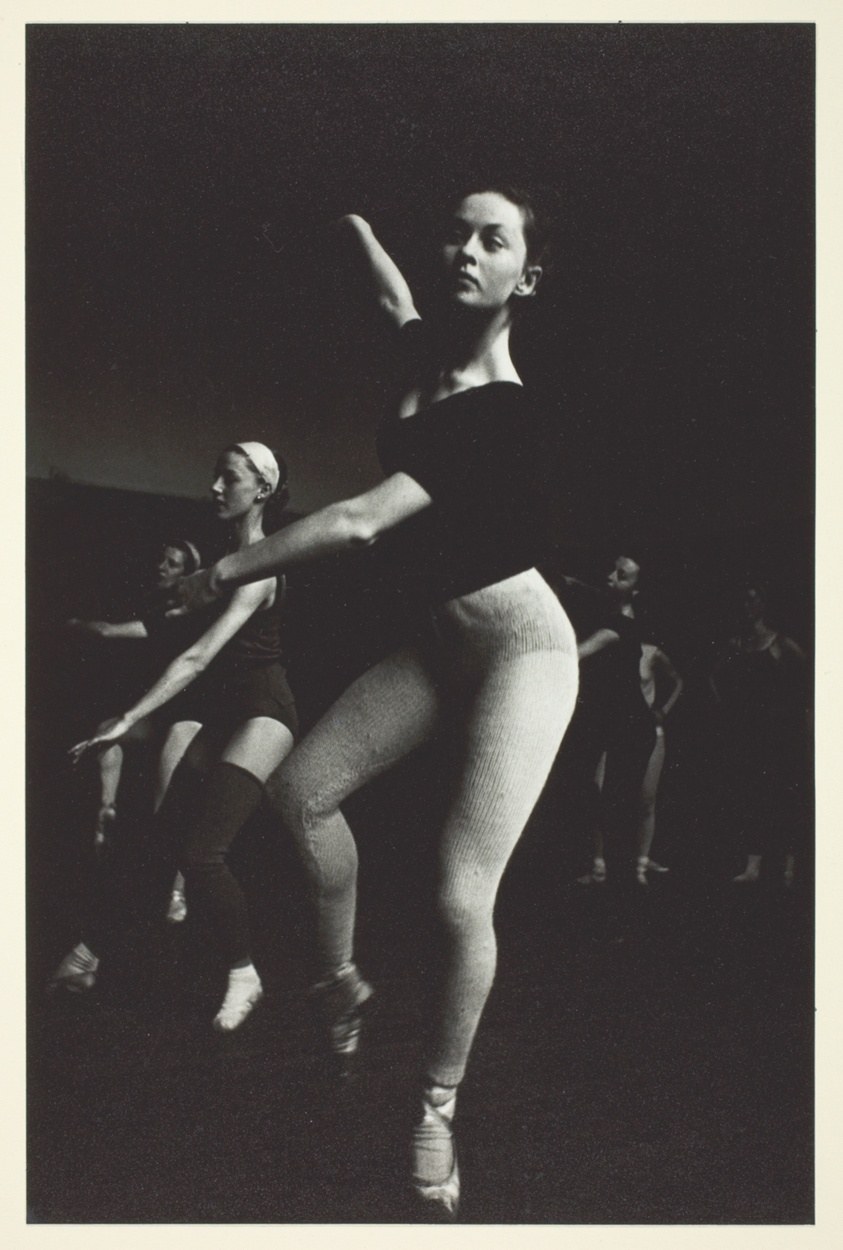
Ballet Students #2
Ed Van Der Elsken Dutch, 1925–1990
- Medium:
- Gelatin silver print
- Collection:
- Photography and Media
- Source:
- Art Institute of Chicago
- Rights:
- Rights reserved by the holding institution — do not reuse without permission. Source record ↗
- Recorded as:
- AIC — rights reserved
This photograph documents the visual and kinetic vocabulary of mid-twentieth-century European ballet training at a moment when photography was becoming a serious medium for art-world discourse. For dance historians, it offers evidence of how classical ballet was taught and understood in this period—the standards of posture, focus, and control that defined professional practice. For photography historians, it demonstrates how the medium could capture and aestheticize the human body in motion without resorting to narrative or spectacle.
What you are looking at
A black and white photograph captures a moment of classical ballet instruction or rehearsal. In sharp focus in the foreground stands a male dancer en relevé, his body held in a precise vertical line with his weight lifted high on the balls of his feet. His left arm is raised and extended with controlled geometry; his right arm hangs at his side. His gaze is directed upward and away, the classical ballet focus that ignores the camera. He wears a dark leotard and pale knit socks or leg warmers. Behind him, slightly out of focus, are three younger dancers—two female and one male—in similar dark practice clothes, their poses suggesting they are observing or awaiting their turn. The background is entirely dark, creating a stark studio environment that isolates the figures against shadow. The lighting is theatrical, raking across the lead dancer's body to emphasize musculature and the precision of his vertical alignment.
The dancing
The primary figure demonstrates the épaulement and carriage essential to classical ballet: shoulders held back and low, the raised arm extended from the shoulder in a clean line without tension, the torso elongated. His relevé position—weight entirely on the balls of the feet—is held with apparent ease, suggesting both strength and training. The supporting dancers in the background are blurred but appear to mirror or watch the demonstration, indicating this is likely a teaching moment. The spatial hierarchy—one figure sharp and centered, others subsidiary—suggests a master class or formal instruction.
The dance depicted
This is a documentation of classical ballet training or technique demonstration, almost certainly from a professional school or company. The relevé, the arm placement, and the upward focus all correspond to academic ballet vocabulary as taught in European schools. The presence of multiple dancers watching suggests this may be a teaching photograph or a record of a master class. The formal, almost ritual quality of the pose—the dancer's gaze fixed upward rather than at the camera—indicates this is ballet being done for its own rigor, not for the photographer's benefit.
How it was made
This is a gelatin silver print, a photographic medium that dominated documentary and art photography in the mid-twentieth century. The print's high contrast and the photographer's careful use of raking light suggest darkroom skill and intentional aesthetic choice: the dark background and sharp focus isolate the figure and emphasize form over context. Silver gelatin printing allowed for fine gradation of tone and deep blacks, making it the preferred medium for serious art photography in this period. The image's dramatic chiaroscuro—the stark separation of light and dark—suggests either studio lighting or careful darkroom printing to enhance the sculptural quality of the dancers' bodies.
About this work
This is a mid-twentieth-century art photograph of a classical ballet dancer in a training or demonstration context, set against a dark studio background with three observing dancers rendered soft and secondary in focus. The image is part of a series titled 'Ballet Students,' recorded by the Dutch photographer Ed van der Elsken, known for his lyrical documentary work in Paris and his engagement with bohemian and artistic communities. The photograph sits at the intersection of dance documentation and formal art photography: it records ballet technique with precision while making a deliberate aesthetic statement about form, light, and the body.
How to look at it
Attend to the moment captured: the dancer is held at the apex of relevé, not in motion but suspended in a state of controlled tension that itself constitutes the ballet. Notice how the photographer has positioned the camera and lighting to emphasize the vertical line of the body—the feet, ankles, legs, and spine all form a single plumb line. The raised arm is not a gesture but a geometry. The three watching dancers in the soft background frame this as an act of transmission: one dancer showing another what the body is capable of holding. The darkness around the figure is not accident but choice, isolating the dancer from any context except the demands of technique itself.
The artist
Ed van der Elsken (1925–1990) was a Dutch photographer and filmmaker who became known for his humanistic, often poetic documentation of urban life and subcultures, particularly in post-war Paris. He worked primarily in black-and-white gelatin silver photography and was drawn to bohemian artistic communities, street life, and intimate moments of human experience. His photographs are characterized by strong formal composition, dynamic use of light and shadow, and a capacity to find dignity and grace in everyday scenes. The Ballet Students series aligns with his interest in documenting the lives and practices of artists and performers.
The period
In 1950, when this photograph was made, European ballet was in a period of reconstruction and renewal following World War II. Classical ballet technique, codified through the Russian Imperial school and transmitted through émigré teachers across Europe, remained the standard for professional training. Simultaneously, photography was consolidating its status as a serious art medium; mid-century photographers were increasingly using sharp focus, high contrast, and dramatic lighting to explore form and gesture. In Paris specifically, where van der Elsken was based, ballet was part of a broader cultural renaissance that drew photographers and filmmakers to document artistic practice.
Where it lives
The photograph belongs to the Art Institute of Chicago's Photography and Media collection. It is part of a numbered series, 'Ballet Students,' and is catalogued under the artist's name. The collection's provenance records should clarify how and when the photograph was acquired.
Dance in this work
Questions about this work
Who is the dancer in the photograph?
The catalogue record does not identify the individual dancer. The image is part of van der Elsken's documentation of ballet students and training, likely made in a Parisian studio, but the specific identity of the dancer is not recorded. The anonymity may be intentional—the photograph is more interested in the technique and the discipline than in the celebrity of the performer.
What is the dancer doing in this pose?
The dancer is holding a relevé—standing en pointe on the balls of the feet with weight lifted vertically—while maintaining classical ballet arm placement (one arm raised to shoulder height and extended, the other at rest). This is a fundamental position in classical ballet technique, used to build strength, control, and the elongated line that defines academic ballet. The pose suggests a training or demonstration context rather than a moment within a choreographed dance.
Why are the other dancers out of focus?
The photographer used depth of field selectively, keeping the primary dancer in sharp focus while rendering the observing dancers soft and secondary. This is a deliberate compositional choice that emphasizes the lead dancer as the subject of instruction or demonstration. It also creates a visual hierarchy that mirrors the pedagogical moment: one dancer performing or being corrected, others watching and learning.
What school or company is this?
The catalogue record does not specify. Van der Elsken was based in Paris in the early 1950s and documented cultural life there, so this was likely a Parisian ballet studio, but the exact institution has not been recorded. If you have additional information about the photograph's provenance or the dancers pictured, the Art Institute would likely be interested in that documentation.
More dance artwork





