49 works in this view — arrow keys or swipe to move between them.
Dance in Art
Yellow Dancers (In the Wings)
Edgar Degas (French, 1834–1917)
- Medium:
- Oil on canvas
- Collection:
- Painting and Sculpture of Europe
- Source:
- Art Institute of Chicago
- Rights:
- Public domain — free to use, share and adapt.
- Recorded as:
- CC0 (Public Domain)
Degas's paintings of ballet dancers fundamentally changed how dance was represented in fine art, shifting focus from the idealised performance to the lived experience of dancers—their bodies at rest, their labour, their social world. This painting is particularly significant because it depicts the female dancer not as a ethereal, otherworldly creature for male consumption, but as a working professional whose skill and strength are rendered through her body's relaxed, practical knowledge. For dance historians and practitioners, Degas's work offers a rare and intimate visual record of how ballet was actually danced and lived in the 1870s Paris Opéra.
What you are looking at
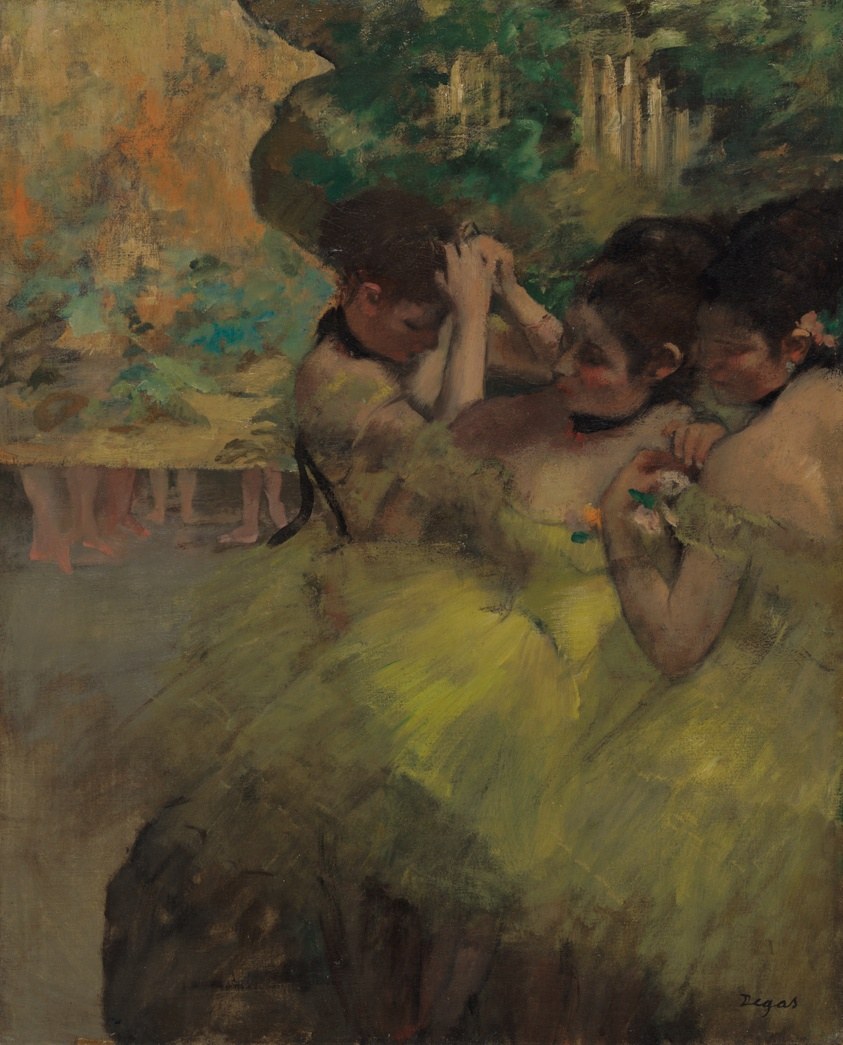
Three young dancers in pale yellow tutus are captured in a moment of repose or preparation, likely backstage or in the wings of a theatre, as the title suggests. The figure on the left adjusts her hair or headdress with both hands raised, her body angled away from the viewer. The two figures on the right are closer together, one with her arm around the other's shoulder in a gesture of intimacy or support. The setting is rendered in warm ochres and greens, with architectural elements—possibly columns or stage scenery—visible in the soft-focused background. The paint is applied loosely, with visible brushwork that gives the scene an immediacy and softness; the yellow of the tutus is rendered in broken strokes that suggest movement and light rather than describing the fabric precisely. A small detail of what may be a costume piece or prop appears in the lower foreground. The overall effect is one of private, unguarded moments between performers, away from the formal gaze of the stage.
The dancing
The three dancers are positioned at different depths, creating a sense of casual grouping rather than formal arrangement. The leftmost figure's raised arms and turned torso suggest she is adjusting her appearance—a moment of practical preparation rather than performance. The two figures on the right are in close proximity, with overlapping silhouettes and one arm slung across the other's back, suggesting companionship and the kind of physical ease that exists between dancers who work together. All three wear the standard ballet costume of the period: long, pale tutus and what appears to be fitted bodices. Their bodies are relaxed rather than extended; there is no sense of the turned-out positions or lifted carriage that characterise stage performance.
The dance depicted
This is a ballet scene, depicting the Paris Opéra ballet of the 1870s. The pale yellow tutus and the backstage setting are consistent with the Romantic and post-Romantic ballet tradition, though the loose, informal poses suggest this is not a moment of choreographed action but rather a glimpse of the dancers' lived experience. The painting captures what was a growing interest among artists of this period in the offstage world of dancers—their fatigue, their camaraderie, their bodies at rest. The work belongs to the tradition of Romantic ballet imagery, which emphasised the ethereal and otherworldly qualities of the female dancer, yet here that tradition is complicated by an interest in the banal reality behind the illusion.
How it was made
Oil on canvas, executed with loose, impressionistic brushwork that prioritises the effect of light and atmosphere over precise detail. The paint is layered thinly in places and more thickly in others, allowing the ground to show through in parts of the composition—particularly in the yellows and ochres of the background. This technique, which avoids sharp outlines and instead suggests form through colour and tone, was innovative for figure painting in the 1870s and reflects Degas's engagement with Impressionist methods, though his work remains more structured and drawing-based than pure Impressionism. The loose handling allows the viewer to read the scene quickly, in the manner of a sketch or study, which reinforces the sense of capturing a fleeting, private moment.
About this work
This is an oil painting by Edgar Degas, one of France's most significant painters of the nineteenth century, who made the world of professional ballet and its dancers a central focus of his artistic practice. The work depicts three dancers in pale yellow tutus in what appears to be a backstage or offstage moment—a subject that Degas returned to repeatedly throughout his career. Degas was fascinated by the ballet not as a grand theatrical spectacle but as a site of labour, skill, and the complex social and economic realities of women's work in performance. This painting exemplifies his approach: it captures a moment of intimate, unguarded interaction between dancers, rendered in loose, luminous brushwork that emphasises the play of light over anatomical precision. The work belongs to the collection of the Art Institute of Chicago and is dated to 1874, placing it in the early years of the artist's sustained engagement with ballet imagery.
How to look at it
The painting's composition is deliberately asymmetrical and intimate, inviting the viewer into a private, backstage moment that feels almost voyeuristic. Notice how the three dancers are clustered on the right side of the canvas, leaving much of the composition to the soft, warm background—a spatial arrangement that emphasises their isolation and the quiet of the moment. Look at the way Degas has rendered the yellow tutus not as bright, hard shapes but as soft, luminous form, created through broken brushwork and the interplay of warm and cool tones. The raised arms of the left figure create a sense of verticality and slight tension, contrasting with the resting, almost slumped posture of the figure on the right. This is not a moment of performance or spectacle, but a moment of bodily ease and fatigue—the kind of moment that only becomes visible in art when the artist chooses to look offstage.
The artist
Edgar Degas (1834–1917) was a French painter and printmaker associated with Impressionism, though he resisted the label and maintained a commitment to drawing and form that set him apart from his contemporaries. Beginning in the 1860s, Degas became obsessed with the ballet, making thousands of drawings, pastels, and paintings of dancers in rehearsal, performance, and offstage moments. Unlike many of his Impressionist peers, Degas worked from sketches and memory in the studio rather than from direct observation, and he employed a wide range of techniques—oil, pastel, printmaking, mixed media—to capture the movement and light of the ballet world. His ballet paintings are among the most celebrated works of the nineteenth century and established a new way of seeing dance as a subject for serious artistic attention. Degas was also a pioneering photographer and drew inspiration from photographic composition, particularly the cropped, asymmetrical framings and unusual viewpoints that appear in his ballet paintings.
The period
The 1870s were a period of significant change in European ballet. The Romantic era—with its emphasis on the ethereal ballerina, pointe work, and narrative spectacle—was giving way to a more eclectic aesthetic. In Paris, the Opéra Ballet under the direction of Saint-Léon was producing both classical revivals and new works that experimented with music, narrative, and spectacle. At the same time, Paris was experiencing rapid modernisation and social change, and artists were beginning to depict the modern city and its inhabitants in new ways. Degas's interest in ballet coincided with a broader fascination among avant-garde artists with the everyday life and labour of the city. In painting, Impressionism was emerging as a radical new approach, prioritising light, colour, and the fleeting moment over academic tradition. Degas's engagement with ballet imagery was thus both a continuation of academic subject matter—the human figure in motion—and a radical reimagining of it, through Impressionist techniques and a focus on the offstage, unglamorous reality of performance.
Where it lives
The painting is held by the Art Institute of Chicago, one of the major American museums with significant holdings of Degas's work. The museum acquired numerous paintings, drawings, and prints by Degas throughout the twentieth century, and his ballet imagery forms a key part of the institution's collection of nineteenth-century European art.
Dance in this work
Questions about this work
Why did Degas paint ballet dancers so often?
Degas was fascinated by the ballet as a subject that allowed him to explore movement, light, and the human figure—the core concerns of painting. But he was also interested in the ballet as a modern, urban institution, a place where working-class and lower-middle-class women laboured, often under difficult conditions. His repeated focus on offstage moments, rehearsals, and the mundane aspects of dancers' lives was a deliberate choice to represent the reality of performance, not its illusion.
Are the dancers identifiable?
No. Degas rarely named his subjects and often worked from sketches and memory rather than from life sittings. His dancers are typically composites, drawn from observation but not portraits of specific individuals. This anonymity was deliberate—it allowed him to focus on the type of the dancer, the moment, the light and movement, rather than on individual identity.
What kind of ballet is this?
This appears to be a moment from the classical ballet tradition of the Paris Opéra in the 1870s. The pale yellow tutus are characteristic of this period and setting. However, because the painting captures an offstage moment rather than a specific choreographed scene, it does not depict a particular ballet or style of dancing—rather, it depicts the world in which ballet was made and performed.
What does the loose brushwork mean?
The loose, impressionistic handling of paint was a relatively new approach for figure painting in the 1870s and reflects Degas's engagement with Impressionist methods. However, Degas maintained a stronger emphasis on drawing and structure than most Impressionists. The loose handling here serves to convey the softness and immediacy of the moment—the play of light on flesh and fabric—and also suggests that this is a sketch or study, a private glimpse rather than a finished performance.
More dance artwork





