49 works in this view — arrow keys or swipe to move between them.
Dance in Art
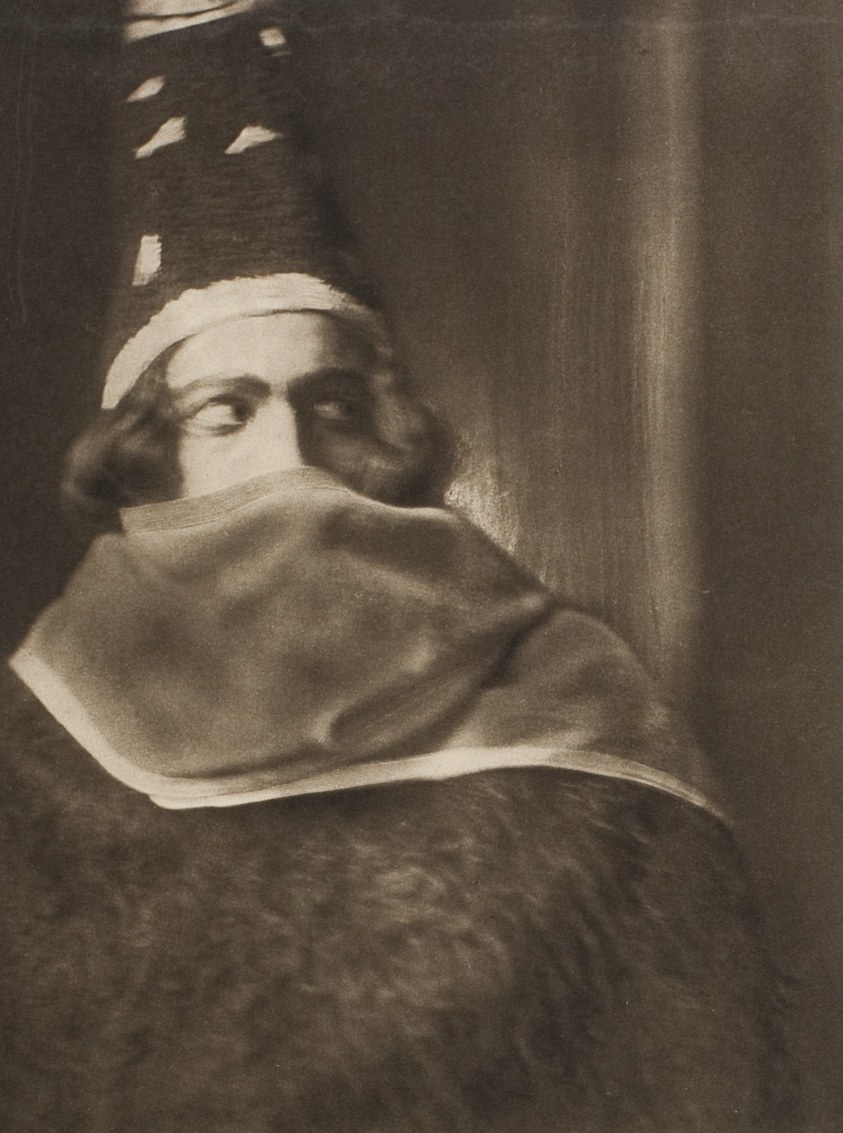
Adolf Bolm in Thamar (Monsieur Adolph Bolm, Thamar)
Emil Otto Hoppé English, born Germany, 1878–1972
- Medium:
- Photogravure, from the portfolio "Studies from the Russian Ballet"
- Collection:
- Photography and Media
- Source:
- Art Institute of Chicago
- Rights:
- Rights reserved by the holding institution — do not reuse without permission. Source record ↗
- Recorded as:
- AIC — rights reserved
Hoppé's photographs are among the most sophisticated visual records of the Ballets Russes, capturing the company's aesthetics of costume and character with a refinement that separates them from casual stage photography. This image in particular reveals how male dancers in the early 20th century were presented not as bodies in motion but as dramatic presences—a contrast to later modernist dance documentation that privileged movement. For anyone studying the Ballets Russes, the aesthetics of male dance in this period, or Hoppé's practice, this work is essential.
What you are looking at
A male dancer is photographed in three-quarter view against a dark, atmospheric background. He wears a wrapped turban or headpiece and a draped garment that swathes his torso and shoulders, leaving one arm bare. The fabric arrangement suggests a romantic or exotic costume of the early 20th century. His gaze is directed downward and inward, his posture introspective and dignified. The composition is intimate and portrait-like, with careful attention to the fall and weight of the drapery. The photogravure technique renders the image in warm sepia tones, with subtle gradations of light that model the form and create an almost sculptural effect. The setting is undefined—a stage or studio space suggested only by the shadowed backdrop.
The dancing
The dancer stands with weight settled, his body upright but contemplative. His face is partially obscured by the wrapped headpiece and by his lowered gaze. One arm is visible and appears relaxed at his side; the other is largely concealed by the voluminous draped fabric. There is no dynamic movement frozen in the frame—rather, a moment of stillness or repose. The overall impression is of nobility and introspection rather than kinetic energy. This is a presentation of the dancer's presence and costume, not of action.
The dance depicted
This is Adolf Bolm in the role of Thamar, from the Ballets Russes production of Mikhail Fokine's *Thamar* (1912). Bolm was a principal male dancer of the company and a celebrated performer of dramatic roles. *Thamar*, with music by Mily Balakirev and designs reflecting Caucasian and Russian orientalism, was a vehicle for both male and female soloists, and the costume shown here—turban, draped robes—reflects the exotic setting of the work. The image captures not the dance itself but the character and bearing of the role.
How it was made
This is a photogravure, a photomechanical printing process that combines photography with intaglio printing. The image is from Emil Otto Hoppé's portfolio *Studies from the Russian Ballet*, published around 1912–13. Photogravure allowed for extraordinarily fine tonal gradation and was valued for its ability to render delicate modulation of light and shadow; it was also a method suited to portfolio publication and distribution to the dance press and collectors. The technique and the portfolio format indicate this was a work of serious documentary ambition, aimed at dancers, critics, and theatregoers who wanted a record of the Ballets Russes.
About this work
This photogravure documents Adolf Bolm as the protagonist of Fokine's *Thamar*, one of the Ballets Russes' most ambitious orientalist works. It is one of a series of portrait studies by Hoppé, a leading photographer of theatrical dance in the early 20th century. Rather than depicting dance in action, it functions as a costume study and character portrait—recording not the movement but the visual and dramatic identity the dancer brought to the role. The work belongs in a gallery of dance art because it shows how dance performance, especially in the high romantic and orientalist tradition of the Ballets Russes, was built on the dancer's stillness, presence, and command of costume and character as much as on kinetic display.
How to look at it
Look at the relationship between the dancer's body and the fabric: how the turban and robes have been arranged to create a silhouette that is both monumental and vulnerable. Notice the direction of his gaze—downward and inward—which gives the image introspection rather than outward address. The lighting is calibrated to emphasize form and fabric texture rather than to flatten or dramatize; this is the work of a photographer thinking about how light models a three-dimensional object. The absence of movement or gesture is itself the point: this is a study in presence, not action. Finally, observe the slight asymmetry of the composition—the figure is not centered, and one side is more brightly lit than the other—which prevents the image from becoming a mere costume diagram and gives it psychological depth.
The artist
Emil Otto Hoppé (1878–1972) was a German-born photographer who became one of the most celebrated theatre and portrait photographers of the 20th century. Based in London, he was given access to major theatrical companies including the Ballets Russes, the London theatre, and the opera. He published several portfolios of dance and theatre photographs between 1912 and the 1920s, including *Studies from the Russian Ballet* and *The Russian Ballet in Western Europe*. His work combined pictorial sensitivity with documentary urgency, creating images that functioned simultaneously as art and as historical record. He was a member of the London Salon and exhibited internationally.
The period
In 1912, when this photograph was taken, the Ballets Russes under Sergei Diaghilev was at the height of its influence and innovation. Fokine's *Thamar*, which premiered in 1912, exemplified the company's investment in orientalist exoticism and dramatic narrative ballets, which departed from the classical plotless ballets of the Imperial Russian tradition. Male dancers in the Ballets Russes during this period were expected to be both dramatic actors and virtuosos; Bolm was celebrated for his dramatic intensity and for roles in works like *L'Après-midi d'un faune* and *Petrouchka*. Simultaneously, art photography was establishing itself as a serious medium, and the documentation of theatre through photography—especially through portfolio publication—was becoming a mark of cultural prestige.
Where it lives
This photogravure is held in the Photography and Media collection at the Art Institute of Chicago. It is one of a series of images from Hoppé's *Studies from the Russian Ballet*, a portfolio that documented the Ballets Russes' London and European seasons. The AIC's holdings of Hoppé's work are among the most comprehensive.
Dance in this work
Questions about this work
Who was Adolf Bolm?
Adolf Bolm (1884–1951) was a Russian-born dancer and choreographer who joined the Ballets Russes in 1909. He was Diaghilev's leading male dramatic dancer, celebrated for roles in works like *Petrouchka*, *L'Après-midi d'un faune*, and *The Rite of Spring*. He later founded his own companies in Chicago and Los Angeles and became an important figure in early 20th-century American modern dance.
What is *Thamar*?
*Thamar* is a one-act ballet choreographed by Michel Fokine with music by Mily Balakirev. It premiered with the Ballets Russes in 1912 and draws on a Georgian legend; the set and costumes reflected Caucasian and Russian orientalist aesthetics. The work is a vehicle for both a female and male lead and showcases dramatic mime and character dance rather than pure technique.
What is photogravure?
Photogravure is a printing process that combines photography with intaglio (etched metal plate) printing. A photographic image is transferred to a copper plate which is then etched with acid, creating fine lines of varying depth. The plate is inked and printed on a press, allowing for subtle gradations of tone. It was valued for art photography because it produced rich, nuanced images and allowed photographers to publish portfolios for wide distribution.
Why photograph dancers in stillness rather than action?
Early theatre photography was limited by slow film speeds and stage lighting, making action difficult to capture sharply. But stillness also served artistic purposes: it allowed viewers to study the dancer's bearing, the costume, and the character without the distraction of movement. For orientalist roles like *Thamar*, the exotic costume and noble repose were often more important to the aesthetic than the kinetics of the dance.
More dance artwork





