49 works in this view — arrow keys or swipe to move between them.
Dance in Art
Ballet
Edward Gorey American, 1925-2000
- Medium:
- Gouache on newspaper
- Collection:
- Prints and Drawings
- Source:
- Art Institute of Chicago
- Rights:
- Rights reserved by the holding institution — do not reuse without permission. Source record ↗
- Recorded as:
- AIC — rights reserved
The work exemplifies how mid-twentieth-century visual artists understood ballet not as a rarefied, separate world but as embedded within—and in tension with—the commercial and social machinery of contemporary life. For historians of dance imagery, it represents the growing ironic distance modernist artists maintained from nineteenth-century romantic ballet aesthetics, even as they continued to depict it.
What you are looking at
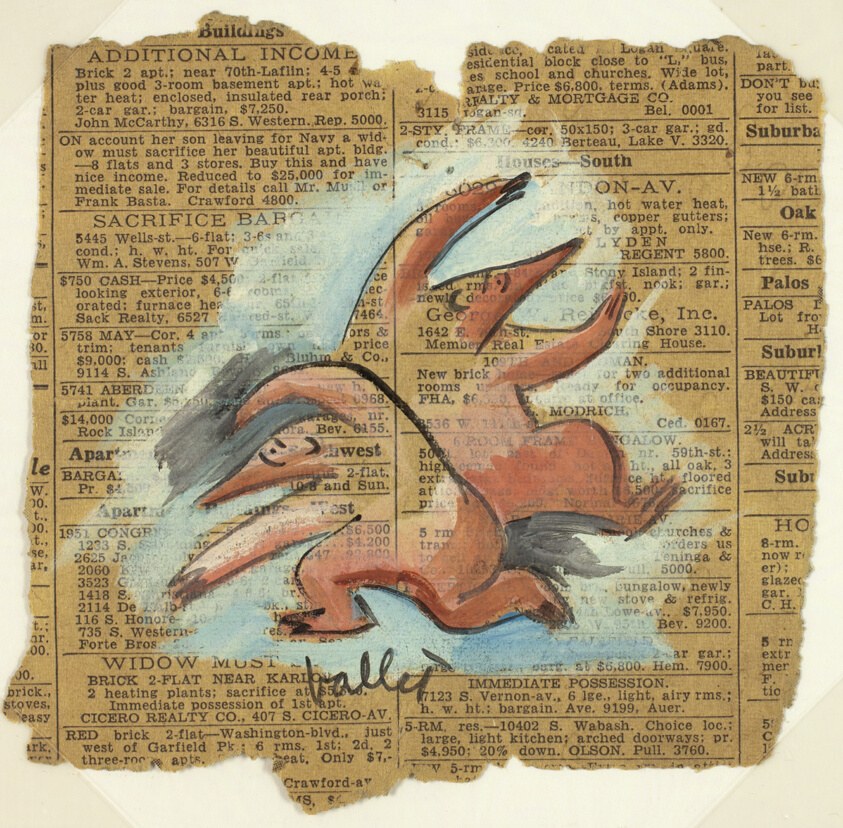
Three ballet dancers rendered in gouache on newspaper, their bodies arranged in a diagonal composition across the collaged surface. The figures are depicted in profile and three-quarter view, wearing classical ballet costumes—fitted bodices and full skirts—rendered in reddish-brown and peachy tones against the aged, cream-colored newsprint. The dancers appear caught mid-movement, their limbs extended in arabesque or attitude positions. Gorey's characteristic linear precision defines each figure despite the loose, almost sketch-like quality of the paint application. The newspaper underneath remains visible throughout, creating a deliberately fragmented, hybrid ground where classified advertisements and building listings form an ironic backdrop to the dancers' refined gestures. The work's compositional rhythm mirrors the staccato patterns of the printed text beneath.
The dancing
The three dancers display the hallmark verticality and elongation of classical ballet training. Each figure achieves a lifted, weightless quality through extended limbs and pointed feet. The nearest dancer to the viewer (bottom left) appears in a supported arabesque or attitude, with one leg extended behind and arms positioned in classical épaulement. The upper two figures maintain similar balletic extensions, with one leg raised and bodies held in the upright, refined carriage expected of ballet training. Gorey's line work emphasizes the straight geometry of ballet positions—straight backs, pulled-up torsos, and clean extensions—rather than anatomical softness.
The dance depicted
This work depicts classical ballet, recognizable through the pointe shoes implied by the pointed feet, the tutus, the arabesque and attitude positions, and the upright carriage of trained dancers. The piece appears to reference or depict Romantic or Classical ballet repertoire from the nineteenth century based on the costume silhouettes and the idealized, ethereal quality Gorey has emphasized. The composition suggests a moment of repose or a formal pose rather than rapid action—the dancers held in the suspended attitudes that define ballet's aesthetic of effortless elevation and control.
How it was made
Gouache applied directly onto newspaper—a deliberately collage-like approach that combines painting with found material. The newspaper remains legible and active as a compositional element rather than being fully obscured, creating a tension between the refined subject of ballet and the mundane, utilitarian ephemera beneath. Gouache's opacity and matte finish allow for clear definition despite being applied over printed text, and its quick-drying properties suit this experimental, immediate approach. This technique suggests a mid-twentieth-century modernist sensibility, combining fine art with vernacular materials in a manner associated with early-to-mid-century avant-garde practice.
About this work
Edward Gorey's *Ballet* overlays three figures in classical ballet positions onto a collage of newspaper clippings—a juxtaposition that locates the timeless refinement of ballet within the material reality of the everyday world. The work dates to 1945, a moment when American artists were experimenting with mixed media and challenging the boundaries between "high" art and vernacular culture. By positioning ethereal, formally trained ballet dancers against prosaic real estate listings and classified advertisements, Gorey creates a visual irony that questions both the social status of ballet and the competing demands for space and attention in modern life.
How to look at it
Notice how the newspaper remains readable throughout—advertisements for apartments and businesses continue visibly behind the dancers. This is not an accident but a compositional choice that forces the viewer to read both registers simultaneously: the ideal, elevated world of ballet and the material world of property, commerce, and survival. The dancers' classical positions are rendered with Gorey's meticulous line work, which emphasizes geometry and form over naturalism, making them appear almost diagrammatic against the chaotic texture of text. The viewer should attend to the tension this creates—refinement against ordinariness, verticality against horizontal text, the timeless against the temporally specific.
The artist
Edward Gorey (1925–2000) was an American visual artist, illustrator, and writer known for his distinctive linear style, darkly comic sensibility, and fascination with theatrical design and performance. Though widely recognized for his illustrated books and macabre sensibility, Gorey maintained a serious engagement with dance and the performing arts throughout his career. His work frequently explores the relationship between the body, costume, and narrative, blending high art references with vernacular imagery in ways that challenge hierarchies of taste.
The period
In 1945, as World War II concluded, American art was engaged in vigorous debates about modernism, abstraction, and the role of figuration. Artists like Gorey were exploring collage techniques and mixed media inspired by Cubism and Dada, techniques that had begun circulating more widely in American artistic practice. Simultaneously, ballet was undergoing significant transformation in America: the American Ballet Theatre and other companies were establishing ballet as a central American art form, even as some artists and intellectuals regarded it with ambivalence as an imported, European tradition. Gorey's layering of ballet imagery with newspaper suggests skepticism toward ballet's claims to transcendence.
Where it lives
The work is held by the Art Institute of Chicago in its Prints and Drawings collection, catalogued as a gouache work on newspaper from 1945. As a work on newspaper—a found, ephemeral material—it represents the kind of experimental practice that museums often acquired during the postwar period as modernism and avant-garde methods became established within institutional collecting.
Dance in this work
Questions about this work
Why did Gorey paint ballet dancers on newspaper?
The juxtaposition creates deliberate irony: ballet is conventionally understood as an art of transcendence and timelessness, but Gorey grounds it in the ordinary, commercial reality of the newspaper page. This technique was common among mid-century modernists exploring the relationships between fine art and mass culture. The newspaper refuses to disappear behind the dancers, forcing viewers to acknowledge both registers at once.
Is this a finished work or a study?
The work appears intentional and complete in its concept, even though it employs a spare, sketch-like technique. The dialogue between the gouache and the newspaper is clearly orchestrated, suggesting this is a finished artistic statement rather than a preparatory study. Gorey's characteristic approach often privileged economy of line and deliberate incompleteness as aesthetic choices.
What is gouache and why did Gorey choose it?
Gouache is an opaque, water-based paint that dries quickly to a matte finish. Its opacity makes it ideal for working over newspaper text while still allowing the text to remain visible—a semi-transparent approach would obscure the point of the collage. The medium's immediacy and flatness suit Gorey's linear, graphic sensibility.
More dance artwork





