49 works in this view — arrow keys or swipe to move between them.
Dance in Art
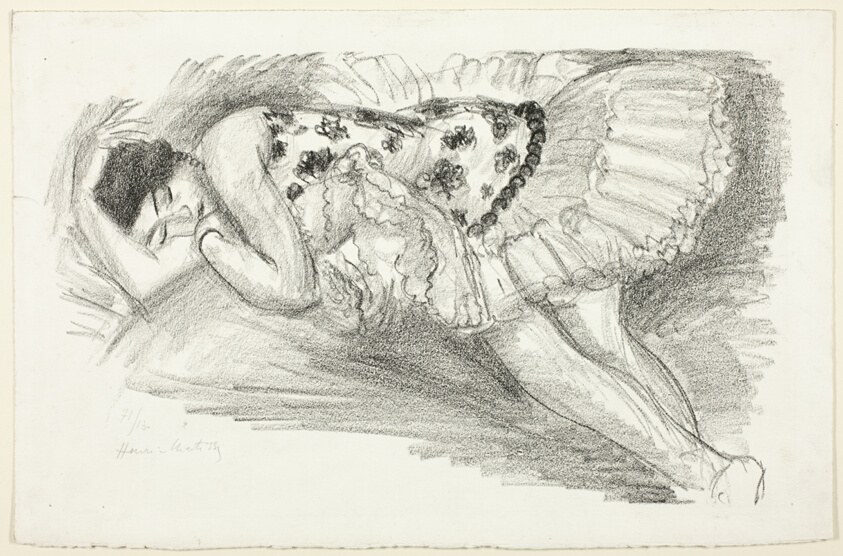
Ballet Dancer, from Ten Dancers
Henri Matisse French, 1869-1954
- Medium:
- Lithograph in black on ivory wove paper
- Collection:
- Prints and Drawings
- Source:
- Art Institute of Chicago
- Rights:
- Rights reserved by the holding institution — do not reuse without permission. Source record ↗
- Recorded as:
- AIC — rights reserved
Matisse's dance prints are rare evidence of how a major modernist painter understood the dancer's body—not as an idealized abstraction but as weight, fabric, and spatial presence. This reclining figure reveals a side of early 20th-century ballet rarely captured: not virtuosity or spectacle, but rest and interiority, suggesting that Matisse was observing dancers in their working reality, not just performance moments.
What you are looking at
A single female dancer reclines or lies in a languid, reclining pose against cushioned support, her body weight settled into deep repose. She wears what appears to be a short tunic or dance dress with a decorative spotted or patterned bodice, and her legs extend with relaxed elegance. The composition is intimate and close, almost reclining-room rather than stage, rendered in precise graphite with careful attention to the fall of fabric and the curve of the body. The drawing uses soft shading to model the forms and emphasizes the dancer's ease and repose—this is not an active moment but one of rest or theatrical languor, possibly between movements or in a scene demanding stillness.
The dancing
A single dancer, viewed in three-quarter perspective as she reclines. Her upper body is propped on one elbow or rests against cushioning; her legs are extended and relaxed. The posture is one of complete ease, with no tension in the frame—weight is entirely settled. The arms are gently positioned without strain. This is a figure at rest or in a pose of deliberate repose, far from the vertical uprightness or dynamic tension typical of classical ballet technique.
The dance depicted
This appears to be a figure from Romantic ballet or from early 20th-century theatrical dance that incorporated reclining or repose poses. The languid, horizontal pose suggests either a dream sequence, a scene of enchantment or supernatural rest (common in Romantic ballet), or a moment of theatrical stillness. The dress—short, decorated—is consistent with early 20th-century ballet costuming. Without additional context or inscription, it is difficult to identify a specific ballet, but the aesthetic aligns with the early 1900s when Matisse was documenting contemporary theatrical subjects.
How it was made
A lithograph in black on ivory wove paper, a printmaking technique that allowed for fine tonal gradations and was well-suited to capturing both sharp detail and soft modeling. Lithography was favored for theatrical prints and artist portfolios in the early 20th century, permitting relatively wide circulation among collectors and dance enthusiasts. Matisse's use of the medium here shows his ability to render fabric and bodily weight through careful shading and line, creating a sense of solidity and ease that a photographic document might miss.
About this work
This is one of ten lithographs Matisse created documenting ballet dancers, probably around 1927, a period when he was intensely engaged with theatrical subjects. The series captures not the dynamism of performance but moments of rest, pose, and private physical ease. This particular sheet shows a dancer in absolute repose, reclining against cushions in a pose of deep relaxation or theatrical languor. The work sits at the intersection of fine art and dance documentation—not a narrative scene but a study of the human figure in a specific theatrical context, made by one of the period's most formal and analytical artists.
How to look at it
Attend to the complete absence of dynamic tension in this figure. There is no turnout, no lift, no readiness—this is a body at absolute rest, settled into support. The artist has chosen a moment of non-performance, which is itself significant: it tells us that Matisse was interested in how dancers inhabited their bodies when not moving. Notice how carefully the lithographic line models the weight of the thigh and the softness of the cushioning—this is not a quick sketch but a studied observation of how gravity and fabric work together.
The artist
Henri Matisse (1869–1954) was deeply invested in the human figure throughout his career and regularly drew from live models and theatrical observation. In the 1920s, he created works on dance subjects, including designs for theatrical productions and studies of performers. His approach was analytical and intimate—he sought to understand bodily form and movement through careful study rather than impressionistic capture. This series of ten dancers reflects his practice of sustained observation and his conviction that drawing from life was central to modernist practice.
The period
By 1927, ballet had undergone significant change since its Romantic heyday. The Ballets Russes and other avant-garde companies were experimenting with new movement vocabularies and theatrical forms. Simultaneously, modernist artists (including Matisse, Picasso, and others) were returning to figurative drawing after years of abstraction, treating the human form with renewed formal attention. In this context, Matisse's dance series represents a moment when high modernism and theatrical observation converged—artists were studying dancers not as narrative subjects but as problems in form and movement.
Where it lives
This work belongs to the Art Institute of Chicago's Prints and Drawings collection. It is one of a series of ten ballet studies, suggesting it was part of a deliberate documentary or artistic project rather than a single commission.
Dance in this work
Questions about this work
Is this a specific ballet or a generic study?
Without inscriptions or additional documentation, the specific ballet cannot be identified with certainty. The work is labeled as one of ten dancers, suggesting Matisse created a series of studies, possibly from observation of rehearsals or performances. The reclining pose and decorated tunic are consistent with early 20th-century ballet costuming but do not point to a single known work.
Why is the dancer reclining rather than dancing?
This may represent a theatrical moment—a dream, enchantment, or scene of rest. Alternatively, Matisse may have chosen this pose as a study of the dancer's body in repose, exploring how weight and fabric behave when tension is removed. His interest in the figure as a formal problem, not as narrative spectacle, suggests the latter.
What does a lithograph tell us that a photograph wouldn't?
Lithography allowed Matisse to select and emphasize what he considered essential: the volume of the body, the character of the pose, the fall of fabric. A photograph records everything; a lithograph interprets. This image shows Matisse's judgment about what matters in this moment.
More dance artwork





