49 works in this view — arrow keys or swipe to move between them.
Dance in Art
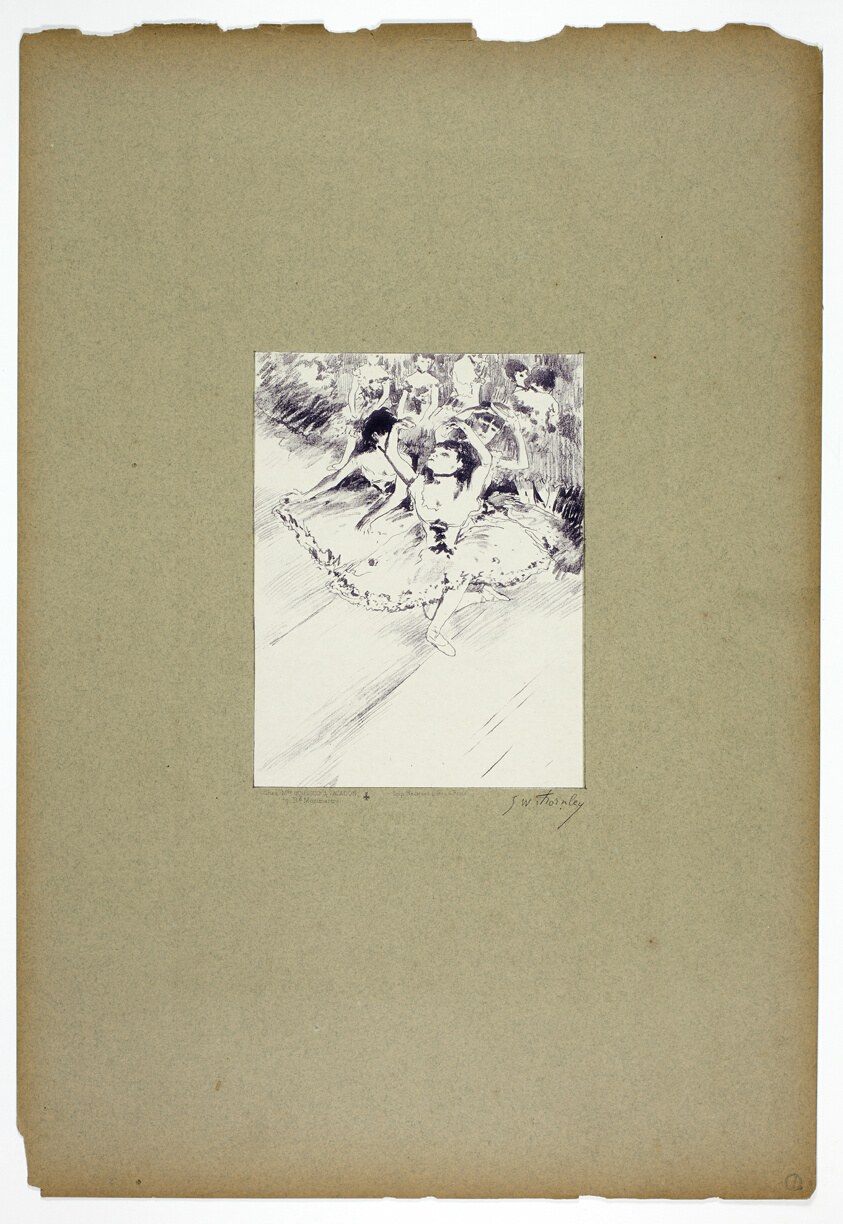
Ballet Practice
Georges-William Thornley (French, 1857-1935) after Edgar Degas (French, 1834-1917) printed by Atelier Becquet (French, 19th century) published by Boussod, Valadon, & Company (French, 18th-19th century)
- Medium:
- Lithograph in purple on paper
- Collection:
- Prints and Drawings
- Source:
- Art Institute of Chicago
- Rights:
- Public domain — free to use, share and adapt.
- Recorded as:
- CC0 (Public Domain)
Degas's ballet scenes fundamentally changed how artists saw theatrical dancers: not as idealized bodies performing for an audience, but as working athletes and craftspeople. For dancers and dance historians, these images matter because they document the actual practice, costuming, and spatial experience of nineteenth-century ballet, and because Degas's formal innovations—the cropped frame, the tilted space, the casual asymmetry—influenced how dance itself came to be understood as a modern subject.
What you are looking at
Two ballet dancers in practice costume occupy the center of this lithographic composition. The figure on the left wears a tutu and extends her leg in a développé or arabesque position, her body angled away from the viewer. At right, a second dancer in similar dress gazes upward, her posture suggesting she watches or responds to her partner's movement. The setting is loosely indicated—hatched lines suggest a studio interior or stage floor beneath them, while the background is sketched with quick, economical strokes that evoke other dancers or studio fixtures. The medium is purple lithographic ink on cream paper, applied with varied pressure: some areas show fine, delicate line work in the faces and upper bodies, while the lower portions and background are more heavily worked with bold parallel hatching. The sheet is mounted on tan paper in the collection's tradition.
The dancing
Both dancers display the elongated line and lifted carriage characteristic of ballet vocabulary. The left figure's raised leg is turned out and extended high, with her supporting leg straight and her upper body held in classical alignment—a position requiring significant technique and training. The right figure's head tilt and gaze suggest an attentive, engaged presence. Neither dancer is in a closed partnered hold; instead, they share the space as two soloists, each absorbed in the practice or performance of her own movement. The composition emphasizes verticality and the extended line of the body.
The dance depicted
This is ballet—specifically, a ballet practice or rehearsal scene, a subject Edgar Degas returned to repeatedly throughout his career. The tutu, the turned-out positions, and the vocabulary of the extended leg are unmistakable markers of nineteenth-century classical ballet technique. The setting and informality of the poses suggest rehearsal rather than performance. Ballet was the dominant theatrical dance form in Paris during the 1880s when this work was made, and scenes of dancers in the studio or backstage offered artists both intimate access to a popular spectacle and a motif ripe for formal experiment.
How it was made
This is a lithograph printed in purple ink by the Atelier Becquet after a composition by Edgar Degas. Thornley was a prolific printmaker known for translating Degas's paintings and pastels into lithographic form, which allowed wider distribution to a collecting audience. Lithography's sensitive responsiveness to crayon and pressure meant that Thornley could capture Degas's characteristic handling: the sketchy, searching line in the faces, the bold geometric hatching that structures space, and the asymmetrical composition that suggests the momentary glimpse rather than a posed tableau. The purple ink—rare among lithographs—gives the image an unusual warmth and suggests a deliberate aesthetic choice rather than technical necessity.
About this work
This is a ballet studio scene rendered in purple lithographic ink, after Edgar Degas's exploration of backstage and rehearsal life at the Paris Opéra. Degas's fascination with the ballet was not primarily about spectacle or performance; instead, he was drawn to the fractional moments of practice, the casual postures of dancers between takes, and the geometric possibilities of the extended human body in motion. His compositions often crop figures, tilt horizons, and emphasize an almost photographic immediacy—the sense of having caught the subject unaware. Thornley's lithographic translation preserves this directness while adding the texture and tonal range of the medium. The work belongs to a tradition of artists recording modern theatrical practice, but Degas's particular gift was to find in the ballet studio a subject worthy of the formal and philosophical seriousness he brought to history painting.
How to look at it
Look at the balance between the two figures: they do not form a traditional group or symmetric composition, but rather share the space as two separate moments of attention. Notice the tilt of the right dancer's head—it suggests a gaze, a consciousness, rather than mere posture. The hatching that structures the floor and background creates a sense of space that is flattened and tilted, closer to the viewer than conventional perspective would allow. This distortion makes the dancers feel imminent and real. Finally, attend to the purple tone itself: it is neither the black of a traditional engraving nor the warm brown of chalk, but something that suggests the particular light of a studio interior or the colored casts of stage lighting.
The artist
Georges-William Thornley (1857–1935) was a French printmaker and painter who specialized in translating the works of other artists, particularly Degas and Monet, into lithographic form. Working from Degas's compositions—sometimes with the artist's authorization, sometimes not—Thornley created hundreds of prints that circulated widely among collectors and museum visitors. His technical mastery of lithography and his sensitivity to Degas's handling made these translations valued objects in their own right, not mere reproductions. Thornley was part of a larger ecosystem of printmaking that allowed avant-garde works to reach audiences who could not afford originals.
The period
The 1880s saw the ballet at the height of its prestige in Paris and the Romantic tradition giving way to a new realism. Degas's work coincided with—and helped to shape—a broader artistic interest in modern life, unidealized bodies, and the spaces of theatrical production. At the same time, Impressionism and its aftermath were pushing painters toward more radical formal experiment: asymmetrical framing, the influence of photography and Japanese prints, and a new attention to light and color. Ballet provided an ideal subject because it contained all of these interests: modern spectacle, the moving body, the play of stage light, and the geometric possibilities of line and posture. Lithography as a medium was experiencing a renaissance in this period, championed by artists like Toulouse-Lautrec who saw it as capable of capturing the immediacy and spontaneity of modern experience.
Where it lives
This lithograph is part of the Art Institute of Chicago's Prints and Drawings collection. It was published by Boussod, Valadon & Company, a major art dealer and print publisher in late-nineteenth-century Paris, which ensured its circulation among collectors and institutions across Europe and North America.
Dance in this work
Questions about this work
Is this an original Degas?
No. This is a lithograph by Georges-William Thornley after a painting or drawing by Edgar Degas. Thornley was an authorized translator of Degas's work into print form, and these lithographs were highly valued in their own time as skillful interpretations. They are original artworks in their own right—not mechanical reproductions, but handmade translations that required significant technical ability.
What are the dancers doing?
They appear to be in a rehearsal or practice session, not performing on stage. The left dancer is executing a développé or similar extended leg position, while the right dancer observes or attends to her own movement. Ballet practice in this era was a rigorous, repetitive process of perfecting vocabulary, and Degas often captured these intimate moments of work.
Why purple instead of black?
The choice of purple ink is unusual and deliberate. It may reference the atmospheric effect of stage lighting or the particular tonality of a studio interior. Lithography allowed printmakers to experiment with colored inks, and Thornley's choice suggests an interest in capturing Degas's attention to light and color, not just his compositional innovation.
When and where was this made?
The print was made in 1889 in Paris by the Atelier Becquet and published by Boussod, Valadon & Company. This places it near the height of Impressionism and during a period of intense experimentation with printmaking as a modern medium.
More dance artwork





