49 works in this view — arrow keys or swipe to move between them.
Dance in Art
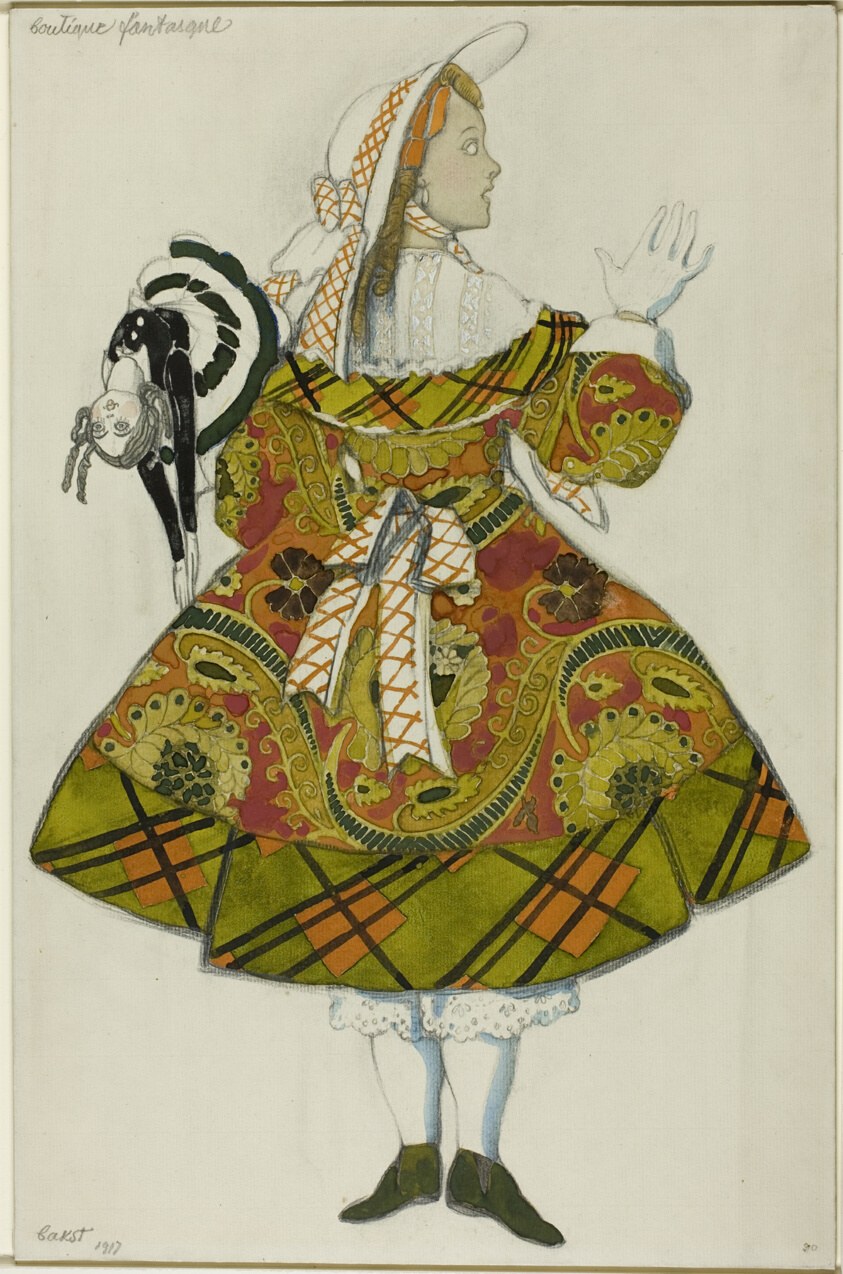
Costume Design for Girl in a Green Dress, for Ballet Boutique Fantasque
Léon Bakst Russian, 1868-1924
- Medium:
- Watercolor, gouache and graphite on ivory laid paper laid down on gray board
- Collection:
- Prints and Drawings
- Source:
- Art Institute of Chicago
- Rights:
- Rights reserved by the holding institution — do not reuse without permission. Source record ↗
- Recorded as:
- AIC — rights reserved
Bakst was one of the twentieth century's most influential theatre designers, and his costume work for the Ballets Russes established visual conventions for theatrical dance that persist today. This design exemplifies his method: the costume is not historical dress, nor is it purely fantastical, but rather a constructed image that uses color, pattern, and silhouette to communicate character and mood. For historians, the sheet documents the labour of costume design as a collaborative practice—this drawing was a communication from designer to maker, a blueprint for bodies on stage.
What you are looking at
A single figure in three-quarter profile, facing right, stands against a plain cream ground. She wears an elaborate costume of vivid greens, oranges, and reds in an ornamental pattern featuring floral and scrollwork motifs. The dress has a voluminous skirt with a complex plaid or tartan pattern in olive, yellow, and black, with cartouche-like decorative panels across the bodice in red, gold, and green. Over her shoulders drapes a shawl or mantle with similar ornamental patterning. Her headwear is a tall, elegant headdress combining a transparent white lace coif with an orange and gold wrapped crown element; a long white veil or scarf trails from the back. Her left arm gestures outward and upward in an expressive, open movement; her right arm is raised with hand extended, suggesting animation or emphasis. She wears white stockings and dark green shoes. In her left hand she holds a large feathered ornament—a fan or theatrical prop composed of black feathers with white quills arranged in a dramatic arc. The execution is refined watercolor and gouache over graphite, with careful attention to pattern, color harmony, and the three-dimensional volume of the costume.
The dancing
A single dancer is depicted in a pose of theatrical expressiveness. Her torso is erect and turned in profile; her left arm extends outward with an open palm, the gesture suggesting a moment of revelation or presentation to an audience. Her right arm is raised, the hand open. The weight appears centered, with no indication of active footwork—this is a posed, frontal presentation moment rather than a captured action. The silhouette emphasizes the costume's sculptural mass, the voluminous skirt and layered upper body dominating the compositional space.
The dance depicted
This is a costume design for a character in *Ballets Russes* repertory, specifically for Léon Bakst's *Ballet Boutique Fantasque* (1919). The figure is likely a character dancer or member of an ensemble in a work known for its fantastical, colorful aesthetic. The elaborate fantasy costume—with its non-European patterning, rich color, and theatrical ornamentation—is consistent with Bakst's approach to designing for the avant-garde ballet of the 1910s and early 1920s. The pose is a designer's presentation attitude rather than a captured movement; the work documents how the dancer was meant to appear on stage, not how she danced.
How it was made
The work is executed in watercolor and gouache over graphite on cream laid paper. Bakst used these materials frequently for costume designs intended for theatre production: they allowed rapid color development, could be revised easily, and reproduced legibly in the theatre's working copies. The transparency of watercolor beneath opaque gouache creates luminosity in the ornamental details while maintaining crisp definition in the linear patterning. This is a working design document, not a finished artwork for exhibition.
About this work
This is a costume design by Léon Bakst for *Ballet Boutique Fantasque*, a Ballets Russes production of 1919. It depicts a single figure in theatrical dress, shown in a posed, frontal attitude rather than mid-movement. The design is remarkable for its synthesis of historical reference, fantastical invention, and chromatic sophistication—the costume integrates plaid patterning with exotic ornamental motifs, suggesting a character who belongs to a stylized, theatrical world rather than a geographical one. Bakst's costume designs were as important to the success of the Ballets Russes as the choreography itself; they transformed the dancer's body into a complete aesthetic object and signaled the company's commitment to visual innovation. This sheet shows that commitment in miniature: every element—proportions, color, pattern, ornamentation—is deliberate and decorative.
How to look at it
Look at the orchestration of colour first: the greens, oranges, and reds are not realistic but harmonious, creating a sense of controlled intensity. The pattern is layered—large plaid geometry beneath smaller floral and scrollwork ornaments—which creates spatial depth and prevents the eye from settling on any single element. Notice the headdress: it is architecturally complex, combining practical elements (the transparent coif that would protect the dancer's hair) with fantastical ornament (the wrapped crown, the trailing veil). The gesture of the arms is restrained and frontal—this is not a photograph of movement but a designer's presentation of the character's silhouette and bearing. The pose tells you that Bakst understood his role as extending, not illustrating, the choreography.
The artist
Léon Bakst (1868–1924) was a Russian painter, designer, and illustrator who became the visual architect of the Ballets Russes. Working with impresario Sergei Diaghilev from the company's founding in 1909, Bakst designed costumes and scenery for some of the twentieth century's most influential ballets, including *The Firebird*, *Scheherazade*, and *L'Après-midi d'un faune*. His approach to costume design was revolutionary: he understood the costume as an extension of the dancer's movement vocabulary, using colour, silhouette, and ornamental detail to amplify the choreographer's intentions. His designs appeared in exhibitions, in theatrical journals, and in reproductions; they influenced fashion, interior design, and graphic art. Though he moved to Paris after the Russian Revolution, his work remained rooted in Russian aesthetic principles and his training at the St. Petersburg Academy of Arts.
The period
The Ballets Russes operated from 1909 to 1929 and fundamentally transformed attitudes toward theatrical dance in Europe and America. In the 1910s and 1920s, ballet was no longer seen as a secondary spectacle but as a serious art form equal to painting and music—this shift was partly visual. Bakst's costumes were partly responsible: they demonstrated that dance design could be as innovative and labour-intensive as any other visual art. At the time this design was made (1915, though the production was realized in 1919), European theatre was experimenting with non-naturalistic costume and set design; the Futurists, Expressionists, and Constructivists were all developing new visual vocabularies. Bakst's work, rooted in Russian Imperial aesthetics, colour theory, and historical research, represented a different modernist approach—decorative, sensuous, and deeply learned.
Where it lives
The work is held in the Prints and Drawings collection of the Art Institute of Chicago, where it is catalogued as a costume design on paper. It is a working design document produced for theatrical production, not an autonomous artwork.
Dance in this work
Questions about this work
What is Ballet Boutique Fantasque?
*Ballet Boutique Fantasque* (also known as *The Boutique Fantasque*) was a comic ballet choreographed by Michel Fokine with music by Gioachino Rossini, first produced by the Ballets Russes in 1919. It is set in a small shop filled with magical dolls and toys that come to life. The ballet is lighter in tone than many Ballets Russes productions and showcases character dances and pantomime alongside classical ballet technique.
Who was Léon Bakst?
Bakst (1868–1924) was a Russian painter and theatre designer who became the visual director of the Ballets Russes under Sergei Diaghilev. He designed costumes and sets for most of the company's landmark productions and was widely influential in fashion and the decorative arts. His work synthesized Russian Imperial aesthetics with modernist innovation.
How were Bakst's designs used in production?
Bakst created designs like this one as working documents for the theatre's costume makers and dressers. The designs were photographed or printed and given to seamstresses who would construct the garments. Bakst also supervised fitting and made revisions. His designs were carefully annotated with colour notes and specific construction details.
What does the costume tell us about the character?
The costume is fantastical and decorative rather than historically or geographically specific. The combination of plaid patterning, floral ornament, and the elaborate headdress suggests a character from a magical or theatrical realm. The voluminous skirt and ornamented bodice indicate a character of some importance or distinction within the ballet's narrative.
More dance artwork





