49 works in this view — arrow keys or swipe to move between them.
Dance in Art
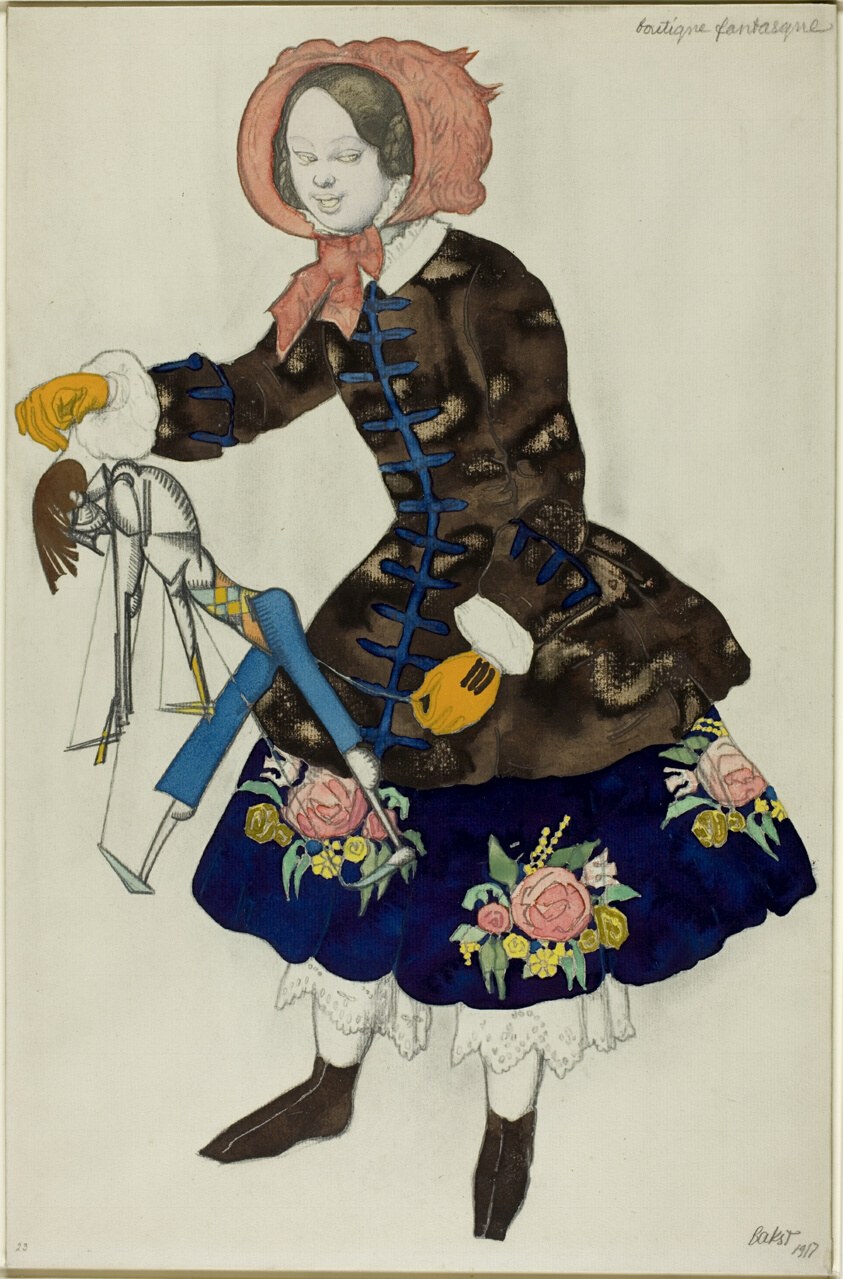
Costume Design for Young Woman in Red Bonnet, for Ballet Boutique Fantasque
Léon Bakst Russian, 1868-1924
- Medium:
- Watercolor and graphite with gouache, on ivory laid paper laid down on gray board
- Collection:
- Prints and Drawings
- Source:
- Art Institute of Chicago
- Rights:
- Rights reserved by the holding institution — do not reuse without permission. Source record ↗
- Recorded as:
- AIC — rights reserved
Bakst's designs were revolutionary: they moved beyond prettiness toward psychological specificity and spatial drama, influencing how dancers understood their own bodies and how audiences read character and emotion in ballet. This drawing shows a master designer at the peak of his powers, synthesizing folk ornament, classical training, and theatrical fantasy into a single, coherent image of a performer. The work also documents a moment when costume design was recognized as central to choreography—not decoration, but meaning.
What you are looking at
A young woman in an elaborate costume stands in a three-quarter pose against a neutral ground, holding a delicate fan with yellow and white ostrich plumes in her raised right hand. She wears a rust-red bonnet tied with a ribbon bow beneath her chin, framing a pale face with downturned eyes and a slight smile. Her brown jacket, decorated with gold embroidery and blue frogged fastenings down the front, fits closely at the waist above a striking navy skirt embroidered with pink roses and yellow leaves in a dense floral pattern. White lace or linen fringe trims the hem of the skirt. Her legs are clad in blue stockings, and brown shoes anchor her grounded stance. The costume reads as a fantastical or theatrical interpretation of a young peasant woman or folk character, rendered with the jewel-toned palette and ornamental detail typical of early 20th-century theatrical design.
The dancing
The single figure is poised in a relaxed, three-quarter stance with weight evenly distributed. Her right arm is raised and extended to present the fan, the hand opening gracefully; her left arm hangs at her side. The pose is balletic in its refinement and elongation, avoiding any stiffness or natural ease—this is a figure composed for display rather than caught in motion. The downturned gaze and slight smile suggest a moment of coquetry or modest pleasure, consistent with a character in a romantic or whimsical scene.
The dance depicted
This is a costume design for a theatrical ballet role, most likely from a comic or fantastical ballet of the early 20th century. The title's reference to "Boutique Fantasque" (The Fantastic Toyshop) and the costume's playful folk-peasant aesthetic suggest a character from a lighter, plotted ballet rather than abstract classical work. The figure's refined posture and balletic bearing indicate a dancer trained in classical technique, but the costume—rural, ornamental, and deliberately picturesque—signals a character role rather than a prima ballerina en tulle. The fan is an accessory of flirtation and charm, essential to how such a character would move and relate to other dancers on stage.
How it was made
This watercolor and gouache drawing on laid paper, mounted on board, is a working design document created by hand in the atelier tradition. The technique allows Bakst to achieve the translucent layering visible in the skirt's embroidered flowers and the bonnet's soft texture while using opaque gouache for the jacket's sculptural folds and the figure's face. The precision of the graphite underdrawing, visible in the fan's structure and the garment's seams, shows the designer's commitment to technical accuracy—a costume must be constructed from such drawings. The watercolor medium and the small scale suggest this was one of many designs in a series, circulated among the theatre's workshop, dancers, and collaborators rather than intended as a finished artwork for sale or exhibition.
About this work
This is Léon Bakst's costume design for a named character—a young woman in a red bonnet—in the 1917 ballet *Boutique Fantasque*. Bakst, the Ballets Russes' most celebrated designer, created hundreds of such drawings to realize his vision of how performers should appear in space and movement. The drawing is simultaneously a technical specification for tailors and seamstresses, a visual communication to the dancer about character and bearing, and a record of a specific theatrical moment in early 20th-century dance.
The work belongs in a gallery of dance not because it depicts a step or a formal pose, but because it documents the physical language of a role—how a character looks, stands, and moves through space with an object. The costume design is the dancer's partner; it teaches the body its shape and permits or constrains its movement. To see the costume is to know something true about how the dance was performed.
How to look at it
Attend first to the costume's visual architecture: the way the jacket's structured folds and blue fastenings anchor the figure above the explosive floral embroidery of the skirt, creating a visual center of gravity. The bonnet frames and isolates the face, directing our gaze downward toward the fan in the raised hand—a moment of presentation or charm. Notice that nothing here is naturalistic: the colors are heightened, the proportions are balletic, the ornament is dense and artificial. This is a costume that teaches a performer how to move—the raised arm invites a flow of motion; the long skirt invites a kind of turning or walking that would show off the embroidery. The artist chose to show the figure standing still, but the stillness is a pose, not a rest.
The artist
Léon Bakst (1868–1924) was a Russian painter and designer who became the visual architect of the Ballets Russes, Sergei Diaghilev's company. Beginning in 1909, Bakst designed costumes and scenery for dozens of productions, establishing a new standard for theatrical design: integrated, psychologically acute, and informed by scholarship in historical dress, ethnography, and modernist color theory. His designs were reproduced in journals, exhibited in salons, and widely influential among artists and designers of the period. By 1917, when this drawing was made, Bakst had already created the costumes for *Firebird*, *Scheherazade*, *L'Après-midi d'un faune*, and many others. He worked primarily in watercolor and gouache, producing hundreds of studies that were at once practical workshop documents and finished artistic statements.
The period
In 1917, ballet was undergoing rapid stylistic change. The Ballets Russes had moved away from the narrative spectacle of *Firebird* and *Scheherazade* toward more intimate, modernist works and toward a revival of comic, character-driven ballets rooted in Russian folk traditions and 18th-century commedia dell'arte. *Boutique Fantasque* itself, with a score by Rossini-Respighi and choreography by Léonide Massine, exemplified this turn toward lightness, humor, and theatrical artifice. The first World War was ongoing; the Russian Revolution had just occurred; yet the Ballets Russes continued to innovate and tour. Costume design in this period was understood as a primary medium of artistic vision, equal to music and choreography. Bakst's watercolors were exhibited, reproduced, and collected as works of art in their own right, not merely as technical documents.
Where it lives
The drawing is held in the Prints and Drawings collection at the Art Institute of Chicago, source AIC. As a working costume design from a major theatrical production, it represents one of hundreds of such documents that Bakst created over his career—some preserved in museum collections, others dispersed or lost. The mounting on gray board suggests conservation and curation as a fine art object, consistent with how Bakst's designs were valued during and immediately after his lifetime.
Dance in this work
Questions about this work
What ballet is this costume for?
The title identifies this as a design for *Boutique Fantasque* (The Fantastic Toyshop), a comic ballet that premiered in 1919 with music arranged from Rossini and choreography by Léonide Massine. The character is a young woman in a red bonnet, likely one of several character roles in the ballet. The costume's folk-inspired ornament and playful design are consistent with the ballet's theatricality and humor.
Who was Léon Bakst?
Bakst (1868–1924) was a Russian painter and the primary costume and set designer for the Ballets Russes, Sergei Diaghilev's groundbreaking company. He designed over 80 productions and became one of the most influential theatrical designers of the 20th century. His work synthesized historical research, ethnographic study, modernist color, and psychological insight into unified visual statements that shaped how ballet was seen and danced.
Is this a finished artwork or a working document?
It is both. Bakst's costume designs were created in watercolor and gouache to communicate precise technical information to the workshop—tailors, embroiderers, and the dancer herself needed to understand the garment's construction and effect. Simultaneously, they are finished artworks of significant quality, exhibited and collected during Bakst's lifetime. The distinction between 'working document' and 'artwork' did not exist for him; the designs are both at once.
How does this design relate to the actual dance?
The costume is inseparable from the choreography. The raised arm and the fan suggest how the character moves; the long skirt with its embroidery invites spinning and turning that would display it. The bonnet frames the face and directs the viewer's attention downward, suggesting a coy or demure character. The dancer wore this costume as she would wear her own body—the design taught her how to stand, move, and present herself to the audience.
More dance artwork





