49 works in this view — arrow keys or swipe to move between them.
Dance in Art
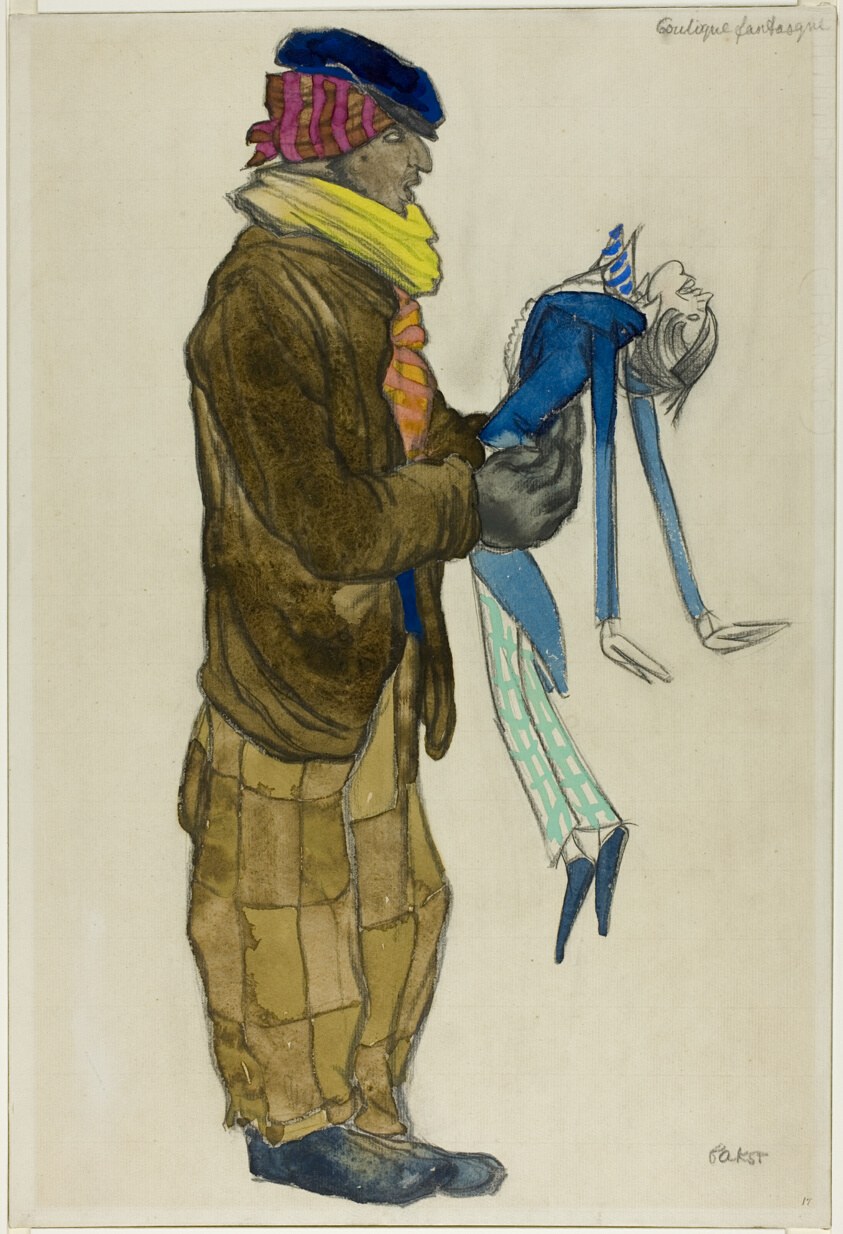
Costume Design for Man in a Brown Suit, for Ballet Boutique Fastasque
Léon Bakst Russian, 1868-1924
- Medium:
- Watercolor and graphite with gouache, on ivory laid paper laid down on gray board
- Collection:
- Prints and Drawings
- Source:
- Art Institute of Chicago
- Rights:
- Rights reserved by the holding institution — do not reuse without permission. Source record ↗
- Recorded as:
- AIC — rights reserved
Bakst was one of the most influential theatrical designers of the early twentieth century, and his work for the Ballets Russes shaped how ballet looked and what it could represent. This drawing is direct evidence of his working process and of a specific production's visual vocabulary—and it captures a moment when the Ballets Russes were experimenting with puppet and doll characters as theatrical performers, blurring the line between animation and dance.
What you are looking at
A standing figure in profile, facing right, holds aloft a marionette or puppet dancer whose body hangs limp in the handler's grasp. The man wears a brown wool coat with a yellow scarf wound round his neck, and a blue-and-pink striped cap pulled low. His face is gaunt and lined, drawn with a few sharp strokes; his expression suggests concentration or weariness. The puppet he displays has a bright blue body, a decorative blue headdress with an ornament, and limbs rendered in quick graphite lines that trail downward. The puppet wears pale leg coverings that end in dark shoes. The composition is spare—a cream-coloured ground with no setting detail—and the watercolour is applied with restraint, allowing the paper to show through. The title *Boutique Fantasque* and the artist's signature (lower right, 'BAKST') are inscribed on the sheet. The work reads as a design drawing rather than a finished composition: notes for costume, silhouette, and character, not a narrative scene.
The dancing
The handler's frame is upright and frontal, his left arm extended upward at full length to support the puppet's torso. His posture is that of a showman or puppet-master—controlled, deliberate. The puppet hangs like a doll, its limbs slack and unweighted, with no articulation of its own. The spatial relationship is one of control and display: the man presents the figure to view as an object, a costume to be examined. There is no dance happening—only the presentation of a dancer-doll.
The dance depicted
This is not a depiction of dance, but rather a costume design for a theatrical character or prop—specifically, the human handler of a marionette. *Boutique Fantasque* (The Whimsical Shop) is a Léon Bakst-designed ballet that premiered in 1919 with the Ballets Russes. The work often featured fantastical toys and puppet characters as performers. This drawing documents the costume of a character whose role is to animate or present the puppet-dancer to the audience. The image captures the apparatus of theatrical illusion: the dressed figure who makes the marionette move. Dance occurs through the puppet, not the handler, placing this at the boundary between costume design and puppet theatre.
How it was made
Watercolour and graphite with gouache on laid paper, mounted on board. The technique is economical and illustrative—characteristic of Bakst's working method for costume and character design. The watercolour is applied selectively to define key visual elements (the blue of the costume, the pink stripes, the yellow scarf) while allowing the underdrawing in graphite to remain visible and to carry the detail of physiognomy and the puppet's limbs. This hybrid approach was standard in early twentieth-century theatre design, where the drawing served as a working instruction for costume makers and set designers rather than as an autonomous artwork. The mounted format suggests professional archival care.
About this work
This is a costume design by Léon Bakst for a human character in *Boutique Fantasque*, a Ballets Russes production. The drawing shows a handler or puppet-master in travelling clothes—worn brown coat, a cheerful scarf and cap—displaying a dressed marionette that will perform as a dancer. The work sits at the intersection of ballet design, puppet theatre, and the Ballets Russes' investigation of theatrical spectacle and artifice. Bakst's economy of line and strategic use of colour—the bright blue of the puppet against the muted earth tones of the handler—creates visual hierarchy and narrative purpose.
The work belongs to the archive of early twentieth-century theatrical design, a body of work that documents how ballet companies imagined character, costume, and the performer's body. It is also a record of the Ballets Russes' experimental approach to narrative and form, where the boundary between dancer, doll, and design was deliberately fluid. For dance historians, it reveals how costume functioned as both character and spectacle; for visual artists, it exemplifies the graphic clarity and compositional wit that Bakst brought to theatrical design.
How to look at it
Look first at the relationship of scale and labour: the handler is human-scaled, the puppet diminished, but the costume of the puppet is rendered in crisp colour while the handler's body is largely underdrawn in graphite. The eye is pulled to the blue figure even as the composition centers the handler. Notice how Bakst has economized: a few lines suggest the puppet's limbs, the scarf is a ribbon of yellow, the cap's pattern is indicated without being fully rendered. This is the language of design notation—showing only what is essential, trusting the reader to complete the image. The gaunt, lined face of the handler is drawn with character; there is no sentiment, only precise observation. The work asks: who is performing—the puppet or the figure that holds it?
The artist
Léon Bakst (1868–1924) was a Russian painter, designer, and theatrical visionary best known for his costume and set designs for the Ballets Russes under Sergei Diaghilev. He trained as a painter and worked in the symbolist and art nouveau idioms before turning to theatre design in the early 1900s. His work for *Schéhérazade* (1910), *Le Spectre de la rose* (1911), and *L'Après-midi d'un faune* (1912) established him as the primary visual architect of the Ballets Russes aesthetic. Bakst understood costume as a form of meaning-making: silhouette, colour, ornament, and historical reference were tools for conveying character and dramatic intent. His designs were also influential in wider fashion and graphic culture, circulated through publications and exhibition. He worked until his death in 1924, producing designs across multiple Diaghilev productions and also working independently as a painter.
The period
In 1918–1919, when this design was made, the Ballets Russes had been operating for over a decade and had already established itself as the primary force in European avant-garde ballet. The company was experimenting with narrative form, non-human characters, and the possibilities of puppetry and mechanical movement. *Boutique Fantasque*, which premiered in 1919, was part of this exploratory period. Concurrently, the art world was absorbed in Dada, futurism, and constructivism—movements that also questioned the boundaries between object, figure, and animation. Bakst's designs for puppet-characters in this period can be read as part of a wider cultural fascination with the doll, the marionette, and the mechanical body as theatrical subjects.
Where it lives
The drawing is held by the Art Institute of Chicago in their Prints and Drawings collection. It was mounted on gray board at some point in its archival history, suggesting it was prepared for storage or exhibition as a finished object. The inscription of the artist's signature and the title on the sheet indicate Bakst's own labeling, suggesting this was a design document retained by the artist or his estate.
Dance in this work
Questions about this work
Is this a painting or a drawing?
It is a hybrid work: watercolour and gouache applied over graphite on paper. Bakst's working method for theatre designs often combined these media, using colour to establish key visual information while allowing the underlying graphite drawing to remain visible and carry finer details. This mixed technique was economical and practical for a working designer.
What is Boutique Fantasque and when was it performed?
Boutique Fantasque (The Whimsical Shop) was a ballet designed by Léon Bakst and choreographed by Michel Fokine, with music by Gioachino Rossini. It premiered in 1919 as a Ballets Russes production. The narrative involved a magical shop where dolls and puppets come to life as dancers—a concept that allowed for fantastical costume and character design.
Why is the figure holding a puppet rather than dancing?
This is a costume design for a human character—a handler or showman—whose role in the ballet was to present or manipulate the puppet-dancer. The Ballets Russes frequently used human performers to animate objects and figures, blurring the boundary between dancer and doll. This drawing documents the costume worn by that handler.
Who was Léon Bakst?
Bakst (1868–1924) was a Russian painter and theatrical designer who became the primary visual architect of the Ballets Russes. His costume and set designs for productions such as Schéhérazade, Le Spectre de la rose, and L'Après-midi d'un faune were enormously influential in early twentieth-century ballet and in wider visual culture. He understood costume as a form of character and meaning-making.
More dance artwork





