49 works in this view — arrow keys or swipe to move between them.
Dance in Art
Shiva as Lord of the Dance (Nataraja)
India Tamil Nadu
- Medium:
- Bronze
- Collection:
- Arts of Asia
- Source:
- Art Institute of Chicago
- Rights:
- Public domain — free to use, share and adapt.
- Recorded as:
- CC0 (Public Domain)
For dancers and dance historians, this work is essential because it shows how a single body—in this case divine, but rendered with physical specificity—can embody an entire philosophy of motion. The tandava is not a technique to be mastered but a principle to be understood: controlled asymmetry, the coexistence of opposing forces, the transformation of physical effort into spiritual power. Contemporary dance, too, has drawn on Nataraja as an image of what dance can mean beyond entertainment or social bonding.
What you are looking at
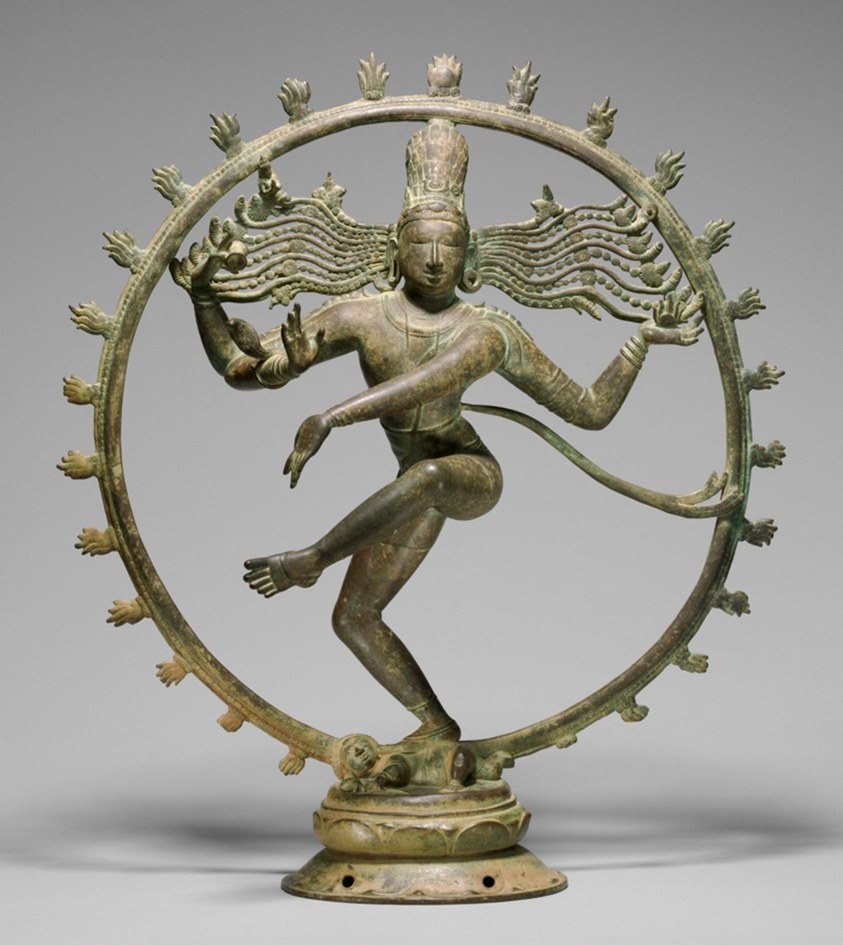
A bronze sculpture depicts a four-armed figure in dynamic motion within a circular frame studded with stylized flames or leaf forms. The figure stands in a lunging pose on the right leg, the left leg raised and bent, arms arranged in a complex symmetry: the upper pair gestures outward in opposing directions at shoulder height, while the lower pair mirrors this movement. The dancer wears a tall cylindrical crown and a minimal waist-cloth; the body is lean and idealized, rendered with anatomical clarity. The face is calm and frontal despite the body's energy. The circular frame—a ring of cast bronze ornamented with repeated pointed projections—sits on a lotus-form base, creating a self-contained cosmic stage. The whole is compact and three-dimensional, designed to be viewed from all sides.
The dancing
The single dancer occupies the center of the frame with complete command. The weight shifts onto the right leg in a deep lateral bend, while the left leg lifts in a controlled arc. The four arms create a visual rhythm through opposing curves: each upper arm extends outward; each lower arm bends at the elbow. The posture suggests both control and ecstasy—the spine curves without collapse, and the shoulders remain level despite the asymmetrical weight. The dancer's face looks forward, serene and unaffected by the body's intensity. This is not a pose of strain but of contained power.
The dance depicted
This is Nataraja, the Hindu god Shiva as the cosmic dancer, a subject developed across South Indian bronze sculpture from at least the 10th century onward. The sculpture depicts the tandava, Shiva's violent dance of creation and destruction, a cosmological event rather than a human social dance. The four arms are an iconographic constant: the upper right typically holds a drum (creating time), the upper left sometimes holds fire (destruction), the lower right gestures reassurance, and the lower left points to the raised foot as the way of liberation. The dynamic asymmetry—the raised left leg, the arched spine, the forward-facing head—embodies the paradox of Nataraja: simultaneous destruction and grace, motion and stillness, terror and beauty. This is not a dance to be performed by humans in this lifetime, but to be meditated upon as an image of divine reality.
How it was made
This is a lost-wax bronze casting, a sophisticated technique that allows for intricate detail, undercuts, and three-dimensionality. The casting required multiple stages: a wax model carved by hand, an outer clay mold, heating to melt and remove the wax, and pouring of molten bronze. The method allowed the sculptor to achieve fine surface detail—the pleats of the waist-cloth, the textures of the crown, the pointed ornaments of the frame—and to create the work as a freestanding object viewable in the round, not as a relief. This was a technique of considerable expense and skill, marking the work as a prestige object made for temple or court patronage. The patina indicates age and handling over centuries.
About this work
This is one of the most iconic images in Hindu sculpture: the dancing Shiva, Nataraja, cast in bronze in the Chola period of South India. The work collapses several registers at once—divine and mortal, stillness and motion, destruction and creation—into a single compact form. The sculpture was designed for worship and meditation, placed in temples or carried in processions, but it also functioned as a supreme statement of what a human body *could* be in the hands of an artist who understood both anatomy and cosmology. The circular frame transforms the dancer from a figure in space into a figure *in time itself*, the ring marking the endless cycle of birth and death that the dance perpetuates.
How to look at it
Look first at the angle of the spine and the position of the legs: the artist chose a moment of maximum instability, a lunging stride, to convey perpetual motion. Then notice the arms: they do not mirror each other exactly but create a rotating, spiral rhythm that your eye can follow around the figure. The face remains frontal and calm, as if the frenzy of the body is happening below or beyond consciousness. Finally, observe how the circular frame echoes the dancer's motion—the repeated points suggest the spinning wheel of time, or the halo of power. This is a sculpture designed to be circled, its meaning changing with each angle of view.
The artist
The work is attributed to Tamil Nadu, the southern Indian region that became the center of Chola bronze casting from roughly the 9th to 13th centuries. The Chola dynasty was a major imperial power; their workshops produced some of the finest bronzes of medieval Asia, many of which were destined for temples across South India and beyond. The sculptors of these works are not individually named in surviving records, but they worked within a highly codified tradition that specified the proportions, attributes, and poses of each deity. Individual genius expressed itself through refinement of surface, precision of casting, and a kind of spiritual intensity conveyed through form rather than through novelty.
The period
The 10th century in South India was a period of Hindu temple expansion and theological deepening, particularly around the worship of Shiva. The image of Nataraja became fixed in this period as a supremely powerful symbol of Shiva's dual role as destroyer and creator. In the same centuries, South Indian classical dance forms—particularly Bharatanatyam—were developing in temple contexts, with their own vocabulary of gesture (mudra) and poses (asana). There is no direct evidence that Nataraja was danced by temple dancers of this era, but the image carries the imprint of a culture for which the body—whether sculpted or moving—was a vehicle for divine truth.
Where it lives
The work is held by the Art Institute of Chicago in the Arts of Asia collection. It is recorded as a bronze from Tamil Nadu, dated to 901 CE, making it a major example of Chola-period metalwork from a museum that has built one of North America's strongest holdings in South Asian sculpture.
Dance in this work
Questions about this work
Is Nataraja a real dance that people perform?
Not in the classical sense. Nataraja depicts a cosmic event—Shiva's creation and destruction of the universe—rendered through the human body as an image of divine power. However, contemporary Indian and Western dancers have created works inspired by Nataraja's form and philosophy. The raised leg, the four-armed asymmetry, and the idea of stillness-within-motion have all influenced modern choreography.
What do the four arms mean?
Each arm typically carries a symbolic meaning: the upper right often holds a drum (creation of time), the upper left holds fire (destruction), the lower right is in a gesture of reassurance (don't fear), and the lower left points to the raised foot (the path of release). The four arms allow a single figure to embody opposite forces simultaneously.
Why is the circle so important?
The circle (called the prabhamandala or 'circle of radiance') represents the cycle of time and the cosmos itself. It transforms Nataraja from a single dancer into a symbol of universal motion. The pointed ornaments around the ring suggest flames or the rays of the sun, reinforcing the idea of endless, divine energy.
How was this bronze made?
Using the lost-wax casting method, a technique in which a wax model is encased in clay, heated until the wax melts away, and then molten bronze is poured into the hollow mold. This allows for fine detail and undercuts that would be impossible to carve. The process was time-consuming and expensive, marking such bronzes as objects of significant value and prestige.
More dance artwork





