49 works in this view — arrow keys or swipe to move between them.
Dance in Art
Nightlife
Archibald John Motley Jr. (American, 1891–1981)
- Medium:
- Oil on canvas
- Collection:
- Arts of the Americas
- Source:
- Art Institute of Chicago
- Rights:
- Rights reserved by the holding institution — do not reuse without permission. Source record ↗
- Recorded as:
- AIC — rights reserved
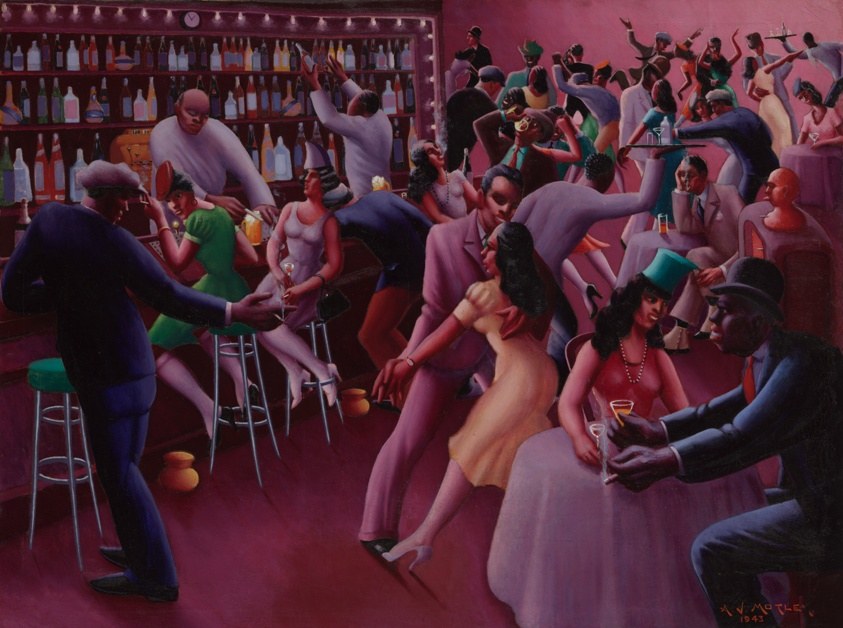
This painting documents an essential but often underpictured context for American social dance: the actual nightclub or juke joint where vernacular styles like swing, blues dancing, and social ballroom were performed by ordinary people, not trained dancers. For historians of African American urban culture and dance, the work is valuable both as evidence of how social dancing was actually practiced and as an example of how twentieth-century artists chose to represent dance as a lived social practice rather than a theatrical spectacle. Motley's treatment of the nightclub as a space of dignity, pleasure, and social mixing—rendered with painterly sophistication—elevates what might otherwise be dismissed as entertainment into genuine cultural documentation.
What you are looking at
A crowded nightclub or dance hall dominates the composition, painted in saturated magentas, purples, and deep reds that create a warm, intimate atmosphere thick with energy. The space is packed with figures in various states of movement and socializing: couples dance while others sit on tall stools at tables, and still others stand in clusters throughout the room. The background shows a bar lined with bottles, staffed by bartenders in white shirts attending to patrons. The palette—dominated by warm purples and reds with accents of teal and deep blue—creates strong visual rhythm and sense of crowded conviviality. The composition is dense and layered, with figures overlapping across multiple planes from foreground to deep background, suggesting a thriving venue filled with music, conversation, and movement. The lighting appears warm and artificial, typical of an indoor nightclub, and casts the entire scene in a sensual, moody glow.
The dancing
The dancers visible throughout the composition show partnered movement in close proximity, with bodies leaning into one another in relaxed, social holds. Several couples are mid-dance with arms positioned in social ballroom fashion—men's hands at women's waists or backs, women's hands on men's shoulders or held in their partners' hands. The figures are rendered with rounded, fluid forms and generally upright posture, though some lean into their partners. The painting captures multiple moments simultaneously: some figures are clearly dancing, others are seated or standing in conversation, creating a snapshot of social mixing typical of a nightclub setting. No footwork details are visible, but the overall body positions suggest close-contact partner dancing rather than solo or line work.
The dance depicted
This appears to depict social ballroom or jazz-age nightclub dancing of the early-to-mid twentieth century—the kind of close partner dancing that characterized American urban nightlife and juke joints. The dress, setting, and body positions suggest swing-era social dancing or blues-based partner dance, likely 1940s-era American social dancing. The informality of the setting, the mix of standing and seated patrons, and the close partnered holds suggest the vernacular ballroom context rather than formal competitive ballroom. Without more specific costume or movement detail, identifying a single named style is difficult, though the overall visual language points to American rhythm dancing or swing-era social blues. The painting captures the democratic, mixed social environment of the nightclub rather than a staged or formal dance performance.
How it was made
This is an oil painting on canvas, a medium that allowed Motley to build the complex layering of color and form visible here. Oil enabled the rich, saturated color palette—particularly the expressive use of complementary magentas and teals—and the subtle modulation of flesh tones against the vibrant background. The painting technique shows confident brushwork and compositional complexity, with multiple overlapping figures rendered with clarity despite the crowded space. The medium's capacity for depth and luminosity was essential to creating the sensual, atmospheric quality of the nightclub interior.
About this work
Nightlife is a crowded urban nightclub scene rendered in warm, saturated color and populated by dozens of figures engaged in social dancing, drinking, and conversation. Painted in 1943, it captures a moment of American social life during the swing era—a period when jazz, juke joints, and vernacular ballroom dancing were central to urban culture, particularly in African American communities. The work is significant both as a dance document and as a social portrait, depicting the mixed, informal setting in which much American social dancing actually took place rather than the formal ballroom or theatrical stage. Motley's composition emphasizes density, movement, and the overlapping rhythms of the nightclub environment itself.
How to look at it
Notice first the overall rhythm created by the saturated, warm color palette: the magentas, purples, and deep reds that fill the entire composition create a visual sense of warmth and pressure that mirrors the crowded, energetic space. Look at how Motley handles the overlapping figures—the way bodies are layered throughout the composition creates visual depth and a sense of simultaneous activity. Observe the variety of figure poses and positions: some are clearly dancing in partnered holds, others sit or stand, creating a complex social scene rather than a unified dance moment. The painting captures not a single dance step or moment but rather the overall atmosphere and social density of the nightclub environment itself.
The artist
Archibald John Motley Jr. (1891–1981) was an American modernist painter known for his vibrant, complex compositions depicting African American urban life, particularly the jazz age and nightlife of the early-to-mid twentieth century. Working in a style that combined modernist color and composition with observational figuration, Motley created a visual record of Black urban experience at a time when such subject matter was largely absent from mainstream American art. His work is characterized by rich color palettes, crowded compositions, and an unsentimental, dignified treatment of everyday social scenes. Motley's paintings of nightclubs, parties, and street scenes are now recognized as major documents of African American cultural history and modernist practice.
The period
Nightlife was painted in 1943, during World War II and at the height of the swing era in American popular culture. This was a period of extraordinary vitality in urban African American communities, where jazz, blues, and social dancing were central to cultural life and identity. Nightclubs and juke joints were spaces of relative freedom and social mixing in a segregated America—places where Black Americans could gather, dance, and socialize in their own spaces. Simultaneously, this was a moment when American modernist artists were increasingly turning to vernacular and urban subjects; the nightclub became a subject of artistic interest for painters seeking to capture contemporary American life. The painting reflects both the realities of Black urban nightlife and the modernist interest in depicting modern leisure, movement, and crowded urban spaces.
Where it lives
The work is held in the Arts of the Americas collection, suggesting it is part of a major institutional collection focused on art from the Western Hemisphere. The painting's presence in a major American art collection acknowledges its significance both as a modernist artwork and as a historical document of African American cultural life.
Dance in this work
Questions about this work
What kind of dancing is shown in this painting?
The painting depicts social partner dancing typical of 1940s American nightclubs and juke joints—likely swing-era social dancing or blues-based ballroom styles. The close partnered holds, upright posture, and informal setting suggest vernacular ballroom rather than formal competitive dancing or theatrical performance. Without more specific costume or movement details, a single named style cannot be definitively identified, but the overall context points to American social rhythm dancing.
Why did Motley paint this subject?
Motley was deeply committed to depicting African American urban life with dignity and sophistication. The nightclub was both a historically important space for Black cultural expression and a modernist subject of artistic interest. By painting such scenes in an elevated modernist style, Motley asserted their cultural and artistic significance.
Is this a real nightclub or an imaginary scene?
Motley's nightclub scenes are based on observation and familiarity with actual Chicago nightlife, where he lived and worked. However, the painting is a composed artistic work, not a documentary record of a specific moment or venue. It synthesizes observed details into an idealized or characteristic scene of nightclub life.
More dance artwork





