49 works in this view — arrow keys or swipe to move between them.
Dance in Art
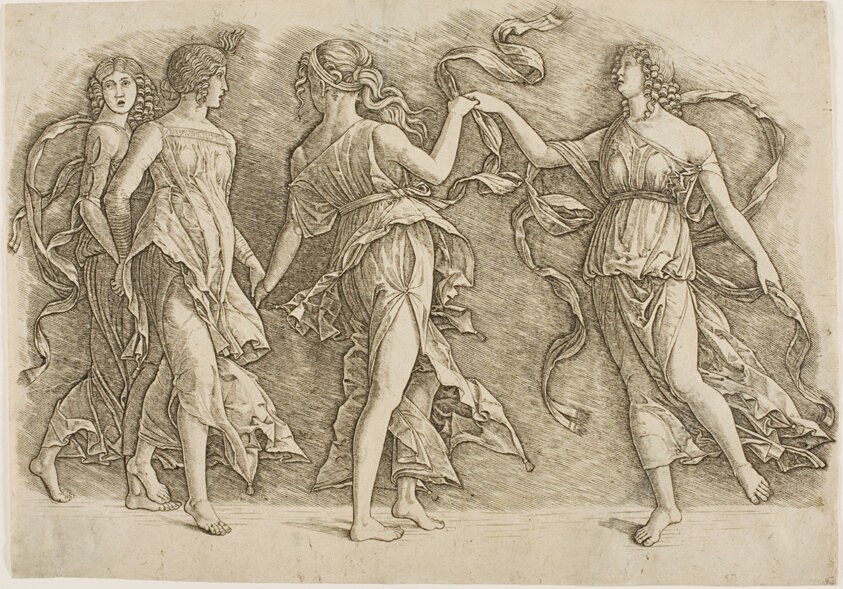
Four Women Dancing
Workshop of Andrea Mantegna Italian, 1431-1506
- Medium:
- Engraving on paper
- Collection:
- Prints and Drawings
- Source:
- Art Institute of Chicago
- Rights:
- Public domain — free to use, share and adapt.
- Recorded as:
- CC0 (Public Domain)
This is one of the few surviving visual records of Italian Renaissance court dance, a practice that profoundly influenced the development of ballet yet left almost no choreographic notation. The print captures the aesthetic values of the period—the ideal of classical drapery, the elevated and composed body, the expression of harmony through geometric arrangement—and shows how dance was distributed and celebrated among the educated elite through the reproductive medium of engraving. For anyone tracing the origins of formal European dance technique, this image bridges the performance and its afterlife in art.
What you are looking at
Five female figures occupy a shallow stage defined by a ground line. They are arranged in a processional or sequential composition that reads from left to right, each body caught in a different moment of movement. The leftmost pair—one winged, one in profile—seem to initiate the action. The center figure stands with weight on one leg, torso twisted, arms raised and apart as though frozen mid-turn or mid-leap. To her right, another figure gestures with one arm extended upward while the other crosses her body; her drapery billows dramatically. The rightmost dancer mirrors a similar contrapposto stance, her body inclined, one arm held up. All five wear classical drapery of varying fullness—some garments cling to the body, others sweep and flow—and all are barefoot. The engraving technique renders their forms through parallel hatching that gives the figures volume and movement even in stillness. The setting is spare: no architecture, no musicians, no ground detail. The women occupy an abstracted space defined only by their arrangement.
The dancing
Each of the five figures occupies a distinct pose within what appears to be a continuous action. The bodies show strong classical training: weight shifts clearly from one leg to the other (contrapposto), arms are raised to frame the head or gesture outward, and torsos twist to create dynamic profiles. The leftmost winged figure (likely a putto or allegorical being) establishes a lighter, more aerial quality. The center three figures show the most vigorous movement—high arm positions, lifted chests, weight transferred through the legs. The poses suggest simultaneity rather than sequence: this is not a line of dancers moving in unison, but a moment in which multiple bodies express related but distinct movements. The spacing is generous; no figure touches another, emphasizing individual expression within a shared action.
The dance depicted
This engraving most likely depicts allegorical or mythological female figures engaged in a court or classical dance rather than vernacular social dance. The barefoot stance, flowing drapery, raised arm positions, and the presence of a winged figure suggest the vocabulary of Renaissance court spectacle or early ballet (ballo). The composition and style are consistent with a *ballo* or figure dances common in Italian Renaissance entertainments—organized movement of idealized bodies expressing order and grace. The artist has chosen a moment of apparent climax or apotheosis rather than a recognizable step pattern, suggesting the dance serves as an emblem of harmony or celestial movement. Without text or clearer iconographic markers, the specific narrative cannot be determined, but the visual language points firmly toward aristocratic, theatrical dance rather than social ballroom practice.
How it was made
This is an engraving on paper, a printmaking technique that uses a burin to cut lines directly into a copper or steel plate; the ink is then applied to the raised surface and transferred to dampened paper under pressure. Engraving's precision and tonal range (achieved through systematic parallel hatching) made it ideal for circulating classical and allegorical imagery to educated audiences across Europe. The fine hatching visible here—used to model the figures' flesh, define the fabric's weight and movement, and create atmospheric effect—is the hallmark of skilled northern Italian or Venetian printmaking of the late 15th or early 16th century. The technique's labor-intensity and the quality of execution here suggest this was a high-status object, likely produced for collectors, artists, and courtiers rather than a broadsheet audience.
About this work
This engraving records a moment in a classical or mythological dance, rendered with the precision and allegorical ambition characteristic of Renaissance printmaking. Five female figures, including one winged attendant, occupy a shallow stage in a variety of raised, twisted, and expressive poses that suggest they are moving through a coordinated action. The work belongs to a tradition of *balli figurati*—choreographed spectacles presented at Italian Renaissance courts—and serves as evidence of how such performances were documented and circulated through prints. The engraving captures not a repeatable step or social form, but a single moment of composed, idealized movement, elevated through classical drapery and spatial clarity.
For historians of Renaissance dance, this print is significant as a visual record of how court dance was understood and represented during a period when dance increasingly mimicked painting and sculpture in its pursuit of classical grace. The absence of musicians, ground detail, or architectural setting directs all attention to the bodies themselves—their poses, proportions, and the geometry of their arrangement. This is a document of dance as fine art rather than social practice.
How to look at it
Focus on the variety of poses and what they suggest about the bodies' motion through space and time. Notice how each figure's weight rests on a single leg while the other is bent or extended, creating the illusion of continuous movement even though the image is static. Observe the way the drapery moves differently on each body—some folds follow gravity and cling, while others billow outward as though caught by the momentum of turning or leaping. The engraver's hatching technique (parallel lines closer together for shadow, farther apart for light) gives the figures convincing volume and makes the fabric's drape legible from a distance. Finally, consider the composition's balance: five separate figures, none touching, arranged in a subtle arc or progression that gives the scene a sense of order despite its apparent spontaneity. This is a moment deliberately composed, not captured, to convey grace, harmony, and classical restraint.
The artist
The work is attributed to the workshop of Andrea Mantegna (1431–1506), one of the most influential and technically innovative Italian Renaissance painters and printmakers. Mantegna was celebrated for his mastery of classical subjects, archaeological precision, and his pioneering use of engraving to circulate his designs and compositions across Europe. His workshop in Padua was a major center for the production of prints, and engravings after his compositions were widely copied and adapted. Whether this print was directly incised by Mantegna or executed by an associate working from his design remains uncertain, as was common practice in Renaissance workshops, but the style and ambition reflect the classical and theatrical values for which Mantegna was renowned.
The period
In the late 15th century, Italian Renaissance courts were experiencing a golden age of spectacle. Court *balli* and *balletti* were integral to diplomatic ceremonies, wedding celebrations, and courtly entertainment, and they were becoming increasingly choreographed, allegorical, and self-conscious as theatrical art forms. Dancers trained in the newly codified practices outlined in manuals like Domenico of Piacenza's *De arte saltandi et choreas ducendi* (c. 1450). Simultaneously, the humanist recovery of classical texts and images inspired court artists and patrons to model contemporary spectacles on descriptions of ancient Roman performances and to infuse dances with allegorical and mythological content. The engraving medium itself was experiencing rapid refinement in northern Italy and Germany, becoming the primary means by which artistic innovations, including dance imagery, were distributed beyond the court walls. This print represents the convergence of all these developments: a dance conceived as classical allegory, rendered with technical sophistication, and disseminated through a reproductive medium.
Where it lives
The work is held in the Prints and Drawings collection at the Art Institute of Chicago. It is catalogued as an engraving produced in the workshop of Mantegna in 1492. The attribution to the workshop reflects the common Renaissance practice of collaborative production and suggests the work may have been executed by an associate rather than Mantegna himself, though it followed his design and style.
Dance in this work
Questions about this work
What is this dance?
The specific identity of the dance is not clear from the image alone. However, the style, pose vocabulary, and allegorical presentation suggest this is a *ballo figurato*—a choreographed, classically inspired court dance of the Italian Renaissance. Such dances were performed at ceremonies and celebrations and were often named after mythological or allegorical themes (e.g., the dance of the Graces, a dance of Venus).
Why is one figure winged?
The winged figure (leftmost) is likely a putto, a classical allegorical attendant or cupid, or possibly a representation of a divine or supernatural being. In Renaissance court spectacles, such figures often served as narrators, guides, or emblems of celestial or courtly virtues. The presence of a winged figure signals that this dance takes place in an idealized, allegorical realm rather than the natural world.
Were these dances actually performed?
Yes. Court *balli* and *balletti* were central to Renaissance court culture, especially in Italy, and were documented in written manuals and, more rarely, in visual records like this print. However, no surviving choreographic notation records exactly how these dances were performed. Prints like this one served as a kind of visual memory, circulating the image and idea of the spectacle among those who could not attend in person.
How do we know this is by Mantegna's workshop?
The attribution is based on stylistic analysis—the engraving technique, the treatment of classical drapery, and the allegorical subject matter align with the documented practice of Mantegna's workshop, which was famous for producing high-quality engravings. However, the catalog record correctly identifies this as a workshop attribution, meaning the print was likely produced by associates or students under Mantegna's direction rather than by Mantegna himself.
More dance artwork





