49 works in this view — arrow keys or swipe to move between them.
Dance in Art
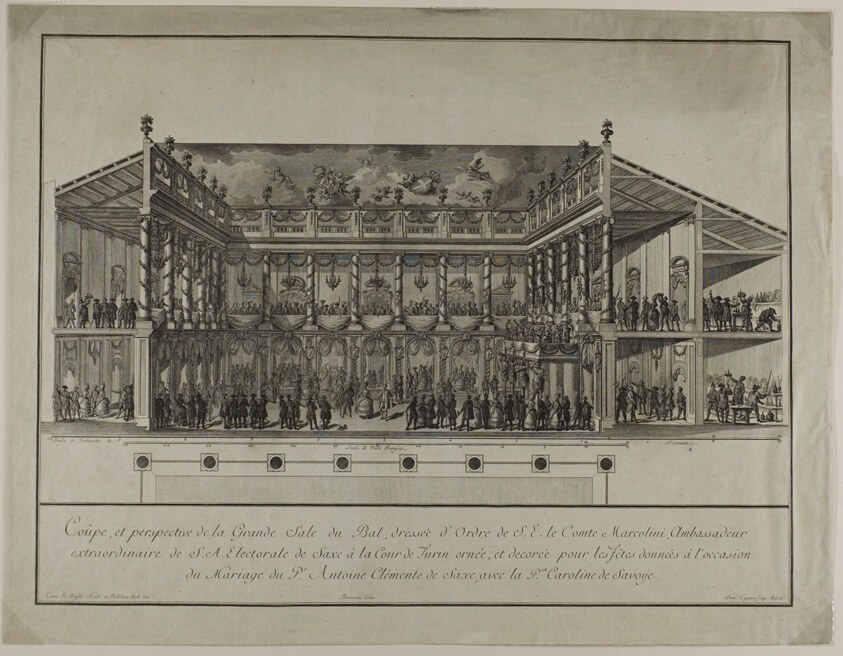
Side Elevation and Perspective of Grand Ballroom
Domenico Cagnoni Italian, 18th century
- Medium:
- Etching on paper
- Collection:
- Prints and Drawings
- Source:
- Art Institute of Chicago
- Rights:
- Public domain — free to use, share and adapt.
- Recorded as:
- CC0 (Public Domain)
This image is crucial for understanding ballroom dance not as a set of steps but as a total social event, staged in a designed environment. It shows that 18th-century court dance was inseparable from architecture, decoration, music, and the display of rank—and that the ballroom itself was a work of art in which the dancers were participants but not the primary subject. For anyone studying Baroque or Regency dance, this kind of image documents the physical reality of the venues and the spatial thinking that structured how people moved together.
What you are looking at
This is a cross-sectional architectural drawing of an 18th-century ballroom rendered in perspective, showing the interior as a cutaway view. The space is a grand, multi-story structure with elaborate decoration: painted ceiling frescoes depicting classical scenes, ornate wall panels, draped garlands, and precisely articulated architectural divisions. The ballroom is populated throughout—figures in formal 18th-century dress (breeches, coats, and gowns) occupy multiple levels: the main floor, gallery balconies on at least two stories, and what appears to be an orchestra or music box at the upper center. The composition emphasizes architectural magnificence and the social hierarchy of space; the foreground shows clusters of elegantly dressed courtiers, some standing in conversation, others in postures suggesting movement or dancing. The lighting is even and descriptive, achieved through the etching's controlled hatching and line work, which defines both architectural form and textile texture.
The dancing
The human figures throughout the composition are small relative to the architecture, rendered in restrained silhouette rather than anatomical detail, which is typical of this genre of architectural illustration. They appear in both standing and moving positions; some seem to be in pairs or small groups, consistent with the formal couple-based dances of the period. The dress—knee breeches, coats with long skirts, and full gowns for women—places this firmly in the Baroque or early 18th-century court world. No specific dance frame or hold is clearly legible at this scale, but the gathering of figures distributed across the ballroom suggests the choreographic use of the entire space rather than localized movement.
The dance depicted
The image documents the setting for court dance and formal assembly, not a specific dance type in action. The French caption indicates this was designed to commemorate a wedding feast and dance held in this ballroom. The architecture itself—with its galleries, multiple sightlines, and formal layout—is a record of how ballroom dance functioned as social performance in the 18th-century aristocracy. The presence of galleries suggests spectators as well as dancers, and the scale of the space implies the formal minuet, quadrille, or contredanse of the court period, which required defined floor patterns and ceremonial spacing. This is a drawing of the stage for dance rather than a representation of the dance itself.
How it was made
This is an etching, a print made by incising lines into a copper or steel plate with an acid-resistant needle, then bathing the plate in acid to bite the lines, and printing from the inked plate. Etching allowed fine linear detail and the precise architectural rendering visible here—the perspectival framework, the careful delineation of panels and orders, the delicate cross-hatching that models the painted ceiling. The technique's suitability for architectural documentation meant such prints circulated widely among architects, collectors, and the educated classes. The formal, measured style and the commemorative inscription suggest this was a print made for distribution after the event, a public record of aristocratic magnificence.
About this work
This etching is a commemoration in architectural form of a ballroom and the occasion of a wedding feast and dance. It is not a record of choreography or movement, but of the social and spatial infrastructure that framed court dance in the 18th century. The work sits at the intersection of architecture and social history, documenting how ballroom design encoded hierarchy, display, and the formal decorum expected of aristocratic society. For dance historians, it reveals not how bodies moved, but where and how movement was staged—the galleries for musicians and observers, the proportions and divisions of the floor, the relationship between architecture and the rituals of courtship and alliance that minuets and quadrilles enacted. The precision and grandeur of the rendering underlines the seriousness with which the court took both its architecture and its ceremonial dances.
How to look at it
Look first at the architectural skeleton—the orders, the proportions, the layering of space—and recognize that this structure is the subject, not a mere backdrop. Then trace the position of the figures: note the gallery spaces above the main floor, which are essential to understanding court dance as a spectacle watched as well as danced. Observe how small the human figures are made relative to the room; this is not false proportion but a deliberate choice—the architecture and the occasion matter more than individual bodies. The cut-away perspective is a technical tour de force that allows you to see all the inhabited levels simultaneously, a bird's-eye view impossible in life but essential for understanding the full social choreography of the ballroom.
The artist
Domenico Cagnoni was an 18th-century Italian architect and printmaker. Little is firmly documented about his biography, but his practice centered on the recording and commemoration of significant architectural and social occasions through etched and engraved prints. The precision of his line work and his mastery of perspective suggest formal training in both architecture and printmaking, and the commemorative nature of his works indicates he served patrons of rank—courts, nobility, and the institutions of the church. His work belongs to a tradition of celebration prints produced for major state occasions.
The period
This etching dates to the early 18th century, during the height of the Baroque in southern Europe and in the reign of the great absolute monarchies that used court ceremony and display as instruments of power. This was the age of the minuet, the most formalized court dance, which had become by this date a marker of aristocratic identity and training. Architecture itself was understood as a form of rhetoric: the scale, order, and ornament of a ballroom made a statement about the power and taste of its patron. The etching as a medium was at the height of its use for the documentation of state ceremonies, festivals, and architectural achievements; prints like this would have circulated among the cognoscenti of Europe as records of contemporary magnificence.
Where it lives
The work is held in the Prints and Drawings collection at the Art Institute of Chicago. It is a commemorative print, commissioned to record a specific state occasion—a wedding feast and dance held in this ballroom—and would have been issued in a limited edition for distribution to interested parties and archives.
Dance in this work
Questions about this work
Is this showing a real ballroom or an imaginary design?
The caption references a specific occasion (a wedding feast), and the style of the architecture and costume date it to the early 18th century. This appears to be a record of an actual ballroom and event, though the perspective and the bird's-eye-view rendering are, of course, artistic conventions—this is not a photograph. The architectural details are precise enough to suggest that Cagnoni was documenting a real space.
What dances would have been performed in a room like this?
At this date and in this social context, primarily the minuet, which required a good deal of space and was danced by couples in turn before an assembled audience. Contredanses and quadrilles were also performed, and the scale of the room suggests it could accommodate group dances involving multiple couples in coordinated patterns. The galleries would have housed the orchestra (visible as a structure at the top center) and allowed spectators who did not participate in the dance.
Why does the image show the ballroom cut away, as if sliced through?
The cross-sectional perspective allowed Cagnoni to show all the inhabited levels of the room at once—the main floor where dancers moved, the galleries above where musicians and observers sat, and the decorative program of the ceiling. This 'cutaway' view was a standard architectural technique in prints of the period, allowing a complete understanding of a space's organization and hierarchy that could not be conveyed from a single vantage point.
How was this print made and distributed?
This is an etching, made by incising a design into a copper plate with a needle and biting it with acid. The plate could then be inked and printed many times, making it possible to distribute copies widely. Commemorative prints like this were made and circulated to mark important state occasions, and would have found their way into royal collections, architectural archives, and the collections of educated patrons across Europe.
More dance artwork





