49 works in this view — arrow keys or swipe to move between them.
Dance in Art
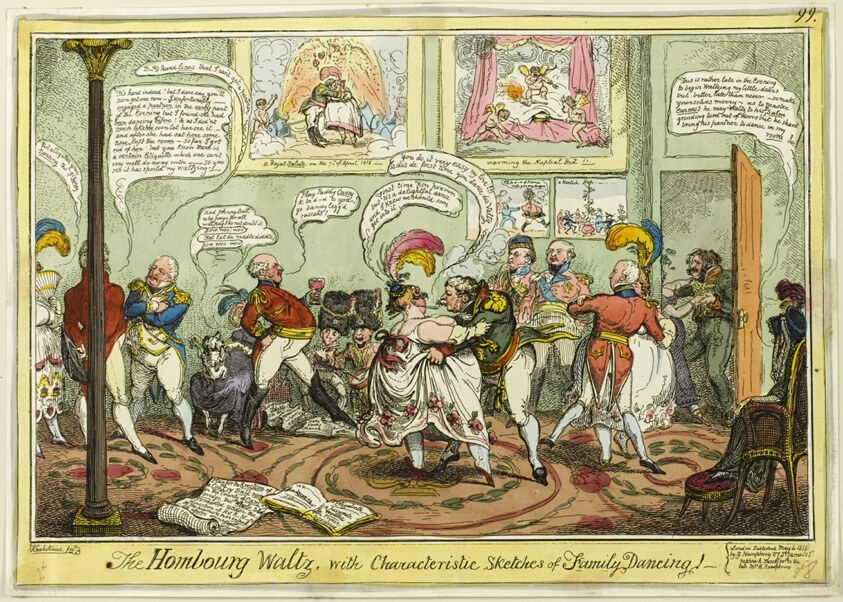
The Hombourg Waltz, with Characteristic Sketches of Family Dancing!
George Cruikshank (English, 1792-1878) published by George Humphrey (English, c. 1773-1831)
- Medium:
- Hand-colored etching on paper
- Collection:
- Prints and Drawings
- Source:
- Art Institute of Chicago
- Rights:
- Public domain — free to use, share and adapt.
- Recorded as:
- CC0 (Public Domain)
This is one of the earliest and most detailed visual records of the waltz in British culture, capturing the moment when the dance was new and culturally contested. Cruikshank's exaggeration, far from making the image useless as evidence, actually records the intensity and scandal the dance provoked—information no formal dance manual could convey.
What you are looking at
A crowded domestic interior filled with well-dressed figures engaged in animated social dancing. The setting appears to be a fashionable drawing room or ballroom, with classical architectural elements including fluted columns at left and right edges, and ornamental wall panels. A large chandelier hangs overhead, and the floor is decorated with a geometric pattern. The composition is dense and theatrical: at least a dozen figures occupy the space, many wearing high-waisted Empire silhouettes, military dress uniforms with epaulettes, and elaborate bonnets and headwear. Several couples are paired in dancing attitudes; others gesture or gesture toward the dancers. Above the main scene, three smaller vignettes in framed cartouches show episodes of the action in greater detail. The entire print is hand-colored in soft greens, pinks, flesh tones, and earth tones, and the etching line remains visible throughout, giving the work a sketch-like immediacy despite its dense composition.
The dancing
The dancers adopt varied postures: some couples appear to hold each other in a close ballroom frame, while others gesture expansively with raised arms. One central female figure in a white dress dominates the composition, her body twisted mid-turn, her raised arm and tilted head suggesting rapid rotational movement. The male figures lean and bow toward their partners. Several onlookers stand in clusters around the dancers, their poses ranging from amused observation to active participation. The prints' hand-coloring picks out individual figures against the green ground, making tracking individual bodies possible but challenging in the dense crowd.
The dance depicted
This depicts the Hombourg Waltz (also spelled Homburg), a fashionable ballroom dance of the Regency and early 19th-century period. The title promises 'characteristic sketches,' suggesting this is a satirical or observational print capturing not just the dance itself but the social behavior and physical exaggeration it prompted. The waltz was new, controversial, and scandalous to British society for its close partnering and rotational motion; Cruikshank's exaggerated poses—the extreme tilting, the high arm positions, the whirling of skirts—suggest the artist was mocking both the dance and the dancers' enthusiasm for it. The vignettes above likely show amplified moments from the central scene, a common satirical device.
How it was made
This is a hand-colored etching, meaning the line work was bitten into a copper plate with acid and then printed, with watercolor applied by hand to each impression. The technique allowed for fine detail in the figures' features and dress while permitting rapid, expressive line-work in the architectural setting and background figures. The visible etching line and the intentional sketchiness suggest a print made for broad circulation and sale—likely a single-sheet satire sold through print shops to be affordable to middle-class viewers. The hand-coloring was likely applied in a workshop by multiple hands, which accounts for the uneven application and the soft, sometimes fugitive quality of the pigments.
About this work
This is a Regency-era satirical print documenting the social dancing and cultural moment surrounding the waltz's arrival in Britain. Cruikshank, one of the period's foremost satirical artists, captures both the dance itself and the exaggerated, sometimes ridiculous physical behavior it prompted in its devotees. The work belongs in a dance collection because it is evidence of how the waltz was perceived—as transgressive, exciting, and worthy of mockery—and because the exaggeration itself tells us something true about the dance: its novelty, its physical demands, and its social power.
The Hombourg Waltz is among the most direct artistic testimonies we have to early-19th-century ballroom dancing in motion. Unlike a formal dance manual, which prescribes correct form, or a polite portrait, which shows dancers at rest, Cruikshank captures the moment of performance—the sweat, the effort, the absurdity, and the pleasure. The work is a primary source for understanding not just the waltz's steps, but how its contemporaries experienced and judged it.
How to look at it
Attend to the central female figure and the implied rotation of her body—her skirt, her tilted head, and her raised arm all suggest the rapid spinning motion that made the waltz so controversial. Look at the extreme closeness of the paired dancers and the angle at which they lean into one another; this was the 'shocking' aspect of the dance. The three vignettes above frame specific moments or types—look for what aspect of the waltz or the waltzers' behavior is being amplified in each. Finally, notice the onlookers: their expressions and postures tell you what the artist thought about waltz enthusiasm. The print is crowded and busy on purpose; that density mirrors the crush of a fashionable ballroom.
The artist
George Cruikshank (1792–1878) was England's leading satirical printmaker and illustrator of the Regency and Victorian periods. Beginning as an etcher and engraver in his father's workshop, he became famous for his social and political satire, his caricature, and his ability to crowd complex narrative action into a single frame. He worked prolifically for publishers including George Humphrey, issuing single-sheet satirical prints on current events, fashions, and social behavior. His line work is rapid and assured, his characterization sharp, and his eye for physical comedy and social observation acute. He was as interested in the foibles of the fashionable classes as in politics, and dances, fashions, and social pretension were frequent targets of his wit.
The period
The waltz arrived in Britain around 1812–1815, imported from Austria and Germany and immediately controversial. Conservative critics condemned it for its close hold, the embracing of partners, and the rapid rotational motion, which was seen as immodest and physically reckless. The dance was associated with Continental fashion and was initially danced primarily by the fashionable elite and at Almack's Assembly Rooms in London. By the time Cruikshank made this print (1818), the waltz was well-established enough to mock—it had moved from dangerous novelty to fashionable affectation. Satirical prints of the waltz's enthusiasts were common, and the exaggeration of dress, posture, and physical effort was a standard way of commenting on social pretension and the adoption of foreign fashions. In visual art, the period saw a flourishing of colored satirical etching as a form of popular print culture.
Where it lives
This hand-colored etching is held in the Prints and Drawings collection at the Art Institute of Chicago. It was published by George Humphrey, a London print publisher and seller who specialized in satirical and topical prints. Such works were sold as single sheets for modest cost, making them affordable to middle-class viewers and collectors.
Dance in this work
Questions about this work
What is the Hombourg Waltz and how does it differ from the Viennese Waltz?
The Hombourg Waltz was a fashionable variation of the waltz danced in Regency-era Britain. Beyond this print, little is recorded about its specific steps or technique. The Viennese Waltz, by contrast, is a standardized ballroom style with documented technique. This print suggests the Hombourg was a social dance adapted for fashionable assembly rooms, subject to exaggeration and variation by its enthusiasts—which is exactly what Cruikshank is satirizing.
Why was the waltz considered scandalous?
The waltz required a close embrace between partners, with the man's hand on the woman's back and the couple rotating rapidly in place. To conservative Regency observers, this was immodest—far closer than polite dance etiquette usually allowed—and the rapid spinning was thought to be physically reckless and ungainly. Satirical prints like this one both recorded and amplified those anxieties, often exaggerating the dancers' dishevelment and loss of composure.
How do we know Cruikshank was satirizing the waltz and not just documenting it?
The exaggeration of the figures' postures, the tilt of heads, the wildness of the hair and dress, and the density of the composition all signal satire rather than documentation. The title itself—'with Characteristic Sketches'—suggests the print is capturing not the ideal waltz but the waltzers' actual behavior: enthusiastic, undignified, and worthy of mockery. The vignettes above isolate and amplify specific comic moments.
Who danced the waltz in Regency England?
Primarily the fashionable elite, especially young unmarried women and men of the upper classes. The waltz required expensive clothing, training, and access to fashionable assembly rooms—it was a marker of social status. This print captures that world: the military uniforms, the expensive bonnets and high-waisted gowns, and the crowded, ornate interior all signal the fashionable ballroom, not popular or working-class dancing.
More dance artwork





