49 works in this view — arrow keys or swipe to move between them.
Dance in Art
Specimens of Waltzing
George Cruikshank (English, 1792-1878) published by Hannah Humphrey (English, c. 1745-1818)
- Medium:
- Hand-colored etching on paper
- Collection:
- Prints and Drawings
- Source:
- Art Institute of Chicago
- Rights:
- Public domain — free to use, share and adapt.
- Recorded as:
- CC0 (Public Domain)
The waltz was a social revolution in bodily practice: the closed hold and speed of rotation scandalized conservatives and delighted younger dancers. This print is rare visual documentation of how the dance looked and felt in the moment of its controversial acceptance into respectable society. For dancers, it is evidence of the technical standards and ballroom etiquette of the Regency waltz; for historians, it is satire as social commentary on class, gender, and the anxiety generated by new forms of physical intimacy in public.
What you are looking at
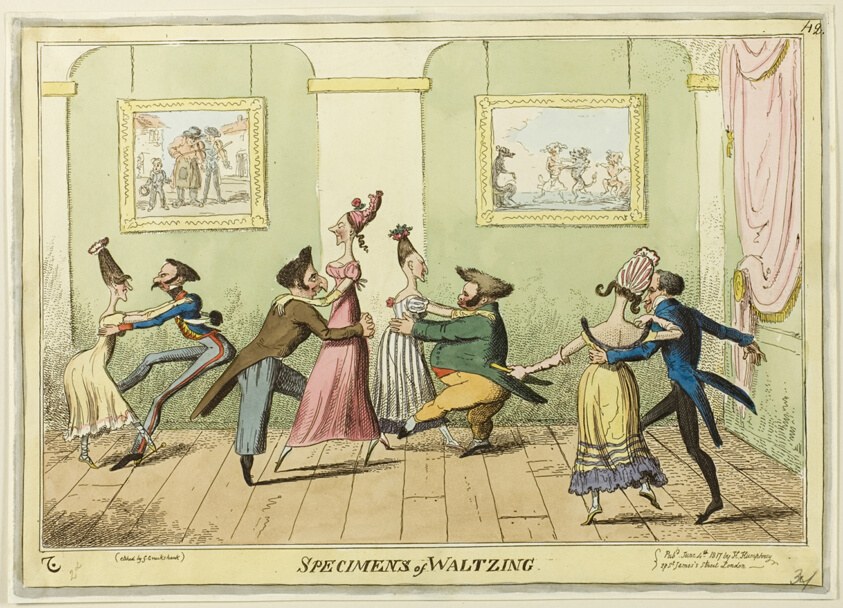
A lively interior scene depicts six figures in Regency-era dress engaged in waltzing within a sophisticated room with pale green walls, arched architectural details, and framed paintings above. The floor is rendered in perspective with wooden boards. A pink silk curtain with swags hangs on the right. The figures are arranged across the space in various stages of the waltz: some in coupled positions, others observing or awaiting their turn. The men wear dark coats with blue breeches; the women wear high-waisted Regency gowns in white, pink, and pale yellow. The composition captures the energetic, slightly comic spirit of the waltz as fashionable but still novel entertainment—the figures' postures and expressions suggest both enthusiasm and the slight awkwardness of learning the dance. Cruikshank's hand-coloring is applied with subtle washes; the line work carries all the detail and wit.
The dancing
The dancers exhibit the characteristic closed hold of the waltz, with partners facing each other at close quarters—notably closer than older dances required. Arms are extended in the ballroom frame: the man's right hand on the woman's back or waist, her right hand resting on his shoulder, their outer hands joined. The bodies are relatively upright, without the elaborate arm positions of baroque or neoclassical styles. Weight appears to rest on the legs rather than lifted through the spine. The footwork is not clearly legible in the etching, but the turned-out placement of feet and the rotational movement of the couples suggests the characteristic three-beat figure of the waltz.
The dance depicted
This is the waltz as danced in Regency England, circa 1810–1820, the period of its first fashionable adoption in British ballrooms. The waltz had arrived from Continental Europe—Vienna and Germany—and was controversial: the closed hold and the speed of rotation were considered daring and even improper by conservatives. 'Specimens of Waltzing' documents the dance at the moment of its social novelty and gradual acceptance into polite society. The title's use of 'specimens' suggests a typological or instructional purpose, as if the print were presenting different stages or styles of waltz technique. The presence of multiple couples in various positions reinforces this didactic quality.
How it was made
This is a hand-colored etching, a technique that allowed for mass production and wide circulation among the middle and upper classes. The etching line is fine and precise, carrying Cruikshank's characteristic satirical energy through the poses and expressions of the figures. Hand-coloring in watercolor or oil wash was applied after printing, which accounts for the soft, translucent quality of the backgrounds and clothing. The medium was ideal for social satire and topical prints: relatively cheap to produce, quick to execute, and capable of reaching coffee houses, print shops, and private collections within weeks of an event or trend. This print's circulation would have been among the London literate public—the audience for satirical commentary on fashion and manners.
About this work
This is a hand-colored etching documenting the waltz at a pivotal moment in British social history: its arrival and adoption as a fashionable ballroom dance in the Regency period. The print functions simultaneously as a record, a teaching tool, and a gentle satire on the social anxieties surrounding the dance's novelty and intimacy. Cruikshank, one of the period's most prolific and observant satirists, captures the waltz not as an abstract pattern but as a lived practice—the hesitation of beginners, the pleasure of couples already confident, the watching of those waiting their turn. The print is valuable to historians as visual evidence of how the waltz was performed, dressed, and perceived in early-19th-century London, and to dancers as a representation of the ballroom technique and social decorum of the period.
How to look at it
Notice the variety of postures and stages of expertise: some couples are mid-rotation, their bodies angled and alert; others are more stiffly upright or tentative. Cruikshank freezes a moment of social flux, not a moment of perfect technique. Attend to the positioning of the closest couple (left foreground): the man and woman are at very close quarters, their bodies nearly parallel, their rotation about to carry them across the room. This was the controversial aspect of the waltz—the intimacy and speed would have been visibly striking to viewers accustomed to older dances like the minuet or the country dance, which kept couples at arm's length and moved in set figures. The composition uses architectural perspective and the green walls to frame the dancers and emphasize the formal setting of the ballroom. The title 'Specimens' invites the viewer to read the print as a guide or instruction, comparing the different couples and inferring the steps and timing from their positions.
The artist
George Cruikshank (1792–1878) was the most celebrated English satirical artist of the 19th century, famous for his caricatures of political figures, social types, and fashionable follies. He worked primarily in etching and wood engraving, and his prints were published and distributed widely through London print shops. Cruikshank was prolific: he produced thousands of designs for satirical and topical prints, book illustrations, and commercial projects. His style—exaggerated proportions, sharp wit conveyed through posture and expression, precise line work—made him the visual chronicler of Regency and early Victorian society. 'Specimens of Waltzing' is characteristic of his social observation: neither cruel nor condescending, but attentive to the comedy and humanity of fashionable life.
The period
The waltz emerged in Vienna in the 1780s and spread to aristocratic and upper-middle-class ballrooms across Europe in the first decade of the 19th century. In Britain, it arrived during the Napoleonic Wars and the Regency period (1811–1820), a time of social ferment, changing gender relations, and anxiety about Continental influences. The waltz's adoption was contested: older dancing masters and conservatives attacked it as immoral because of the close hold and the speed of the turning motion, which was thought to overstimulate the nervous system and compromise female modesty. Younger dancers and fashionable society embraced it. By the time Cruikshank made this print in 1817, the waltz was becoming established, though still new enough to warrant satirical observation. The print coincides with the publication of the first English waltz instruction manuals and the growing availability of waltz music in London. In visual art, dance was more often treated in grand historical or mythological scenes than in contemporary social satire; Cruikshank's choice to document the fashionable dance of his own moment was unusual and valuable.
Where it lives
This print is held in the Prints and Drawings collection of the Art Institute of Chicago. It was published by Hannah Humphrey, a prominent London print seller and publisher active from the 1780s onward. Humphrey's shop on Bond Street was a center for the sale and distribution of satirical and topical prints, and she published many of Cruikshank's most famous works. This print would have been sold as a loose sheet, framed for the home, or bound into a collection; its presence in a major museum collection reflects its value as both social document and work of art.
Dance in this work
Questions about this work
Why was the waltz controversial in 1817?
The waltz was considered improper because of the closed hold—the man's hand on the woman's back—and the speed and dizziness of the turning motion. Older generations saw this as overstimulating and a threat to female modesty. The dance was also associated with Continental fashion and was viewed with suspicion during the Napoleonic Wars as potentially corrupting to English morality.
What can we learn about waltz technique from this print?
The print shows the characteristic closed frame of the waltz, the relatively upright posture of the dancers, and the rotational movement that carried couples around the ballroom floor. The hand positions and body angles suggest the basic mechanics of the waltz figure, though the exact footwork is not legible. The variety of poses also suggests that the waltz was still being learned and standardized in 1817—different couples show different levels of confidence and technique.
Why did Cruikshank call this 'Specimens' of waltzing?
The title suggests a typological or instructional approach, as if the print were presenting different examples or variations of the waltz. Cruikshank may be gently mocking the proliferation of waltz instruction manuals and dancing masters that appeared in London in the 1810s, or he may be genuinely documenting the different styles and levels of expertise visible in a typical ballroom. The term 'specimens' also echoes scientific classification, adding a layer of humor to the treatment of fashion as a subject of serious study.
How was this print made and distributed?
This is a hand-colored etching, a technique that allowed for relatively inexpensive mass production. The image was etched into a copper plate, printed, and then colored by hand in watercolor or oil wash. Hannah Humphrey's print shop would have sold these loose, or customers could have had them framed. The medium and distribution network made satirical prints affordable to the middle class and widely available in London within weeks of their creation.
More dance artwork





