49 works in this view — arrow keys or swipe to move between them.
Dance in Art
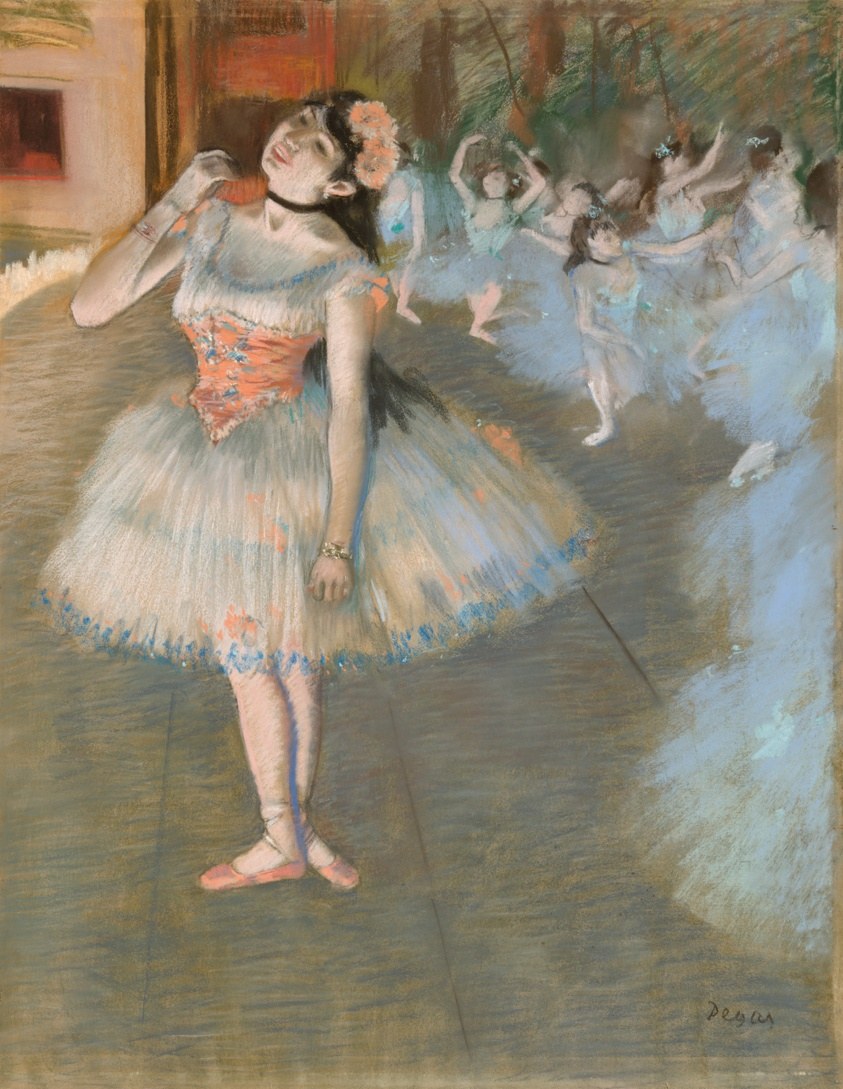
The Star
Edgar Degas French, 1834-1917
- Medium:
- Pastel on cream wove paper, edge mounted on board
- Collection:
- Prints and Drawings
- Source:
- Art Institute of Chicago
- Rights:
- Public domain — free to use, share and adapt.
- Recorded as:
- CC0 (Public Domain)
Degas's ballet works are among the most important visual documents of nineteenth-century dance practice and training, offering insight into how dancers moved, how studios were organized, and what the theatrical experience actually looked like from backstage. His repeated focus on moments of rest, rehearsal, and the corps de ballet rather than dramatic climax shifted the subject matter of dance imagery, making the ordinary and physical as worthy of serious art as the spectacular and romantic.
What you are looking at
A ballet rehearsal or performance captured mid-movement, with a principal dancer in the foreground and a corps of dancers receding into the background. The principal figure, dressed in a pale blue tutu with an orange-coral corset, stands in a classical pose with her head tilted back and one arm raised to her neck or head in a gesture of fatigue or emotion. Her body weight is centered, her legs long and extended. Behind her, five or six corps dancers in identical pale tunics are arranged in loose formation, their bodies turned and arms raised in coordinated but less individually expressive gestures. The setting is a wooden dance studio or stage floor, rendered in warm ochres and grays, with architectural elements—doorways and possibly a mirror—visible in muted earth tones along the left wall. The lighting is soft and natural, with warm highlights catching the dancers' skin and the delicate fabrics of their costumes. The overall mood is one of exertion and concentration rather than theatrical display.
The dancing
The principal dancer's frame is upright but weary, her weight grounded through her legs as she stands nearly en face with her torso centered. Her raised arm and tilted head suggest a moment of rest or emotional expression rather than active movement. The corps dancers behind her maintain similar postures—upright, arms lifted, bodies aligned—but lack the individualized character of the soloist. All figures are rendered with anatomical awareness: visible muscle tone in the legs, the curve of the back, the natural drape of the tutu fabric. The dancers' feet are in soft ballet slippers, and their turnout is evident though not exaggerated.
The dance depicted
This is Romantic-era theatrical ballet, most likely from a work in the 1870s repertoire. The imagery captures a rehearsal or performance in the classical ballet vocabulary of the period: the tutu, the turned-out positions, the corps de ballet as a unified backdrop to the soloist. The principal dancer's pose—head back, arm raised—suggests a moment of pathos or exhaustion, which aligns with the Romantic ballet interest in the dancer's emotional and physical vulnerability. The artist has observed ballet training and performance closely, understanding both the formal positions and the human cost of the dance.
How it was made
Pastel on cream wove paper, a medium that allowed Degas to work quickly and capture the transient qualities of movement and light. The slight edge-mounting on board suggests this was a finished work intended for exhibition rather than a sketch. Pastel's soft texture creates the diffused lighting and the subtle modeling of flesh and fabric visible throughout—the shimmer of the tutus, the warmth of skin tones, the depth of the wooden floor. This was a technique favored by artists interested in capturing ephemeral moments and the quality of stage light.
About this work
This pastel depicts a moment in a classical ballet rehearsal or performance, with a weary principal dancer in the foreground and a corps de ballet arranged behind her. Degas was fascinated by ballet as a subject—its formal beauty, its physical demands, and the gap between what the audience saw and the labor that produced it. The work belongs to a large body of his dance imagery from the 1870s and 1880s, a period when he was attending rehearsals at the Opéra and making dance one of his primary subjects.
The painting captures ballet at a moment of transition in both art and the dance world. The Romantic ballet of the mid-nineteenth century was giving way to new ideas about choreography and technique, yet the classical tutu and the corps de ballet remained constants. Degas's unflinching eye—recording fatigue, concentration, the strain of holding a pose—challenged the audience's fantasy of the ballet as effortless grace, offering instead a more honest portrait of the dancer's craft.
How to look at it
Notice the principal dancer's posture and expression: her head tilted back, her arm raised, her body centered and still. This is not a moment of dramatic action but of recovery or introspection—the kind of moment usually invisible to the audience, visible only in rehearsal. Compare her individuated, emotionally charged pose with the more uniform, less characterized bodies of the corps behind her. The pastel technique allows Degas to render the texture of the tutus and the quality of studio light with extraordinary subtlety. The warm tones of the floor and the cool pale blue of the tutus create a color harmony that feels both naturalistic and carefully composed.
The artist
Edgar Degas (1834–1917) was a French Impressionist painter and sculptor who made dance, particularly ballet, a central subject of his work from the 1860s onward. Unlike other Impressionists, Degas favored structured composition, bold cropping, and a cool eye for human anatomy and effort. He attended rehearsals at the Paris Opéra regularly, sketching dancers in training and performance. His interest was not in the Romantic fantasy of the ballerina but in the physical reality: the musculature, the fatigue, the repetitive work, the hierarchies of the ballet world. He worked in multiple media—painting, pastel, sculpture, printmaking—and his ballet subjects span thousands of works.
The period
The 1870s in Paris were a period of intense artistic experimentation and a moment when ballet itself was in transition. The great Romantic ballets—Swan Lake (1876) was recent—still dominated the stage, but new choreographic ideas were emerging. Degas was part of a generation of artists interested in modern life, and he found in ballet an arena where modernity, discipline, and beauty converged. The Paris Opéra was a major cultural institution, and access to its rehearsal spaces gave Degas an unusual vantage point on the dance world. Pastel, the medium he favored for many of these works, was experiencing a revival in the 1870s as artists appreciated its immediacy and chromatic range.
Where it lives
The work is held in the Prints and Drawings collection of the Art Institute of Chicago, suggesting it was catalogued and preserved as a work on paper rather than as a painting. This reflects the historical category of pastel works, which were sometimes considered more akin to drawing than to oil painting.
Dance in this work
Questions about this work
Is this a real ballet, or did Degas invent the scene?
Degas drew from real observations of rehearsals and performances at the Paris Opéra, which he attended regularly in the 1870s and 1880s. However, his compositions are not documentary records of specific moments; he combined observed details—the architecture of the studio, the shapes of tutus, the postures of dancers—into invented scenes that capture the essence of ballet life. Many of his dance works represent rehearsals rather than performances, a choice that let him show the physicality and effort of dance.
Why is the main dancer so isolated and melancholic?
This posture—head back, arm raised—suggests exhaustion, concentration, or emotional vulnerability rather than depression. Degas was interested in capturing the human cost of artistic training and performance. The raised arm might signal a moment between movements, or it might be part of a gesture within a choreographed phrase. The mood is introspective and physical rather than theatrical.
What is the title 'The Star' referring to?
'Star' was a rank in the ballet hierarchy: an étoile or prima ballerina. The principal dancer in the foreground, with her distinctive orange corset and centered pose, is the star; the corps behind her are supporting dancers. Degas's title plays on this institutional structure, emphasizing both the dancer's status and her solitary burden.
Why did Degas choose pastel for so many of his dance works?
Pastel allowed Degas to work quickly, to layer colors without waiting for paint to dry, and to achieve subtle effects of light and texture that suited the ephemeral, fluid subject of dance. The soft, dusty quality of pastel also matched the atmospheric haze of stage lighting and the delicate fabrics of ballet costume. He could rework areas easily, which was important for an artist who often revised his compositions.
More dance artwork





