49 works in this view — arrow keys or swipe to move between them.
Dance in Art
Two Dancers
Edgar Degas French, 1834-1917
- Medium:
- Pastel and charcoal, with stumping and burnishing, on tracing paper, pieced and laid down on cardboard
- Collection:
- Prints and Drawings
- Source:
- Art Institute of Chicago
- Rights:
- Public domain — free to use, share and adapt.
- Recorded as:
- CC0 (Public Domain)
Degas's ballet scenes established the dancer's working body as a serious subject for fine art, elevating studio practice and rehearsal to the level of finished composition. For dance historians, this image documents the posture, carriage, and arm vocabulary of late-nineteenth-century ballet, showing both the ideal form and the artist's intense anatomical study. For viewers of art, it exemplifies Degas's mastery of pastel as a medium for capturing light, fabric, and the subtle gradations of human form in motion or near-motion.
What you are looking at
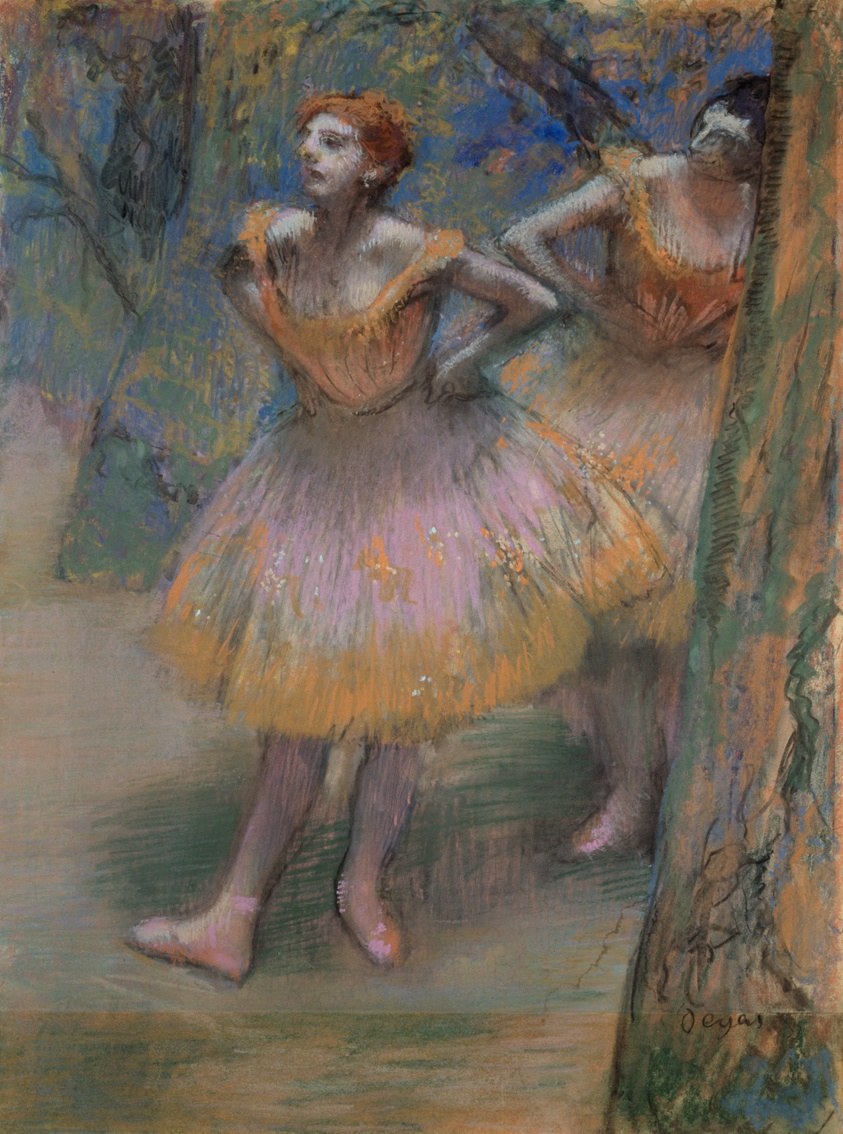
Two ballet dancers occupy a shallow stage space defined by warm-toned drapery and architectural elements rendered in deep blues and greens. The figure on the left, with reddish hair, stands in profile facing upstage, her body arched and arms raised in a classical pose. The second dancer, partially obscured on the right, echoes similar arm positioning. Both wear pale tulle skirts in shades of mauve and pale yellow, gathered at the waist and reaching mid-calf. The setting is sketchy and atmospheric rather than literal—the background suggests theater wings or architectural framing rather than a fully realised stage. The pastel medium creates soft edges and a luminous quality to the dancers' skin and fabrics, while warmer ochres and browns dominate the architectural space around them.
The dancing
Both dancers have raised arms in symmetrical or near-symmetrical positions suggesting an intermediate or advanced ballet phrase. The left dancer's torso shows clear extension and lift through the spine, with weight held upright; the right figure's pose echoes this without being identical. Their legs are not fully visible but suggest a standing position, possibly relevé or en relevé. The raised, rounded arm positions and lifted carriage are consistent with late-nineteenth-century ballet technique. No partnering or contact is evident; the dancers occupy separate vertical axes.
The dance depicted
This is almost certainly Romantic or late Classical ballet, based on the tulle skirts, pointe work implied by the dancers' carriage, and the raised arm positions characteristic of ballet vocabulary of the 1890s. The posed, studied quality and the setting suggest a rehearsal or a carefully staged moment rather than a climactic jump or turn. The painting offers no evidence of narrative action—it captures a moment of stillness or transition between movements. Without a title beyond 'Two Dancers,' the specific ballet cannot be identified from the image alone.
How it was made
This work is executed in pastel and charcoal on tracing paper, then pieced and laid down on cardboard—a technique that allowed Degas to build complex compositions from separate studies and to layer transparent and opaque media for atmospheric effect. The soft blending and stumping of pastel creates the hazy stage lighting and the luminous quality of tulle; charcoal adds definition to outlines and shadows. This technique was labour-intensive but allowed for rich chromatic effects and the kind of spontaneous-seeming composition that Degas favoured. The transfer to cardboard suggests the work was treated as a finished study, part of Degas's practice of developing ballet compositions across multiple sheets.
About this work
This is one of Degas's many ballet studio and rehearsal scenes, capturing two dancers in a moment of posed stillness or between movements. The work demonstrates Degas's refined technique in pastel, with particular attention to the play of stage light on fabric and skin, and his deep knowledge of ballet anatomy and carriage. The composition is typical of his late work: asymmetrical framing, cropped figures, and an emphasis on the everyday studio moment rather than public performance. It belongs to the tradition of dance imagery that Degas initiated in the 1870s—a tradition that treats the dancer's body as a subject for formal and technical investigation rather than as spectacle or narrative.
How to look at it
Look first at the pose and carriage: note how the artist has captured the lifted spine and the particular placing of the arms that identifies these as trained ballet dancers, not generalized figures. Then attend to the handling of light and fabric—the luminous pale tones of the tulle against the darker drapery, and the way the pastel medium allows soft transitions between warmth and cool. The composition is asymmetrical and cropped; the right-hand dancer is partially cut off by the frame. This was a deliberate choice by Degas, reflecting his study of Japanese prints and photography. The moment chosen is not dramatic—it is a held pose, which asks us to look at the body itself rather than at spectacle or narrative.
The artist
Edgar Degas (1834–1917) was a French painter and printmaker who made ballet dancers his dominant subject from the 1870s onward. He attended rehearsals and classes at the Opéra, sketched dancers backstage and in the wings, and developed an archive of poses and studies from which he composed finished works in oil, pastel, and printmaking. Unlike many of his contemporaries, Degas was more interested in the unglamorous, behind-the-scenes life of the dancer than in the spectacle of the stage itself. His approach combined Realist observation with classical figure study; he was influenced by Renaissance masters and by photography. By the 1890s, when this work was made, Degas had largely abandoned oil for pastel, which allowed him faster execution and a broader range of colour. His eyesight was failing in these years, which some have suggested pushed him toward the brighter, bolder palette of his late pastels.
The period
In the 1890s, ballet in Paris was dominated by the legacy of the Romantic era—tutus, pointe work, and ethereal, classically trained female dancers remained the standard. The Opéra continued to produce revivals and new works in this tradition, though the choreography was becoming increasingly codified. In visual art, Impressionism and Post-Impressionism were moving away from the study of dancers; Degas remained devoted to the subject long after other artists had abandoned it. The pastel medium itself was enjoying a revival among avant-garde artists as a tool for experimental colour and texture, and Degas's late pastels were part of a broader Symbolist and Modernist interest in non-traditional media. Studio imagery and the intimate view of artistic practice were increasingly valued as subjects in their own right.
Where it lives
This work is held in the Prints and Drawings collection of the Art Institute of Chicago. It is catalogued as a finished pastel study on paper mounted on cardboard, a form in which Degas frequently worked in the last decades of his career. The work's presence in a prints and drawings collection reflects the artist's and the institution's understanding of it as a work on paper, though pastel was regarded by Degas and his circle as a primary medium, not a study form.
Dance in this work
Questions about this work
Did Degas use live models for his ballet paintings?
Yes, extensively. Degas attended classes and rehearsals at the Paris Opéra and sketched dancers in situ. However, he also worked from memory and from accumulated studies, composing finished works in his studio rather than painting directly from the model. This is evident in the asymmetrical framing and unusual angles of his compositions—effects that could not be achieved with a single live model.
Why are so many of Degas's dancers in rehearsal, not performing?
Degas was interested in the dancer's body as a subject of formal study and in the lived experience of dancers—their work, their effort, their unglamorous training. The stage spectacle held less interest for him than the studio or the moment backstage. This choice reflects both his artistic concerns and his unconventional social position: he had access to rehearsals and private spaces that a painter working from the public theater would not.
What is the difference between this pastel work and Degas's oils?
Pastel allowed for faster execution and a brighter, more luminous colour range than oil. It could be blended and corrected more easily, and it did not require varnishing or long drying times. In Degas's late work, pastel also allowed for a more experimental, gestural approach to line and colour. He often worked on large sheets of paper, building colour in layers and using charcoal for definition.
More dance artwork





