49 works in this view — arrow keys or swipe to move between them.
Dance in Art
Dancer
Pablo Picasso Spanish, 1881-1973
- Medium:
- Graphite on cream laid paper (discolored to tan)
- Collection:
- Prints and Drawings
- Source:
- Art Institute of Chicago
- Rights:
- Rights reserved by the holding institution — do not reuse without permission. Source record ↗
- Recorded as:
- AIC — rights reserved
This work is valuable as a record of early 20th-century theatrical dance as it was actually performed—not idealized or posed for the camera, but sketched from life or memory by an artist attentive to the dancer's physicality and emotional state. It shows a moment of genuine exuberance, not mere technical display, and suggests the ways in which even formally trained dancers (evidenced by the control visible in the musculature and base) were exploring more expressive, less constrained uses of their bodies. For historians of dance in this period, it is a rare artifact of the transition between classical ballet and modern dance—a visual document of a dancer's experience of her own movement.
What you are looking at
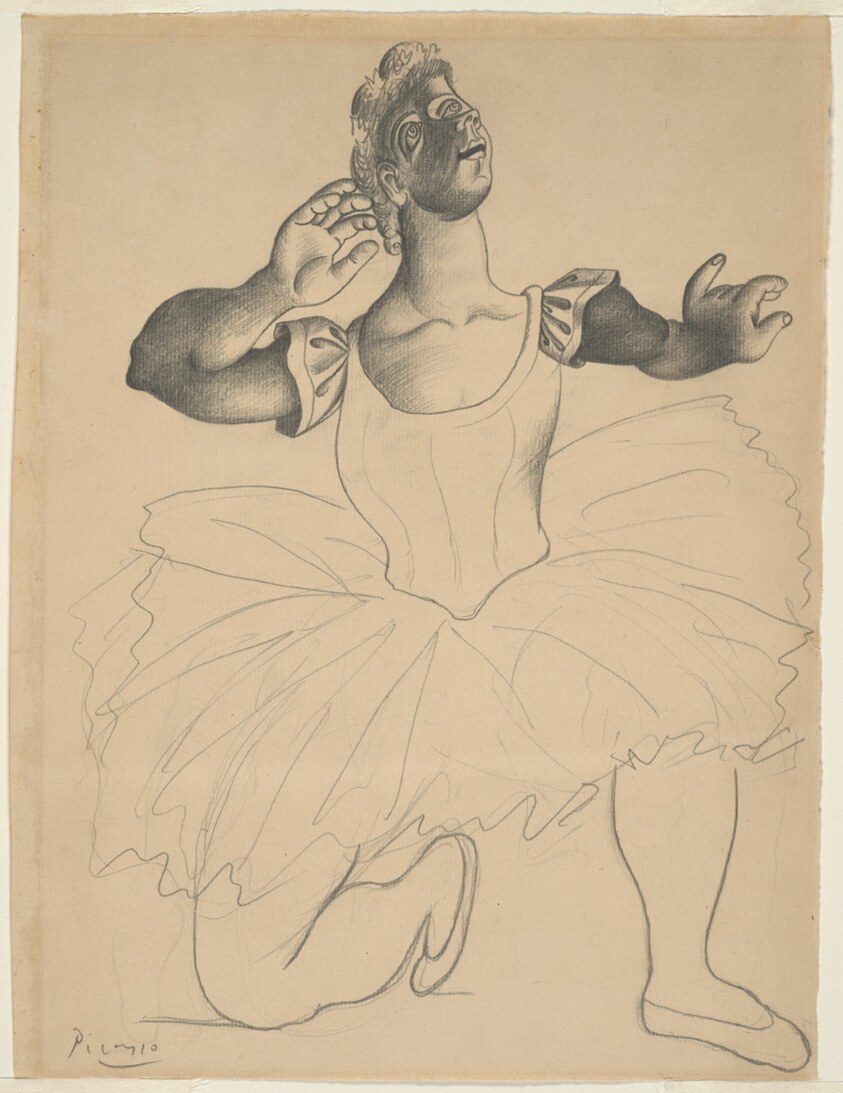
A single dancer dominates the composition, drawn in graphite with bold hatching on the upper body and limbs contrasting against more delicate line work in the lower half. The figure is depicted in a moment of exuberant extension: the left arm is raised and curved overhead, the right arm flung outward in a gesture of abandon or celebration. The dancer's face is rendered in profile, tilted back and upward in an expression of joy or rapture. The lower body is sketched more lightly, with the legs shown in a wide stance that suggests movement or a preparatory position. The most striking element is the skirt or costume piece at the hip level—rendered as a series of rapid, curved lines suggesting volume and motion, as if the fabric has been caught mid-swirl. The drawing technique itself conveys movement: the heavy shading on the torso and upper limbs creates weight and muscularity, while the lighter passages and flowing lines of the lower body suggest airiness and velocity. The entire composition is frontal and symmetrical enough to read as a portrait of the dancer's body in motion, yet the dynamic pose and the energy of the line work make it feel like a split-second capture of an exuberant gesture.
The dancing
The dancer stands in a wide, stable base with both legs visible and the weight evenly distributed, allowing for the expansive upper-body movement. Both arms are extended away from the torso—the left curved up and back in an overhead arc, the right reaching out sideways—creating an open, expansive frame. The head is thrown back in line with the raised left arm, suggesting an arc that flows from the legs through the spine and out through the crown. The musculature rendered in the chest and shoulders indicates strength and control, not collapse. The costume or skirt fabric billows outward from the hips, capturing the momentum of a turn or a gesture made with sufficient force to displace the cloth.
The dance depicted
This drawing most likely depicts a theatrical or concert dance from the early 20th century, executed in a style consistent with European modern or classical dance of the 1910s–1920s. The costume—what appears to be a classical tutu or draped skirt paired with fitted bodice—and the exuberance of the pose suggest either classical ballet or the early modern dance that emerged in reaction to it. The extreme openness of the arms and the backward arch of the head are not canonical positions in classical ballet technique, which favors more vertical carriage and controlled placement. This suggests either a moment of emotional expression within a theatrical narrative, or a work by a dancer or choreographer exploring more expressive or liberated movement vocabularies. The sketch quality and the artist's clear interest in the musculature and weight of the body suggest this is drawn from observation or memory of a live performance, rather than from an idealized or purely compositional impulse.
How it was made
The work is executed in graphite pencil on cream laid paper, now discolored to tan by age. The artist has used the full range of graphite tones available: heavy, dense hatching to build shadow and model the torso and upper limbs, with deliberate tonal gradation; lighter, more gestural linear passages to define the legs and costume; and fine contour lines to establish the profile of the head and the flowing edges of the skirt. This technique is characteristic of preparatory or sketch-stage work in early 20th-century studio practice—the kind of study a draftsperson might make from life or from memory to capture movement and emotional content quickly, before committing to a larger work. The paper surface and the directness of the medium allowed the artist to work with considerable speed and spontaneity, and the resulting image has an immediacy and energy that a more labored medium might have dampened.
About this work
This is a sketch of a solitary dancer in a moment of expansive, joyful movement, rendered in graphite with considerable technical skill and evident understanding of the body in motion. The figure wears what appears to be early 20th-century theatrical costume—a fitted bodice and full skirt—and the pose combines elements of classical dance training with an emotional expressiveness that suggests either a narrative moment or the influence of early modern dance experimentation. The drawing is a study of the human figure in dynamic, asymmetrical movement, captured with a draftsperson's attention to weight, musculature, and the flow of line. It belongs in a gallery devoted to dance because it documents not a static pose but the lived, embodied experience of movement—the way a trained body can be coordinated into an expression of joy or liberation.
How to look at it
Notice first the asymmetry and the backward arc that runs from the feet through the lifted head—this is the moment the artist chose to freeze, the instant of greatest extension and emotional expression. The dancer is not in a stable, symmetrical stance but in the middle of a gesture, with the weight controlled but the upper body in full extension. Look at how the artist has rendered the musculature: the heavy shading on the chest, shoulder, and upper arm shows that this is a trained, powerful body, not a fragile or merely decorative one. The skirt is not rendered realistically but as a series of curved lines suggesting motion—the artist has prioritized capturing the sense of the fabric displaced by movement over representing its actual form. The expression on the face—the thrown-back head, the open mouth suggested by the line work—is central: this is not a pose of classical restraint but of joy or ecstasy. A viewer might compare this to photographic studies of dancers from the same period to see how the artist has selected and distorted elements to convey movement and emotion.
The artist
Pablo Picasso (1881–1973) was a Spanish painter, sculptor, and draughtsman, and one of the most influential artists of the 20th century. Though best known for Cubism, Picasso was a prolific draughtsman throughout his career and returned repeatedly to the human figure, drawing it with classical precision or with the distortions and flattened perspective of his modernist practice. During the period around 1919, when this work was executed, Picasso was actively engaged with theatrical design and performance: he had collaborated with impresario Sergei Diaghilev and the Ballets Russes, designed sets and costumes for theatrical productions, and produced numerous studies of dancers and performers. His interest in capturing movement and the dancer's body was both aesthetic (exploring how the body could be represented in two dimensions) and personal (he frequented theatrical productions and had close relationships with dancers). This sketch sits within a large body of Picasso's work in which the figure—and particularly the performing or moving figure—served as a subject through which to explore composition, form, and the possibilities of representation.
The period
In 1919, European dance was at a moment of ferment and transition. The Ballets Russes, under Diaghilev, had been reshaping ideas about theatrical dance since 1909, bringing together avant-garde visual artists (including Picasso), composers, and dancers to create integrated theatrical works that challenged the conventions of classical ballet. In parallel, the early modern dance movement—developing in the work of dancers like Isadora Duncan, Ruth St. Denis, and Martha Graham—was consciously rejecting the constraints of classical ballet technique in favor of movement rooted in emotion, natural gesture, and individual expression. The costume and pose in this drawing suggest the artist was observing and responding to performers working in this transitional moment—dancers who had classical training but were exploring more liberated, emotionally expressive vocabularies. Visually, this was also a moment when artists across media were intensely interested in representing movement and energy, influenced by Futurism and the photographic study of motion. Picasso's sketch captures something of this ferment: it is technically skilled enough to show his classical training, but the energy and the emphasis on emotional expression align it with the experimental work being done on stage.
Where it lives
The work is part of the Prints and Drawings collection at the Art Institute of Chicago, a major repository of graphic works on paper. Within that collection it is catalogued as a drawing—a sketch in graphite rather than a finished composition or a printed work—suggesting it was likely part of an artist's working process or a study made for reference or sale to a collector with an interest in Picasso's practice.
Dance in this work
Questions about this work
Is this a study for a larger work?
The catalogue record does not indicate whether this sketch was preparatory to another work or was made as an independent study. Given the sketch-like quality, the emphasis on capturing movement and expression rather than detail, and the size and medium, it is consistent with studio practice of the period—it could have been made from life or memory, and either used as reference for a larger work or valued in its own right as a record of a moment.
Who was the dancer?
The catalogue record does not identify the performer. Given Picasso's involvement with the Ballets Russes and the theatrical world of Paris in 1919, it is possible the dancer was a known performer of that circle, but without additional documentation, the identity cannot be established from the image alone.
Is the costume a tutu?
The garment appears to be a full skirt or draped fabric, rendered with enough stylization that a precise identification is difficult. It is consistent with early 20th-century theatrical costume—possibly a classical tutu, but also consistent with the looser, more draped costumes of early modern dance or the costumes designed by avant-garde artists for Ballets Russes productions.
Why is the drawing so sketchy?
The sketch quality is not a result of incompleteness or lack of skill; rather, it is a deliberate choice of technique suited to capturing movement and momentary expression. The loose lines and heavy shading allow the artist to convey energy and weight without getting bogged down in detail. This approach was common in life drawing and in studies made from observation or memory.
More dance artwork





