49 works in this view — arrow keys or swipe to move between them.
Dance in Art
A Dancer
Edgar Degas French, 1834-1917
- Medium:
- Charcoal on dark orange card
- Collection:
- Prints and Drawings
- Source:
- Art Institute of Chicago
- Rights:
- Rights reserved by the holding institution — do not reuse without permission. Source record ↗
- Recorded as:
- AIC — rights reserved
This drawing documents the aesthetic and physical demands of late-nineteenth-century ballet at a moment when supported adagio and the spectacle of the female body in extension were central to the art form's prestige. It shows how a major artist of the period understood and valued the ballet dancer's body—not as a decorative ornament but as a site of architectural beauty and physical labor. For dancers and historians, it is evidence of what the era prized and how it was seen.
What you are looking at
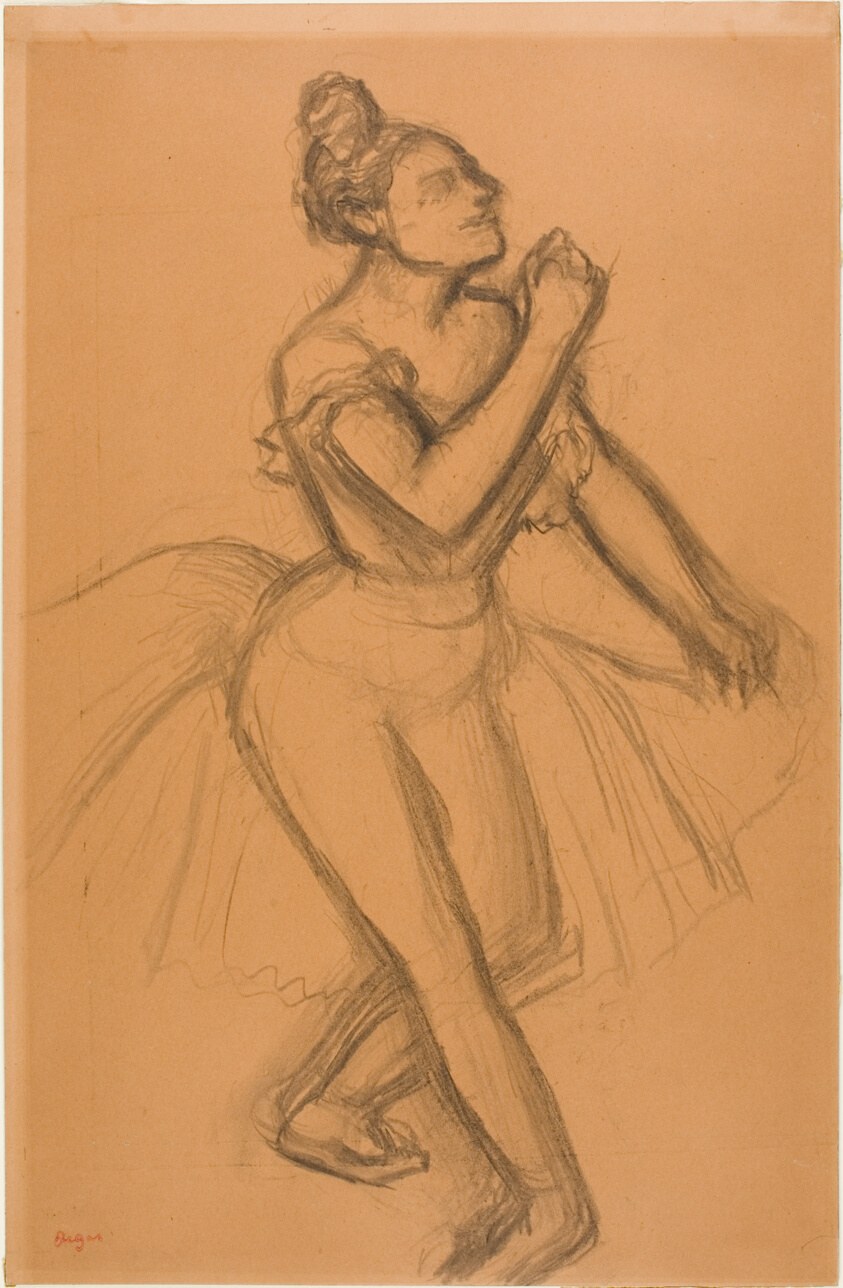
A single female dancer in a balletic pose, rendered in charcoal on warm orange card stock. She is captured mid-movement, her body arched backward in a supported lift or supported balance—the characteristic suspension of romantic-era ballet. Her left leg extends upward and back; her right leg remains bent beneath her for stability. Her torso is nearly horizontal, head tilted back, arms raised in a classical frame. She wears a tutu of indeterminate length—the skirt is sketched in quick, gestural lines that suggest both volume and movement. Her feet appear to wear pointe shoes. The drawing is economical and searching; the artist has worked over certain passages (the torso, the face, the supporting leg) while leaving others—particularly the tutu and the dancer's arms—more lightly indicated. The warm card creates an intimate, studio feeling, as if this is a study from life or a memory of a specific moment.
The dancing
One female figure in an off-vertical, dramatically arched pose that requires external support or a partner. Her body is extended in a concave curve—the head dropped back, the chest opened, the lower spine in extension. The working leg is lifted high and back; the supporting leg is flexed and grounded. The arms are raised but not in the precise, symmetrical frame of academic ballet—they read as engaged but natural, responding to the balance demand of the pose. The artist's attention to anatomical weight and the strain of the position is evident; this is not a pose struck for display but a moment of sustained physical effort.
The dance depicted
This is romantic-era ballet, almost certainly a pas de deux or supported solo in the style practiced in the 1870s–1890s. The pose is typical of the supported adagio work that defined the era: a male partner would support the dancer in this arched suspension, allowing for the extreme extension and opening of the torso. The artist has chosen a moment of profound vulnerability and display—the body extended, the face upturned, the line from the supporting foot through the lifted leg meant to be long and unbroken. This is not character or folk dance; the pointe shoes, the tutu, the classical arm placement, and the balletic proportions confirm theatrical ballet. The specific pose suggests the supported arabesques and cambré (back-bend) figures that were showstoppers in late-nineteenth-century ballet.
How it was made
Charcoal on dark orange (or tan) card, a medium favored in ballet studies and theater sketches for its speed and expressiveness. Charcoal allows the artist to move between precision and suggestion—the face and torso are rendered with careful observation, while the tutu and limbs are abbreviated with broad, searching strokes. This is not a finished exhibition piece but a working study, the kind a theater artist or dance enthusiast would make quickly in rehearsal or from memory. The warm card ground eliminates the need for added highlights; light is implied by the card itself, and shadow is built with charcoal. This technique was common in late-nineteenth-century Paris and suggests the drawing was made for the artist's own record or for a collector with immediate access to the theater or studio.
About this work
This is a charcoal study of a ballet dancer in a supported pose characteristic of romantic and late-nineteenth-century classical ballet. The drawing captures a moment of physical extremity—the body arched in a cambré or supported lean, the leg extended, the face composed but vulnerable. It is not a formal portrait or an idealized diagram of classical technique but a direct observation of a dancer's body in a specific, demanding position. The technique—charcoal on card—is immediate and intimate, suited to a working study made in or near a theater or studio. The work belongs to the tradition of European theatrical dance documentation and sits between fine art and rehearsal record.
How to look at it
Attend first to the dancer's spinal curve and the relationship between the supporting and working legs—this is where the technical demand lies. Notice how the artist has rendered the head and face with more finish than the limbs; this is typical of Degas and suggests his interest in the dancer's psychological moment, not just her physical shape. The quick lines of the tutu indicate volume and motion without describing it; let your eye complete the garment. Look at the position of the arms: they are not in a formal, symmetrical frame but appear to respond to the balance and effort of the pose. This is a moment caught in the work of support and display, not a moment of pure, effortless line.
The artist
Edgar Degas (1834–1917) was one of the most prolific recorders of ballet in Western art. He attended rehearsals and performances at the Paris Opera for decades, filling thousands of sheets with studies of dancers in motion, at rest, and in the wings. Unlike many painters of the period, Degas did not romanticize ballet; he was interested in its physical facts—the strain of training, the geometry of the body in motion, the social reality of dancers' lives. He worked in oils, pastels, prints, and drawings, and his studies on paper were often preparatory to paintings but were also valued as independent works. His ballet subjects reveal a sustained engagement with how bodies move under pressure, how light catches fabric, and how the stage transforms human form.
The period
In the 1880s, when this drawing was likely made, ballet in Paris was dominated by the spectacular pantomime-ballets of the Opéra and by the phenomenon of the prima ballerina—the soloist whose technical achievement and physical beauty were the measure of the company's prestige. The supported adagio, in which a male dancer sustained the woman in demanding positions, was the centerpiece of late-nineteenth-century ballet technique and display. Degas was working in the final decades of this era; the Romantic ballet, with its emphasis on the female dancer's otherworldliness and lightness, had evolved into a more explicitly technical, architecturally ambitious practice. The tutu had become shorter and stiffer; pointe work was more demanding; the lifted, arched line of the body was prized as a sign of control and beauty. Degas's studies are among the richest documents of this moment.
Where it lives
The work is held in the Prints and Drawings collection of the Art Institute of Chicago. Degas's drawings of ballet subjects were highly sought after in his lifetime and after; many were separated from larger studio collections and entered public institutions. This work's presence in a major American museum reflects the early twentieth-century recognition of Degas as a canonical figure in modern art and his ballet studies as central to his achievement.
Dance in this work
Questions about this work
Is this a finished work or a study?
This is a working study—economical, direct, made in charcoal on card stock with no elaborate finishing. It documents a moment and a pose, the kind of drawing a theater artist would make in or near a rehearsal or performance space. That said, charcoal studies like this were also valued as independent artworks and were often collected; the distinction between 'study' and 'finished work' was not absolute in the nineteenth century.
What dance is this?
This is romantic or classical ballet, almost certainly a supported adagio from a pas de deux. The pointe shoes, the tutu, the arched spine, and the extended leg position are all hallmarks of late-nineteenth-century ballet technique. The pose shown here—a cambré or back-bend with the leg lifted—was a showstopper in this era.
Why is the dancer arched backward?
The arched, backward-leaning pose was a key technical and aesthetic feature of late-nineteenth-century ballet. It displayed the line of the body, demonstrated the dancer's flexibility and control, and created a moment of vulnerability and openness that was highly valued as art. This position could only be held with a male partner's support; it was central to the pas de deux.
How do we know this is Degas?
The catalogue record attributes it to him. The style, technique, and subject—a study of a ballet dancer in a demanding supported position—are entirely consistent with Degas's known practice and interests. His treatment of the figure is spare but anatomically exact, and his use of charcoal on card is typical of his working method.
More dance artwork





