49 works in this view — arrow keys or swipe to move between them.
Dance in Art
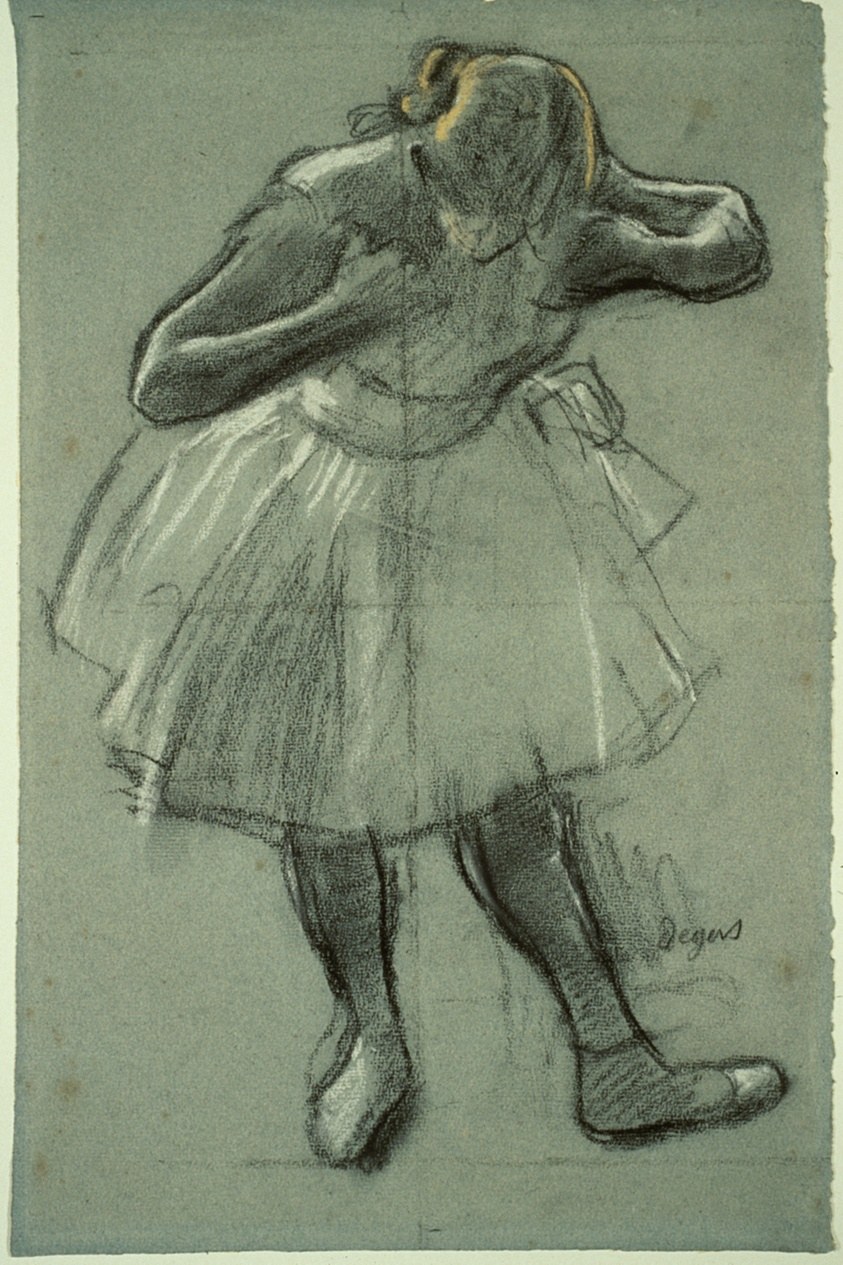
Dancer Bending Forward
Edgar Degas French, 1834-1917
- Medium:
- Charcoal with stumping, heightened with white and yellow pastel with stumping, on blue laid paper ruled with charcoal
- Collection:
- Prints and Drawings
- Source:
- Art Institute of Chicago
- Rights:
- Public domain — free to use, share and adapt.
- Recorded as:
- CC0 (Public Domain)
This drawing reveals how a major artist of the era studied the ballet body—not as a heroic ideal frozen in arabesque, but as a physical, muscular form subject to gravity and fatigue. It documents the actual postures and dress of late-19th-century ballet practice with specificity that even photographs of the period rarely match.
What you are looking at
A single female dancer dominates this charcoal study, captured in a moment of forward flexion. She wears a pale tulle skirt with pronounced vertical pleating that catches the light, paired with dark tights and soft ballet shoes. Her upper body is rendered in deeper charcoal tones, creating strong volumetric modeling of the torso and shoulders as she bends deeply forward from the hips. Her head hangs down, obscuring her face, while her arms hang loosely at her sides or rest against her body. The figure is set against a neutral blue-gray ground, with no setting or background indicated. The artist has used stumping to soften charcoal and pastel, creating a velvety surface texture that emphasizes the three-dimensionality of the form.
The dancing
The dancer's posture is one of profound forward flexion—a deep bend from the hips with the torso nearly parallel to the floor, the head dropped. There is no visible arm port de bras or lift; the limbs are relaxed and heavy. The weight appears to be settled into the hips and supporting legs. The tulle skirt falls in controlled vertical folds, suggesting the fabric is being held by the dancer's forward bend rather than swept by movement. This is a study of a moment of rest or transition, not of dynamic extension or turning.
The dance depicted
This is almost certainly a study for a theatrical ballet dancer in repose. The tulle skirt, soft ballet shoes, and anatomical study of the human form through movement are consistent with the practice of academic ballet in the late 19th century. The emphasis on the female body in a pose of quiet introspection or fatigue—rather than virtuosity—suggests a moment from rehearsal or a contemplative passage within a longer work. The artist demonstrates close observation of how the tulle tutu behaves under gravity and the three-dimensional anatomy of the female torso when not held in an upright line.
How it was made
This work employs charcoal with stumping (blending with a stump or tortillon), heightened with white and yellow pastel, all on blue laid paper. The combination allows for both precise linear definition in the charcoal and soft, atmospheric modeling in the lighter tones. Stumping creates a painterly, unified surface that would be suited to studio study rather than public display. This is a working drawing—a medium that permitted the artist rapid capture of form and tone without the commitment of oil paint, and which allowed for easy reworking.
About this work
This is a character study of a ballet dancer in a moment of quiet repose, created as a studio work on paper. It belongs firmly within the tradition of academic figure drawing as practiced by late-19th-century artists working in Paris, where detailed anatomical observation of the moving body was central to artistic training and to theatrical practice. The work demonstrates both the artist's keen interest in the female body as a formal problem and the intimate access that studio artists had to dancers and their rehearsal spaces during the period.
How to look at it
Look first at how the artist has rendered the forward bend: the compression and weight of the torso, the way the spine curves, the heaviness in the shoulders and arms. Notice how the charcoal is worked darker on the back and sides of the body, creating a sense of volume and the body's mass. The tulle skirt is not idealized or ethereal; each fold is observed with precision, catching light unevenly. The blue paper is left visible in places, functioning as a middle tone that the white and yellow pastel can lift from. This is a drawing made to understand how the body actually moves and rests, not to create a finished, polished image.
The artist
Edgar Degas (1834–1917) was obsessed with dancers throughout his career, especially the dancers of the Paris Opéra. He made thousands of studies of them—drawings, pastels, paintings, and sculptures—often working from sketches made backstage and in rehearsal rooms. Unlike many contemporaries, Degas was interested in unglamorous moments: rest, preparation, strain, repetition. His draftsmanship was schooled in the classical tradition, but his subject matter and the intimacy of his access to his subjects' bodies set him apart. These studio drawings were the foundation of his larger works.
The period
In the 1870s, when this drawing was likely made, ballet in Paris was at a turning point. The Romantic era's idealization of the sylph was giving way to a more technically demanding and physically explicit style. Degas's contemporaries included composers and choreographers pushing ballet toward greater realism and less narrative sentimentality. At the same time, Degas and his fellow Impressionists were beginning to challenge academic art practice; his ballet subjects were often presented in unconventional compositions and lighting that mimicked the artificial light and strange angles of the theater itself. The drawing's focus on the body as an anatomical and mechanical object reflects broader shifts in how the dancing body was understood.
Where it lives
This work is held in the Prints and Drawings collection of the Art Institute of Chicago. It is catalogued as part of Degas's extensive legacy of studies on paper, which form the largest body of material by the artist.
Dance in this work
Questions about this work
Is this a finished work or a study?
It is a studio study—a working drawing made to capture pose, form, and the behavior of costume. Degas made thousands of such studies, from which he would compose finished paintings and pastels. The medium (charcoal and pastel on paper) and the informal composition confirm this as a preparatory or exploratory work rather than a finished piece intended for exhibition.
Why is the dancer bending forward?
The pose may represent a moment of rest during rehearsal, a stretch, or a specific movement within a choreographed sequence. Degas was interested in capturing the unguarded, physical reality of ballet work, not merely the polished moments of performance. Without knowing the specific context, we can only observe what is shown: a body at ease, without artifice.
How can you tell this is ballet and not another dance form?
The soft ballet pointe shoes, the tulle tutu, and the anatomical precision with which a female body in theatrical dress is studied are all consistent with late-19th-century academic ballet practice. The emphasis on the body's vertical line and the formal costume distinguish this from other theatrical traditions of the period.
Why does the artist use both charcoal and pastel?
Charcoal allows for precise, dark definition and can be easily blended with a stump to create soft transitions. Pastel (white and yellow here) allows the artist to add highlights and warm tones that cannot be achieved with charcoal alone. The combination is economical, quick, and well-suited to capturing fleeting poses in the studio.
More dance artwork





