49 works in this view — arrow keys or swipe to move between them.
Dance in Art
Untitled (Dancer)
Susan Rothenberg American, 1945-2020
- Medium:
- Charcoal on paper
- Collection:
- Prints and Drawings
- Source:
- Art Institute of Chicago
- Rights:
- Rights reserved by the holding institution — do not reuse without permission. Source record ↗
- Recorded as:
- AIC — rights reserved
The work exemplifies how late-20th-century visual artists returned to the dancing body as a primary subject for abstraction and formal investigation. Rothenberg's approach—celebrating the extended classical line while emphasizing the artist's gestural mark-making—helped establish a new visual language for depicting dance that valued process and expressiveness alongside formal structure.
What you are looking at
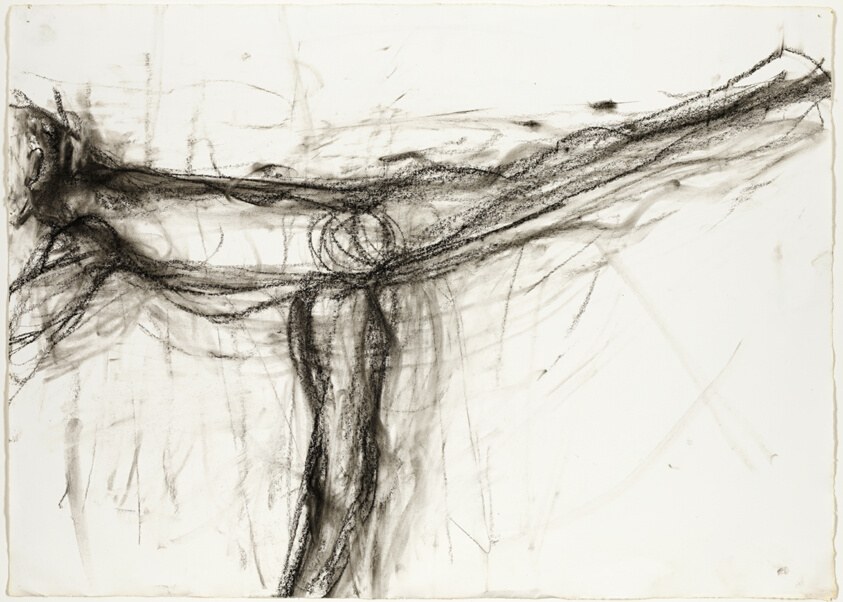
A single figure dominates this charcoal drawing, rendered in gestural, exploratory marks that build form through accumulated line rather than outline. The dancer is captured in a horizontal leap or extension, the body stretched dramatically along the page. The head is tilted back, the extended left arm reaches forward and upward, while the right leg appears to extend behind in a arabesque-like position. The torso is arched in a deep backbend that suspends the body in mid-air. The drawing prioritizes the geometry of the extended body over anatomical detail: Rothenberg has concentrated on the elongated spine, the reach of the limbs, and the taut line created by the posed figure. The paper shows multiple layers of reworking—lighter preparatory lines and shadow-building strokes remain visible beneath darker charcoal definition, creating a sense of searching and revision. The figure emerges from and sits within a field of loose, gestural marks that suggest ground, space, or the artist's own movement across the page.
The dancing
The single dancer's frame reads as a continuous diagonal thrust from the extended back leg through the arched torso to the reaching arm and tilted head. The body is in extreme extension—a deep back arch with no visible support, suggesting a moment of flight or suspension. The weight appears unsupported and anterior, typical of high classical extensions. The drawn line is confident but searching, with visible reworking suggesting the artist was negotiating how to capture both the structural arabesque and the expressive, arched quality of the moment.
The dance depicted
This appears to be classical ballet, most likely a romantic-era extension or arabesque captured at the apex of a leap. The horizontal extension of the body, the back arch, and the port de bras are consistent with 19th-century ballet technique, though Rothenberg has abstracted away period costume and context. The image captures the lifted, weightless quality sought in classical ballet—the illusion that the body has transcended gravity. Without visible pointe shoes or costume detail, the identification rests on the pose itself: the arabesque or extension is fundamental to theatrical ballet vocabulary.
How it was made
Charcoal on paper allows Rothenberg to work with bold, gestural marks while remaining able to erase and revise. The technique here is exploratory rather than finished: preparatory lines in lighter charcoal remain visible, and the darker definition of the final form sits over this pentimento, making the process of finding the pose apparent to the viewer. This directness and immediacy are characteristic of charcoal drawing and suited to capturing movement; the medium's responsiveness to the artist's hand is visible in the line quality.
About this work
Rothenberg's untitled drawing captures a single moment of classical ballet extension in extreme arabesque or suspension. The figure is rendered not as anatomical accuracy but as pure geometric reach—the elongated line of the dancer's body through space. Created in 1985, when Rothenberg was developing her distinctive approach to figuration through horses and human forms, this work demonstrates her interest in the body at moments of intensity and extension. The drawing belongs to a broader tradition of modern artists drawing from dance, yet Rothenberg's approach is distinctly her own: the visible reworking and the emphasis on line over detail suggest the artist was investigating how charcoal could register both the structure and the feeling of a posed body.
For dance historians and dancers, the work documents the classical arabesque as a subject for serious artistic attention outside the ballet studio or stage. Rothenberg treats the pose with the formal interest a sculptor might bring to the human figure, yet the visible process of drawing—the multiple passes of charcoal, the searching quality of the line—insists that this is an encounter with a moving or posed body, not a static sculpture.
How to look at it
Attend to the moment of suspension Rothenberg has chosen: the body at its most extended, caught at the apex of a leap or held in an arabesque. Notice how the visible charcoal strokes—especially the lighter preparatory marks—make the act of drawing part of the subject; this is not a finished representation but a record of the artist's search for the pose. Follow the continuous line from the back leg through the spine and arm to the tilted head; this diagonal thrust is the energy of the drawing. The loose marks around the figure are not background but part of the spatial and gestural field the artist has created.
The artist
Susan Rothenberg (American, 1945–2020) was known for paintings and drawings of horses and human figures rendered in a style that synthesized abstract expressionism with figuration. Beginning in the 1970s with her iconic horse paintings, she progressively developed a visual language that treated the body—animal and human—as a vehicle for exploring line, movement, and expressive gesture. Her work often captures bodies in moments of intensity or extension, and she frequently returned to dance and ballet as subjects. By the 1980s, when this drawing was made, Rothenberg was recognized as a leading figure painter working between abstraction and representation, using charcoal, paint, and printmaking to investigate the possibilities of figuration.
The period
The 1980s saw a renewal of interest in figuration across visual art, following decades of abstract dominance. Simultaneously, postmodern dance was questioning classical ballet vocabulary, yet classical ballet remained central to dance culture and a vital subject for visual artists. Rothenberg's generation of painters—including artists associated with Neo-Expressionism—treated the figure not as narrative subject but as a formal and expressive problem. In dance, the 1980s were marked by the continued influence of Merce Cunningham's innovations and a growing dialogue between visual art and contemporary dance, with many visual artists (Rothenberg included) collaborating with dancers and creating works explicitly about movement.
Where it lives
The work is held in the Prints and Drawings collection of the Art Institute of Chicago, one of the major repositories of works on paper in North America. As a charcoal drawing on paper, it is among the more ephemeral and vulnerable works in such a collection, requiring careful conservation and limited public display.
Dance in this work
Questions about this work
Is this a study for a painting?
It may be; Rothenberg often worked in series across different media. However, the drawing stands as a complete work in its own right. The visible reworking and the exploratory quality of the charcoal suggest this is an independent investigation of the pose, not merely a preparatory sketch.
What ballet pose is this?
It appears to be an arabesque or a penché-like extension—a classical ballet position in which one leg extends behind the body while the dancer balances on the other leg. The deep back arch is characteristic of romantic-era ballet, in which the arabesque was often held with the torso lifted and arched rather than in the more horizontal line preferred in later classical technique.
Why did Rothenberg paint dancers and horses?
Both subjects allowed Rothenberg to explore the body at moments of intensity and movement. Horses and dancers present forms in extension and spatial dynamic that suited her interest in line, gesture, and the expressiveness of the figure. The choice reflects a broader modernist tradition of artists finding in dance and animal movement a pure vocabulary of form and feeling.
More dance artwork





