49 works in this view — arrow keys or swipe to move between them.
Dance in Art
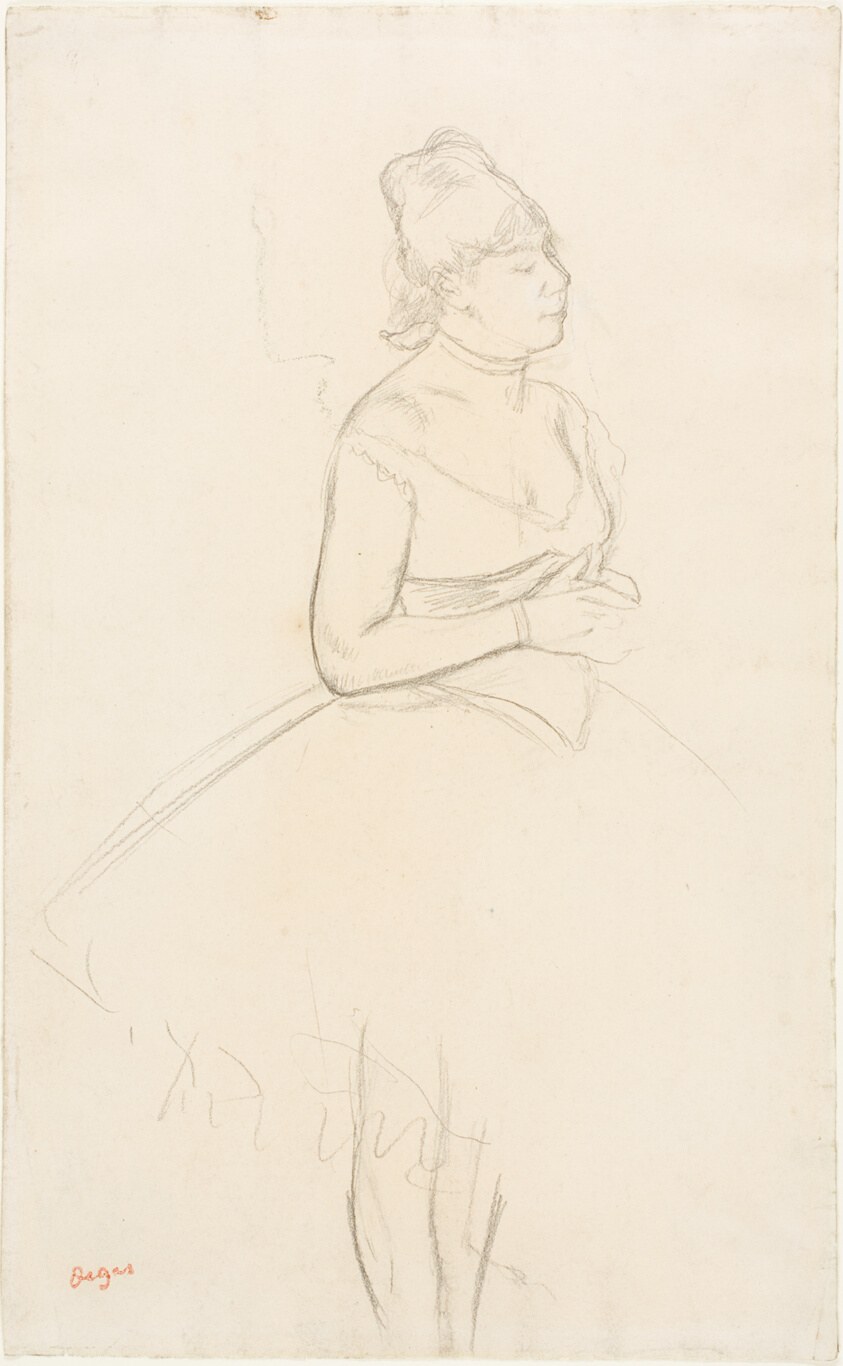
Dancer Taking a Bow
Edgar Degas French, 1834-1917
- Medium:
- Graphite on cream wove paper
- Collection:
- Prints and Drawings
- Source:
- Art Institute of Chicago
- Rights:
- Rights reserved by the holding institution — do not reuse without permission. Source record ↗
- Recorded as:
- AIC — rights reserved
Degas's ballet drawings are among the most accurate and intimate records we have of how classical ballet was actually performed and taught in the nineteenth century. They matter because they show the body not in idealized display but in the anatomical truth of its training and exhaustion—a realism that distinguishes Degas from salon painters who depicted the ballet as spectacle. For dancers and historians, these works are primary documents.
What you are looking at
A young female dancer is shown in three-quarter profile, seated or perched on what appears to be a stool or chair. She wears a sleeveless garment and a belt or sash at the waist; her legs are bare below a short skirt that extends to approximately mid-thigh. Her hair is pinned up in the style of the 1860s–1870s. The drawing captures her in a moment of rest or pause, her body angled away from the viewer, her gaze directed downward or into the distance. The pose suggests both exhaustion and the composed grace expected of a professional dancer. Degas has rendered her with swift, assured graphite strokes, economical in line but confident in capturing the weight and carriage of the body. The background is plain, throwing full attention onto the figure.
The dancing
The dancer's posture is one of repose; her weight appears settled, her shoulders relaxed but held with control. One arm rests across her body or lap; the other hangs naturally. Her legs, visible from hip to foot, show the dancer's characteristic turned-out leg position even at rest—a small but crucial detail that marks her as a trained performer of classical ballet. The tilt of her head and the slope of her torso convey a sense of private reflection, a moment stolen between performances or rehearsal.
The dance depicted
This is an image of theatrical ballet from the mid-nineteenth century, almost certainly depicting a professional ballerina of the Paris Opéra. The title 'Dancer Taking a Bow' suggests the moment after performance, though the pose is too quiet and inward-looking for a formal bow; instead, it captures the transition between the mask of performance and private exhaustion. The dress—sleeveless bodice, short skirt, bare legs—is consistent with the Romantic ballet costume of the 1860s, when tutus were shorter and more revealing than in later classical ballet. The figure's composed posture and the artist's attention to anatomical correctness indicate a subject drawn from life, possibly a specific performer.
How it was made
Graphite pencil on cream wove paper. Degas worked in this medium extensively throughout his career, developing great sophistication in the use of line and tone to suggest form and movement. Drawings of this kind were not finished works for public exhibition but studies from life—records of poses observed in rehearsal or backstage. They circulated among artists and collectors as precious documents of professional practice. The quick, assured line and the absence of heavy shading allow the pose to emerge clearly, making this the kind of drawing that would be studied by other artists as a model of how to render the human figure at rest.
About this work
This is a study by Edgar Degas of a professional ballet dancer of the Second Empire, drawn in graphite on paper. The work captures a moment of apparent rest—the dancer seated, composed, her body marked by the training that defines classical ballet even in stillness. Degas returned to the ballet again and again throughout his long career, drawn to the discipline of the practice, the geometry of the body in motion, and the peculiar life of the theater. This drawing belongs to a vast body of work in which he documented the Paris Opéra ballet from the 1860s onward, recording not only the grand performances on stage but the unglamorous work of rehearsal, fitting, and recovery.
How to look at it
Notice the economy of line: Degas does not outline the figure but suggests form through a few decisive marks. The turned-out leg position is a small but essential detail—it identifies her unmistakably as a trained dancer even in repose. Notice also the artist's refusal to sentimentalize: there is no prettiness here, no theatrical grace. The pose is private, unglamorous, true. The downward gaze and the slight slump of the shoulders suggest fatigue or introspection—the human cost of the performance you do not see. This is a moment stolen from the ballet itself, a glimpse of the body before and after the artifice.
The artist
Edgar Degas (1834–1917) was a French painter and draughtsman of the Impressionist circle, though he resisted the label. Unlike the Impressionists, he worked from memory and discipline rather than direct observation, and he had little interest in landscape or natural light. His subjects were urban and modern: the racetrack, the café, the theater. The ballet consumed his attention from the 1860s onward. He attended rehearsals and performances, sketched dancers constantly, and created a vast archive of ballet imagery—paintings, pastels, prints, and drawings. His ballet works are not romantic idealization but precise anatomy and the aesthetics of discipline.
The period
The 1860s were a turning point in ballet history. The great age of Romantic ballet (1830s–1850s), with its poetic otherworldliness and ethereal heroines, was giving way to a new emphasis on technical virtuosity and the spectacle of the corps de ballet. The Paris Opéra was the center of this world, and the ballet was integral to the life of the city—a subject fit for serious artistic attention. At the same time, photography was emerging as a tool for capturing the figure in motion, and artists like Degas were experimenting with new ways to reconcile photographic truth with artistic composition. The 1860s were also a period of intense social change in Paris, and the theater (especially the ballet, with its display of female bodies) became a site of fascination and sometimes moral anxiety.
Where it lives
The work is held in the Prints and Drawings collection at the Art Institute of Chicago and comes from a source listed as AIC. Degas produced vast numbers of drawings, many of which entered museum collections; this is one of thousands that document his sustained engagement with the ballet.
Dance in this work
Questions about this work
Why is the dancer's leg position important if she is just sitting down?
The turned-out position of the legs—with the hip rotated and the foot rotated outward—is a fundamental aspect of ballet training that becomes habitual even in rest. Degas understood this, and by rendering it accurately he was communicating something essential about what it means to be a dancer: the training has become second nature, inscribed in the body itself.
Is this an actual person or a generic figure?
The specificity of the drawing suggests it was drawn from life, probably during a rehearsal at the Paris Opéra. However, Degas did not always identify his models, and we cannot know the dancer's name without additional documentation. The work is both a portrait of a particular body and a study of the ballet dancer as a type.
What does 'taking a bow' mean in the title if she looks so tired?
The title may be slightly misleading or may refer to the moment after the bow—the transition from the formal gesture of gratitude back to the private self. Or it may simply indicate that this is a dancer, a professional who 'takes bows' as part of her work, rather than attempting to depict a specific moment. Degas's titles are often less prescriptive than we might assume.
More dance artwork





