49 works in this view — arrow keys or swipe to move between them.
Dance in Art
Dancers in the Wings
Edgar Degas French, 1834-1917
- Medium:
- Etching, aquatint and drypoint on ivory loose chine
- Collection:
- Prints and Drawings
- Source:
- Art Institute of Chicago
- Rights:
- Public domain — free to use, share and adapt.
- Recorded as:
- CC0 (Public Domain)
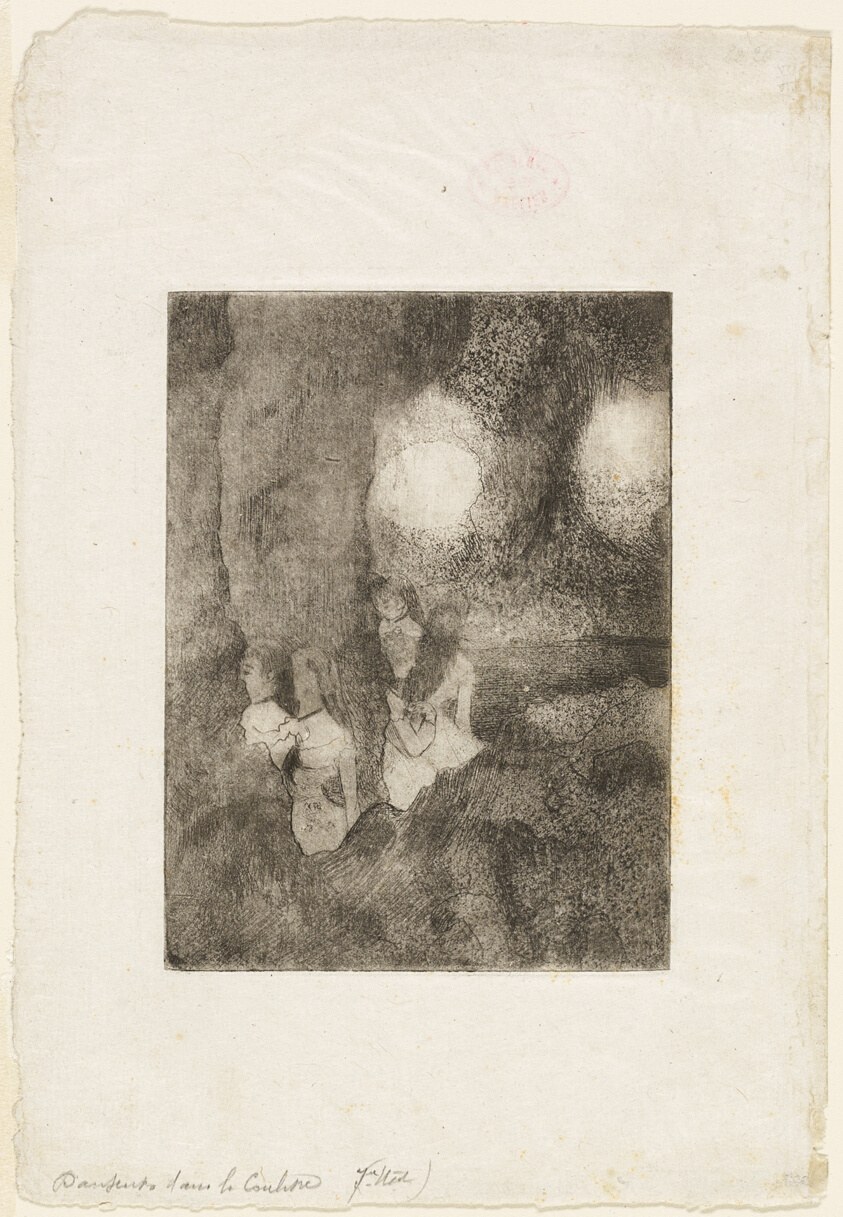
This work shows how nineteenth-century artists understood dance not as the public spectacle of a performance, but as a labor of waiting, preparation, and the bodies of supporting dancers. For historians of ballet, it is evidence of the hierarchies and conditions of the Opéra corps de ballet—who waited, in what costume, in what light. For print historians, it demonstrates how etching and aquatint could capture atmospheric theatrical space.
What you are looking at
Two young dancers in pale, gossamer costumes stand in the shadowed wings of a theater stage, their forms emerging from deep aquatint and drypoint shadow. They wear what appears to be short tulle skirts and fitted bodices typical of nineteenth-century ballet. The figure on the left is smaller, possibly younger, while the taller dancer on the right stands with one arm raised. Behind them looms a massive dark form—a piece of stage scenery or another dancer—rendered almost abstract by heavy cross-hatching. A thin horizontal line suggests the stage floor. The composition captures an intimate, suspended moment: these are not the principal dancers onstage, but the waiting corps, the dancers between performances. The light concentrates on their pale legs and upper bodies while the background dissolves into theater darkness.
The dancing
Both dancers stand upright with a lightness of weight characteristic of ballet training, their legs long and straight. The taller figure's raised arm and the way both hold themselves suggests a readiness or anticipation—the posture of dancers about to enter or just having left the stage. Their costumes—short skirts, fitted bodices—place them as ballet dancers of the corps de ballet or supporting roles. The scale and positioning suggest the younger dancer may be a soloist or principal dancer's understudy, a common hierarchy in nineteenth-century ballet companies.
The dance depicted
This is almost certainly a scene from Romantic-era ballet theater, most likely from the 1870s-1880s Parisian ballet world that Degas observed obsessively. The setting—the wings, the waiting dancers, the theatrical machinery—places this squarely in the context of ballet as a staged spectacle. We cannot identify a specific ballet or dance vocabulary from posture alone, but the costumes and the moment of in-between—not performing, but present—suggests Degas's characteristic interest in the labor and the spaces behind the curtain rather than the grand moments onstage.
How it was made
This is an etching with aquatint and drypoint, printed on chine collé (a thin paper mounted to a thicker backing). The etching line provides fine detail in the dancers' faces and costumes, while the aquatint creates the atmospheric shadow and depth—the theater darkness pressing around the lit figures. Drypoint adds velvety darks. This combination of techniques allowed Degas to achieve a tonal range impossible in line engraving alone, and the chine collé base gives the image a delicate, precious quality. Such refined printmaking was produced in small editions for a connoisseur market, not mass reproduction.
About this work
Degas created this print during his sustained engagement with the Paris Opéra and the world of ballet dancers, beginning in the 1870s. The subject—dancers waiting in the wings rather than performing—was characteristic of his iconography; he was drawn to the unglamorous, intimate moments of theatrical labor. This work belongs to a body of etched and printed works on the same theme, made when Degas was experimenting with multiple printmaking techniques to capture light, shadow, and the fleeting movement of dancers. The image documents not a performance but the liminal space of the theater, the backstage as a subject worthy of fine art attention.
How to look at it
Attend to the moment of suspension—these dancers are not performing but waiting. Notice how Degas has concentrated light on their pale legs and torsos while allowing the background to dissolve into theater darkness; this was a deliberate compositional choice, not a limitation of the medium. The raised arm of the taller dancer is alert, ready—the body language of someone about to go onstage or just having come from it. The technique of aquatint allows you to see how atmosphere—the darkness of the wings—becomes as much a subject as the dancers themselves. Look at the scale and the edge of the composition: one dancer is partially cut off, as if the scene continues beyond what we see.
The artist
Edgar Degas (1834–1917) was obsessed with dance and the ballet world of the Paris Opéra from the early 1870s onward. He made paintings, pastels, drawings, and prints of dancers in rehearsal, onstage, and in the wings. He had unusual access to the backstage world and was permitted to sketch during rehearsals. His interest was not in the romantic illusion of ballet but in the actual bodies, muscles, movements, and spatial relationships of dance as a physical practice. He experimented continuously with printmaking techniques—etching, aquatint, lithography, and combinations thereof—to capture effects of light and movement. His work on dancers was prolific and influential, establishing the rehearsal studio and the wings as legitimate subjects for fine art.
The period
The 1870s-1880s were a period of intense technical innovation in printmaking, as artists sought to move beyond line engraving toward tonal and atmospheric effects. Degas was at the forefront of this experimentation. In ballet, this was the Romantic era's aftermath—the age of stars like Marie Taglioni had passed, and the ballet world was professionalizing, becoming more disciplined and codified. The Opéra was a major institution and a favored subject for artists interested in contemporary life, labor, and the spectacle of modern Paris. Degas's sustained focus on dancers was part of a broader interest in modern labor, leisure, and the female body in movement.
Where it lives
This print is held by the Art Institute of Chicago in their Prints and Drawings collection. It is an impression on chine collé, a technique that produced works of delicate beauty and relative rarity. Such prints circulated among collectors and connoisseurs of contemporary art.
Dance in this work
Questions about this work
Did Degas actually sketch dancers in the Paris Opéra?
Yes. Degas had unusual access to backstage rehearsals and dress rehearsals at the Opéra, and he filled sketchbooks with studies of dancers in motion and repose. He was granted this access because he was already a well-known artist and because the Opéra valued documentation of its dancers. His access was not typical; most artists saw only the public performances.
Why did Degas print so many images of dancers?
Degas was interested in dance as a form of human movement and labor, not as romantic spectacle. The dancers' bodies, their training, their effort, and the spaces where they worked fascinated him as subjects for art. Dancers also represented modern, working female bodies in a way that painting had not typically acknowledged before.
What is aquatint and why would Degas choose it?
Aquatint is an etching technique that uses acid to bite tonal areas into a copper plate, rather than lines. It allowed Degas to create the atmospheric shadows and light effects visible here—something line engraving could not do. This made it ideal for capturing the moody, shadowed theater space.
Why are the dancers in the wings, not onstage?
Degas was interested in the authentic labor of ballet, not the illusion of the performance itself. The wings—the backstage waiting area—showed the real bodies, the fatigue, the hierarchy, and the conditions of dancers' work. This was a radical subject choice in fine art.
More dance artwork





