49 works in this view — arrow keys or swipe to move between them.
Dance in Art
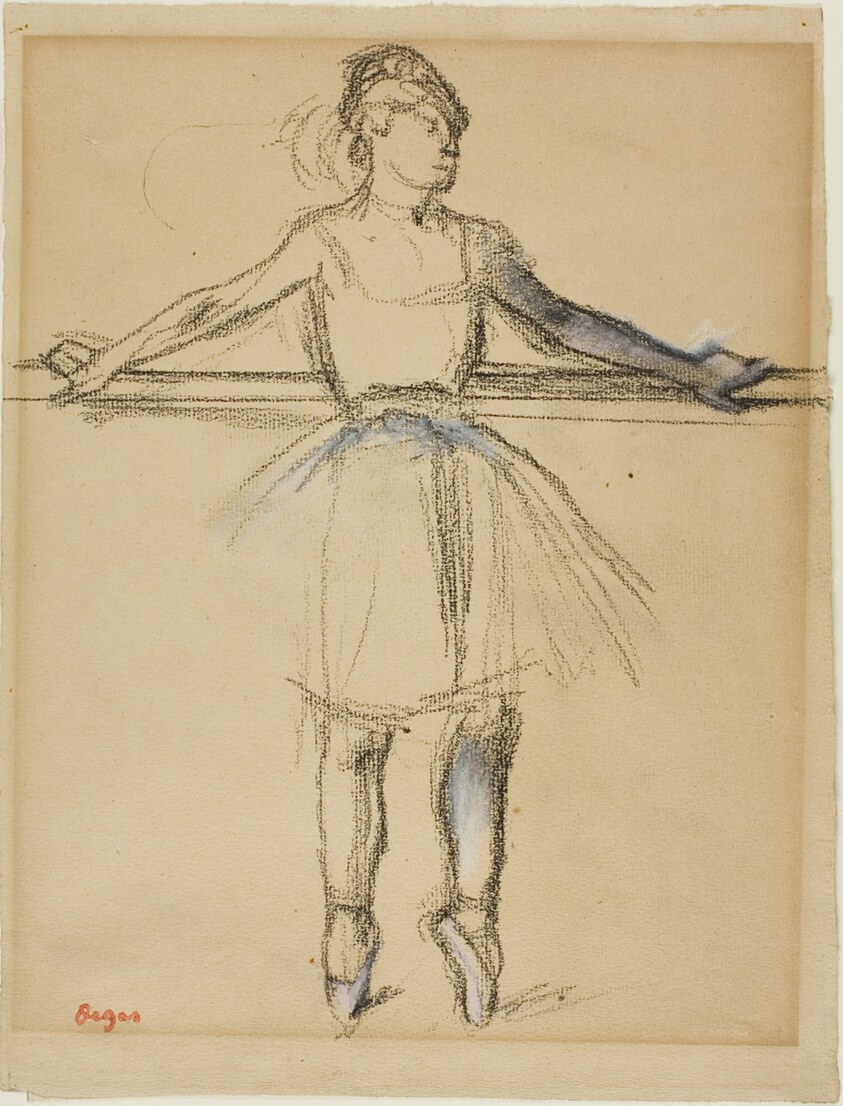
Dancer at the Bar (on Point)
Edgar Degas French, 1834-1917
- Medium:
- Charcoal with pastel and estompe on tan laid paper
- Collection:
- Prints and Drawings
- Source:
- Art Institute of Chicago
- Rights:
- Public domain — free to use, share and adapt.
- Recorded as:
- CC0 (Public Domain)
This work shows a moment of stillness and control—not the spectacle of a grand performance, but the discipline and technique of classical ballet reduced to essential form. For dancers and historians, it is a window into how artists understood and represented the training and technique of academic ballet, and how the aesthetics of the period valorized line, lightness, and the illusion of effortless elevation.
What you are looking at
A single female dancer is shown in a standing pose against a plain tan ground, rendered in charcoal with selective pastel and estompe shading. She wears a short, flared skirt rendered in blue-grey pastel and a sleeveless top. Her left arm extends horizontally to the left while her right arm stretches diagonally downward and back to the right, creating a wide, open frame. Her head is tilted slightly upward and turned toward the left. Her legs are long and slender, with visible shading on the right leg and a darker tone at the feet, suggesting pointe shoes. The pose suggests the moment of balance en pointe, captured with economy of line—the artist uses quick, scratchy charcoal strokes to define anatomy and structure, with pastel applied to the skirt and selective shading to suggest volume and weight.
The dancing
The dancer stands on what appears to be pointe (the feet are darkened to suggest shoes or position), with her weight concentrated in a single vertical line from head through the supporting leg. Her frame is open and extended rather than closed—both arms are lifted and away from the body, the left held at shoulder height and the right lower, creating an asymmetrical balance. The torso is upright and the neck elongated. This is a moment of sustained balance rather than traveling movement, demanding control and stillness.
The dance depicted
This is unambiguously classical ballet en pointe, most likely from the Romantic era repertory or the late-nineteenth-century academic tradition. The pointe work, the open arm frame, the lifted port de bras, and the slight épaulement (shoulder rotation) are all signatures of ballet vocabulary of roughly 1830–1890. The pose itself—extended legs, open arms, upright carriage—resembles the sustained balances and attitudes that anchor classical variations. Without more specific context (a narrative setting, costume detail, or known ballet), the identity of the step or variation cannot be determined, but the technique and aesthetic are unmistakable.
How it was made
Charcoal with pastel and estompe on tan laid paper: a working medium suited to rapid study and refinement. The estompe—a blending stump—has been used to soften and shade the charcoal, particularly visible in the modeling of the legs and torso. The artist has applied pastel selectively (notably the blue-grey of the skirt) to add color and visual interest without full color rendering. This technique was common in nineteenth-century academic practice for life studies and dancer studies; it allowed artists to work quickly, to erase and revise easily, and to capture movement or pose with immediacy. The paper itself, tan laid paper with visible chain lines, is consistent with professional art supplies of the period.
About this work
This is a study of a ballet dancer at the barre, shown in a sustained balance en pointe with extended arms. The work exemplifies the nineteenth-century academic practice of drawing from live models and from dancers—a staple of studio training and of the observational practice that led to major compositions. The economy of line, the focus on anatomical clarity, and the choice of pointe work as subject place it squarely within the tradition of ballet study that engaged many artists of the period, notably Degas. The drawing demonstrates not merely the appearance of a dancer but understanding of the physical demands of the art: the upright carriage, the precise weight distribution, the controlled elevation that pointe demands.
How to look at it
Attend first to the pose: the stillness and precision of pointe work, the geometric clarity of the extended arms, and the subtle lift of the head. The artist has frozen a moment not of dynamic motion but of held balance—a moment a dancer reaches after sustained effort. Notice the minimal use of line: the charcoal is economical and direct, with shading concentrated where the body turns or where shadow falls. The pastel adds the only bright color (the skirt), drawing the eye to the lower body and the structure of the stance. This is not a finished composition but a study, and the unfinished or sketchy quality is part of its power—it conveys immediacy and observation rather than polish.
The artist
Edgar Degas (1834–1917) was obsessed with the Paris Opéra and with ballet dancers throughout his career. He attended rehearsals, sketched dancers at the barre and in the studio, and made hundreds of drawings, pastels, and paintings of dancers in rehearsal and performance. Unlike romantic representations of ballet as spectacle, Degas was interested in the unglamorous reality: the fatigue, the repetition, the intense focus on technique. His dancer drawings are often quick studies in charcoal or pastel, capturing a pose or moment with minimal but assured line. He rarely signed or dated these studies, and many exist in various states of finish. His work fundamentally changed how dancers were represented in visual art, shifting focus from the ethereal image to the physical body at work.
The period
The late nineteenth century saw ballet moving from its Romantic phase (early 1800s, emphasizing otherworldly heroines and pointe work as ethereal flight) toward academic classical ballet, codified in the Russian Imperial Ballet and in the Cecchetti method. Pointe work, once a special effect, became normalized and central to technique. At the same time, artists like Degas were departing from the theater-centric view of ballet to document studio practice. The 1880s, when this drawing dates, coincide with the emergence of modern dance theory and the beginning of ballet's global systematization.
Where it lives
This work is held in the Prints and Drawings collection of the Art Institute of Chicago. It is catalogued as a drawing on paper, a format consistent with Degas's practice of creating hundreds of studio studies and sketch-based works. The work is not dated or signed within the image itself; the attribution and date rest on stylistic analysis and archival research.
Dance in this work
Questions about this work
Why is the dancer on pointe?
Pointe work was central to ballet technique by the time this drawing was made (1880). It creates the visual effect of weightlessness and extension, and it requires intense control and strength. Degas, who studied dancers at the Paris Opéra, would have seen pointe work constantly in rehearsals and made it a subject of his studies.
Is this a finished work or a study?
This appears to be a study or working drawing rather than a finished presentation work. The medium—charcoal with pastel on paper—and the sketchy but controlled line suggest it was made in the studio, possibly from a live model. Many of Degas's finest works began as such studies.
What is the barre in the title?
The barre is the horizontal rail that dancers hold onto during warm-up exercises and technique drills. This drawing is titled 'Dancer at the Bar (on Point),' indicating it depicts a moment from studio training rather than performance. The pose—open arms and upright carriage—is consistent with exercises done at the barre.
Why did Degas draw dancers so often?
Degas was fascinated by the technical and physical reality of ballet, not the romantic fantasy of performance. He attended rehearsals and watched dancers at work, seeking to capture genuine movement and the effort beneath the appearance of effortlessness. Dancers allowed him to study the human body in rigorous, repeatable positions.
More dance artwork





