49 works in this view — arrow keys or swipe to move between them.
Dance in Art
Gentleman and Ballerina
Richard Lindner American, 1901-1978, born Germany
- Medium:
- Watercolor and gouache with graphite on cream wove paper
- Collection:
- Prints and Drawings
- Source:
- Art Institute of Chicago
- Rights:
- Rights reserved by the holding institution — do not reuse without permission. Source record ↗
- Recorded as:
- AIC — rights reserved
This work is essential evidence of how ballet imagery functioned in the 1930s as both high art and object of desire, and how visual artists used the ballerina figure to explore aesthetic, erotic, and economic power. Lindner's style—precise, decorative, slightly artificial—deliberately embodies the artificiality of both ballet and the commercial art world, making visible what other works leave implicit.
What you are looking at
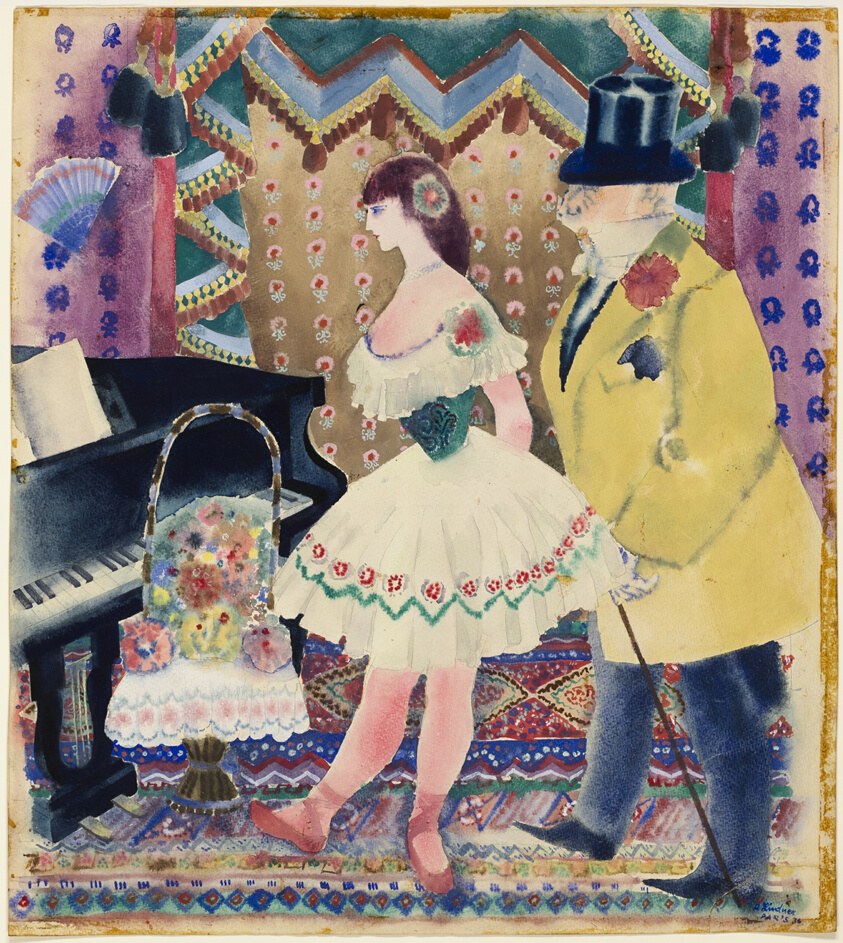
A gentleman in formal dress—a yellow coat, top hat, and dark trousers—stands beside a grand piano in an ornate interior, gazing at a young woman in a white ballet skirt. The woman wears a delicate tutu with a floral embroidered hem in green and red, a white bodice with a small corsage, and pink tights. She is posed in a graceful attitude, weight on one leg, the other extended. The setting is a richly decorated parlor with jewel-toned walls (deep teal, burgundy) adorned with geometric and floral patterning. The background features elaborate architectural molding and draped fabrics with a small blue fan visible on the left. A woven basket filled with flowers sits near the piano. The composition captures an intimate moment of courtship or patronage in a world of refined aesthetic excess—the art deco patterning, the luxurious fabrics, and the careful arrangement of decorative objects all speak to the 1930s cult of beauty and artificiality.
The dancing
The ballerina stands in a pose suggesting classical ballet training—her body elongated, one leg supporting her weight, the other extended in a line suggesting turnout. Her arms are soft and positioned gracefully. She faces the gentleman with a composed, profile-like presentation. The gentleman leans slightly toward her, his posture formal and observational rather than participatory. There is no physical contact; the relationship is one of aesthetic appreciation rather than dynamic partnering.
The dance depicted
The image depicts academic ballet as it existed in the 1930s—a performance or presentation of classical ballet technique in a drawing-room or salon setting. The woman's tutu, pointe-ready posture, and the balletic extension of her leg identify this as theatrical ballet, likely romantic or classical in idiom. The gentleman represents the patron or admirer—a recurring figure in 19th and early 20th-century ballet iconography, particularly in works depicting the ballet world's relationship to wealth and desire. This is ballet as display and courtship, not as narrative performance.
How it was made
Watercolor and gouache on paper, a medium that allows for rich, jewel-like color saturation and precise detail work. The artist has used the opacity of gouache to create the lustrous fabrics, the warm skin tones, and the elaborate patterning. Watercolor permits the luminous quality of the background and the subtle shading in the folds of the skirt. This technique produces an artwork suitable for reproduction and circulation among a cultivated audience—the medium is intimate in scale but ambitious in its decorative effect, typical of luxury illustration and fine art intended for a print-collecting public.
About this work
This 1936 watercolor presents ballet in its interwar form: not as theatrical spectacle on a stage, but as an object of refined domestic consumption and erotic fascination. Richard Lindner captures the moment of artistic and social encounter between a gentleman patron and a ballerina who exists to be observed. The work sits at the intersection of ballet iconography and the visual culture of the 1930s—the art deco geometries, the fetishization of beauty, and the explicit linking of dance, femininity, and desire. It is as much a work about aesthetic ideology as it is about ballet itself, and its meticulous technique and decorative excess make the artificiality explicit rather than transparent.
For a dance historian, the image documents how ballet was understood and depicted in the interwar years: as a refined artistic practice inextricable from luxury consumption, patronage, and the male gaze. The tutu and the posture are real; the frame in which they are set is a construction of desire and money.
How to look at it
Attend first to the formal distance between the two figures: the gentleman and the ballerina do not touch, and they do not meet each other's eyes in a moment of mutual recognition. Instead, she is on display, frozen in an attitude of grace. The artist has chosen to freeze the moment not at a climax of movement, but at a moment of stillness and presentation—the ballerina as sculptural object. Notice the meticulous surface pattern and the jewel-like color: the artist is not interested in the dynamism of dance, but in the aesthetic and erotic fascination that ballet objects provoke. The tutu is rendered with precise attention to fabric and embroidery; the gentleman's gaze is directed at this object of beauty and desire.
The artist
Richard Lindner (1901–1978) was a German-American artist who worked in painting, printmaking, and illustration. Trained in Germany and active in the interwar period, he worked as a commercial illustrator before emigrating to the United States. His work is marked by precise draftsmanship, bold color, and a fascination with the surfaces and structures of modern life—fashion, entertainment, sexuality, and artificiality. He often depicted the figure (particularly women) in ornate, slightly alienating settings that suggest both desire and critique. His later abstract and Pop-influenced work did not displace his earlier interest in figuration and decoration; throughout his career, he used the female body and fashionable excess as vehicles for exploring modernity.
The period
In the 1930s, ballet was at the height of its cultural prestige in Europe and America. The Ballets Russes had transformed ballet into a modern art form through collaborations with visual artists, composers, and dancers. Simultaneously, ballet was deeply entangled with luxury, patronage, and voyeurism—the ballerina was an object of fascination in high society and in commercial culture. In the visual arts, the 1930s saw a retreat from the radical abstraction of the 1920s toward figuration, often with renewed attention to the body, desire, and artificiality. Art deco aesthetics, with their emphasis on geometric pattern, jewel tones, and decorative excess, dominated luxury design. Lindner's work sits within this context: he uses the ballet figure to explore the intersection of modernist aesthetics, commercial culture, and erotic fascination.
Where it lives
The work is held in the Prints and Drawings collection at the Art Institute of Chicago. It is catalogued as a watercolor and gouache work on cream wove paper from 1936, a period during which Lindner was active as both a fine artist and commercial illustrator in Europe.
Dance in this work
Questions about this work
Is this a scene from an actual ballet?
No. The image depicts ballet technique and costume in isolation, not a narrative from a specific ballet. The woman is posed in a classical ballet attitude, and her tutu is period-appropriate, but the domestic drawing-room setting and the relationship between the two figures are invented. This is a meditation on ballet as aesthetic object and social practice, not a scene of theatrical performance.
What is the relationship between the man and woman?
The image suggests patronage, desire, and aesthetic appreciation. In the ballet world of the 1930s, wealthy patrons and admirers maintained complex relationships with dancers. The painting captures the moment of viewing and assessment—the gentleman observes, the ballerina presents herself. Their formal distance and the absence of mutual gaze emphasize the asymmetry of the relationship.
Why is this image important to understanding 1930s ballet?
It documents how ballet was understood and consumed in the interwar years: as a refined practice bound up with luxury, desire, and commercial aesthetics. The meticulous rendering of the costume and the ornate setting show how ballet imagery was deployed in visual culture to signify beauty, modernity, and sophisticated taste. The work also reveals the gendered dynamics of spectatorship that shaped ballet's social meaning.
What is Lindner's style and how does it affect the image?
Lindner's work is characterized by precise draftsmanship, artificial color, and a fascination with surface and decoration. In this watercolor, that style heightens the sense of artificiality and display: the ballerina is not captured in spontaneous movement, but rendered as a carefully composed aesthetic object. The jewel-toned setting and intricate patterning amplify the sense that this is a constructed world of beauty and desire.
More dance artwork





