49 works in this view — arrow keys or swipe to move between them.
Dance in Art
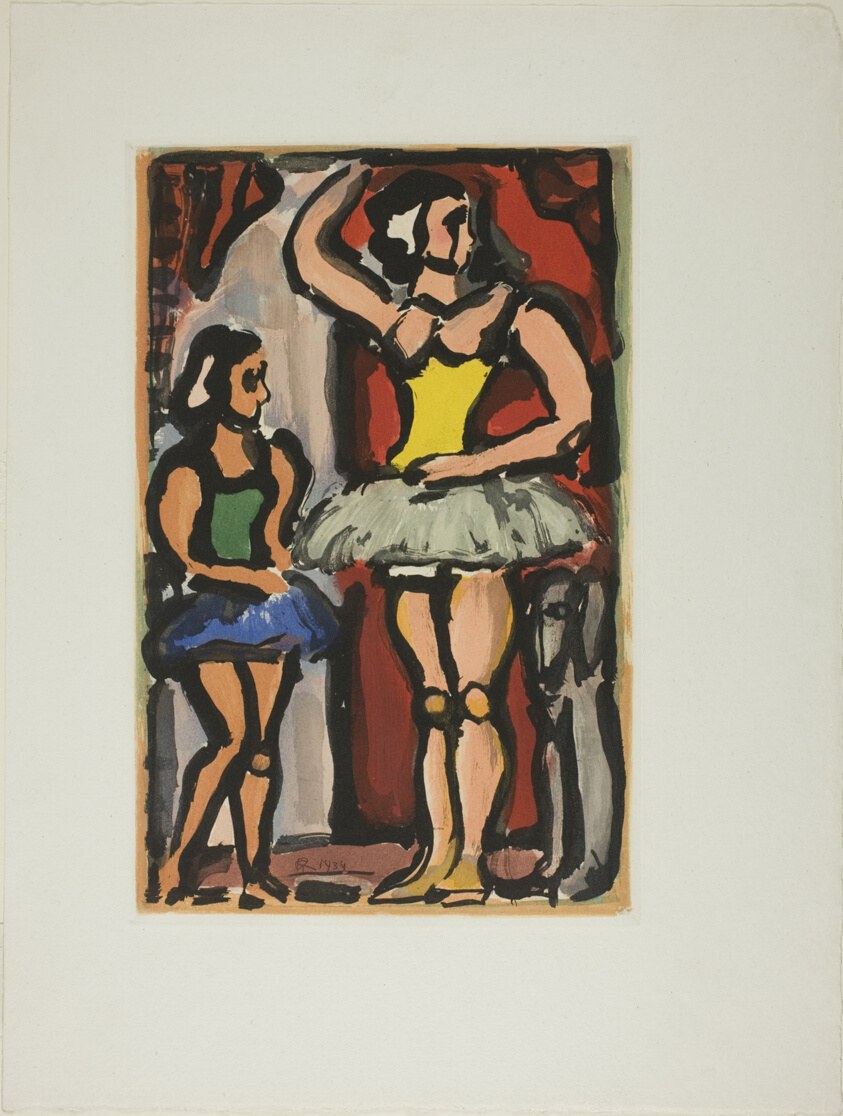
The Ballerinas, plate fifteen from Cirque de l'Étoile Filante
Georges Rouault (French, 1871-1958) edited by Ambroise Vollard (French, 1835-1939)
- Medium:
- Color etching and aquatint on tan wove paper
- Collection:
- Prints and Drawings
- Source:
- Art Institute of Chicago
- Rights:
- Rights reserved by the holding institution — do not reuse without permission. Source record ↗
- Recorded as:
- AIC — rights reserved
Rouault's circus and theater prints of the 1920s–1930s established dance as a major theme in modernist printmaking and challenged the Romantic-era dominance of the prima ballerina as solitary hero. For historians, the work documents how early 20th-century artists saw ballet: not as a distant ideal but as a working theatrical practice involving costume, backstage relationships, and the labor of multiple bodies. The print's emphasis on the interaction between performers, rather than spectacle, offers a different lens on how dance was understood in the avant-garde.
What you are looking at
Two female figures dominate this woodcut-style composition, set against a theatrical backdrop of deep reds and blacks. The larger figure at right wears a bright yellow bodice and a pale tulle skirt, her body angled in a classical ballet pose, one arm raised and curved. A smaller figure at left, dressed in a green top and blue skirt, watches or interacts with the principal dancer. The setting is intensely theatrical: heavy drapery frames both sides, and the background suggests stage curtains or scenery rendered in warm and dark tones. The figures are outlined in bold black lines typical of expressionist printmaking, their flesh tones rendered in warm ochre against the cooler background. The composition has the flattened, simplified forms of early 20th-century modernism rather than naturalistic perspective.
The dancing
The principal dancer at right stands in a controlled upright posture with one arm raised in a curved, graceful line and the other at her side; her weight appears settled on both feet, suggesting a stationary pose or balanced moment rather than mid-leap. The smaller figure at left sits or crouches, her posture more compressed and her gaze directed toward the larger dancer, creating a relationship of observation or admiration. Both figures have simplified, mask-like faces rendered in profile or three-quarter view. The scale difference between them is dramatic and possibly symbolic rather than spatial.
The dance depicted
This depicts a moment from classical ballet, identifiable by the tulle skirt, the upright carriage, and the arm position of the principal figure, which suggests a port de bras from the romantic or classical vocabulary. The smaller figure may represent a younger student, dresser, or fellow performer, a common subject in theatrical imagery of the period. The work is titled *The Ballerinas*, emphasizing the plural and the relationship between the two dancers rather than solo virtuosity. The theatrical setting and the emphasis on costume suggest this is backstage or a moment of performance.
How it was made
The work is a color etching and aquatint on paper, a printmaking technique that allowed Rouault to build complex color effects through multiple plates or careful wiping of acid-bitten surfaces. Aquatint created the soft, almost matte tonal areas visible in the background and drapery; the bold black outlines were likely etched with a needle. This is a work from a published suite, *Cirque de l'Étoile Filante*, edited by the legendary print publisher Ambroise Vollard, indicating professional production and wide distribution among collectors and institutions. The technique's expressionist energy—its capacity for bold line and emotional color—suited Rouault's modernist sensibility.
About this work
This is a color etching from Rouault's 1938 suite *Cirque de l'Étoile Filante*, a landmark modernist print series exploring circus and theatrical subjects. The work depicts two ballet dancers in a moment of theatrical intimacy, rendered in the flattened forms and bold outlines of expressionist printmaking. Rouault brought fine-art seriousness to subjects—circus, theater, working dancers—that academic art had largely ignored, treating the ballet not as a vehicle for beauty but as a site of human encounter and theatrical artifice. The print circulated widely through Vollard's editions and remains central to the modernist engagement with performance as subject.
How to look at it
Attend to the compositional relationship between the two figures rather than the skill of the larger dancer. Rouault has frozen not a moment of technical virtuosity but a moment of looking and relationship—the smaller figure gazes at the larger. Notice how the bold black outline, applied expressionistically rather than decoratively, gives the figures a simultaneously noble and vulnerable quality. The brilliant yellow bodice reads as pure pigment against the dark background, a modernist strategy that values color as a force in itself, not as a tool for rendering form. The flat, almost medieval treatment of the space and the mask-like simplification of the faces suggest Rouault's engagement with non-naturalistic traditions—folk art, Byzantine iconography, tribal sculpture—that modernists were beginning to value.
The artist
Georges Rouault (1871–1958) was a French expressionist painter and prolific printmaker whose visceral, heavily outlined style was forged in the studio of Gustave Moreau. He was fascinated by the margins of Parisian life—the circus, the theater, the demimonde—subjects he treated with psychological intensity and formal boldness. His prints, especially those produced in collaboration with Ambroise Vollard, were technically innovative (he mastered etching, aquatint, and lithography) and widely distributed, making him a major influence on European modernism. His commitment to printmaking as a primary medium, not a secondary reproduction, was unusual among his peers.
The period
In the 1920s and 1930s, ballet was experiencing a cultural renaissance in Europe, driven by the success of Diaghilev's Ballets Russes and the choreographic innovations of figures like Nijinsky and Fokine. At the same time, modernist artists were turning to popular and working-class subjects—circus, music hall, theater—as subjects worthy of fine art. Rouault's *Cirque de l'Étoile Filante* sits at this intersection, treating the circus and ballet not as exotic spectacle but as human drama. The expressive distortion and bold color of his prints reflected broader modernist skepticism toward naturalism and beauty-for-its-own-sake, replacing them with psychological and social engagement.
Where it lives
This work is held in the Art Institute of Chicago's Prints and Drawings collection. It is plate fifteen from the suite *Cirque de l'Étoile Filante*, edited and published by Ambroise Vollard in 1938, one of the most important print publications of the early 20th century. The suite comprises multiple prints on circus and theatrical subjects, all rendered in color etching and aquatint.
Dance in this work
Questions about this work
What is the relationship between the two dancers?
The catalogue record and title do not specify, but the composition suggests a hierarchical or observational relationship—perhaps student and teacher, or principal and dresser. The smaller figure's seated or crouched posture and directed gaze suggest admiration or attendance. Rouault was interested in the social and emotional dynamics of theatrical life, not just virtuoso display.
Why is the image so heavily outlined and flattened?
This is the expressionist technique Rouault developed across all media. The bold black outline—applied with the etching needle—serves multiple purposes: it simplifies form for emotional clarity, it references non-Western and folk art traditions that modernists admired, and it allows the color areas to read as pure pigment rather than naturalistic light and shadow.
What is Cirque de l'Étoile Filante?
A suite of color etchings and aquatints published by Ambroise Vollard in 1938, comprising works on circus and theatrical subjects. Vollard was the most important modernist print publisher of the era, and this suite was among his final projects. It represents a major moment in modernist engagement with popular performance.
Is this a painting or a print?
This is a color etching and aquatint, a printmaking technique. It was created on a metal plate, bitten with acid to create lines and tones, then printed onto paper. The color was applied separately, either through multiple plates or careful inking of a single plate—a labor-intensive process that made these prints expensive and precious objects for collectors.
More dance artwork





