49 works in this view — arrow keys or swipe to move between them.
Dance in Art
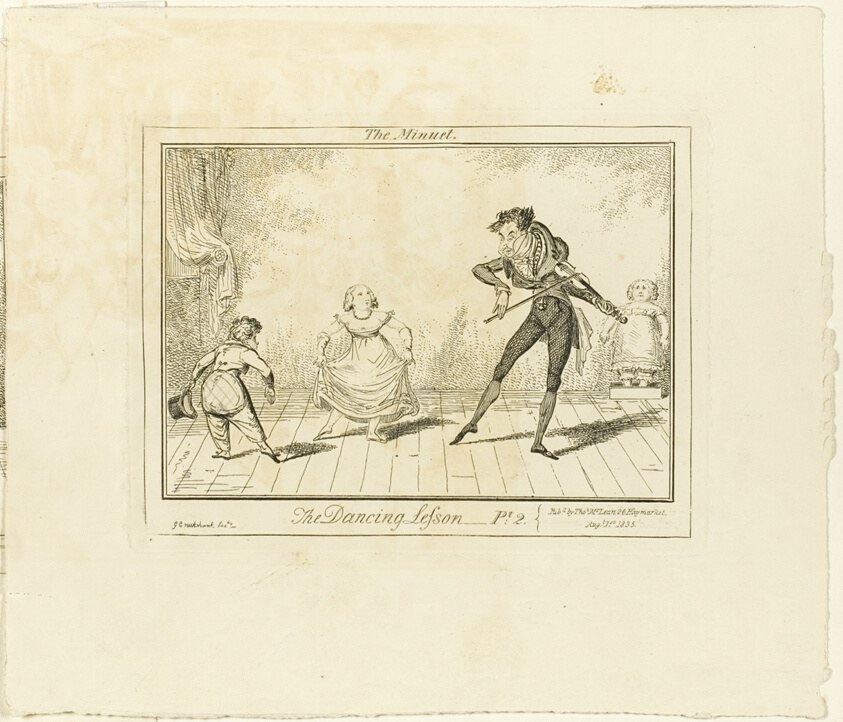
The Dancing Lesson, Part 2: The Minuet
George Cruikshank (English, 1792-1878) published by Thomas McLean (English, 1788-1875)
- Medium:
- Etching on paper
- Collection:
- Prints and Drawings
- Source:
- Art Institute of Chicago
- Rights:
- Public domain — free to use, share and adapt.
- Recorded as:
- CC0 (Public Domain)
This print documents the minuet at a moment when it was ceasing to be a living practice and becoming a historical curiosity. For dance historians, it is rare evidence of the actual method of teaching the minuet: the master's demonstration stance, the pupils' imitative posture, and the formal waiting of the female partner all reflect the real pedagogy of the period. Cruikshank's satirical exaggeration, far from invalidating this evidence, actually highlights what contemporaries found most striking about minuet technique—its rigidity and artificiality—making it an invaluable record of how the dance was perceived at the moment it was beginning to fade.
What you are looking at
A dancing master instructs three pupils in the minuet within an interior space defined by a draped curtain at the left and a window visible at the right. The scene is rendered in the stippled, fine-lined style typical of 18th-century satirical prints. The master, a thin figure in fashionable dress with a fitted coat and breeches, stands at the center-right in an exaggerated teaching posture, one leg extended in demonstration. Two young male pupils flank him—one in the foreground at the left attempting to mirror the posture, the other smaller figure at the right—while a woman seated at the center-left, dressed in a high-waisted gown with puffed sleeves, observes or awaits her turn. The wooden floor is rendered in linear perspective, emphasizing the formal, enclosed space of the dance lesson. The etching's satirical intent is evident in the stiffness and affectation of the poses.
The dancing
The dancing master demonstrates an upright, stylized posture with one leg extended and his torso held rigidly—the canonical minuet frame of the period, exaggerated here for comic effect. The male pupil at left mirrors this position with visible strain, his body tense and mechanical. The seated woman maintains an upright, waiting posture typical of minuet etiquette, where one partner observed before dancing. The second pupil is diminished in scale, a common satirical device. The choreography is stiff and formal rather than fluid; bodies are held rather than moved, emphasizing the artificiality of the dance as a social lesson.
The dance depicted
This depicts a minuet lesson, one of the cornerstones of 18th-century ballroom and court pedagogy. The minuet was taught formally through demonstration and imitation, exactly as shown here: the master poses while pupils replicate his positions. The dance style was governed by strict rules of posture, arm carriage, and foot placement, which the artist captures through exaggeration—the unnaturally straight spines and extended legs are satirizing the rigidity demanded by minuet technique. This is Part 2 of a series titled 'The Dancing Lesson,' suggesting a progression through the pedagogy of social dance. The minuet remained fashionable in drawing rooms well into the 19th century, though by Cruikshank's time (1835) it was increasingly seen as quaint and worthy of comic treatment.
How it was made
This is an etching on paper, a medium well suited to Cruikshank's satirical intent. The fine, controlled line-work and stippling characteristic of etching allowed for precise rendering of fabric texture, facial expression, and the subtle distortions that make this image comic rather than instructional. Etchings were reproducible and relatively inexpensive, enabling wide circulation among the middle-class audience for satirical prints. Published by Thomas McLean, a leading distributor of prints in London, this work was designed for the print market rather than as a unique drawing, reaching viewers through subscription and retail sale. The technique's capacity for fine detail and its association with both high art and popular satire made it the medium of choice for Cruikshank's social commentary.
About this work
George Cruikshank's 'The Dancing Lesson, Part 2: The Minuet' is a satirical etching that captures a moment of formal ballroom instruction in the early 19th century. It documents both the minuet itself—by then a declining but still-taught social accomplishment—and the rigid, formal pedagogy through which it was transmitted. The work belongs in a gallery of dance art because it preserves not just the appearance of the dance, but also contemporary attitudes toward it: as a practice simultaneously valued as a mark of gentility and ripe for mockery as an outdated affectation. Cruikshank was one of the most prolific and influential satirical artists of his era, and his treatment of social dance reveals how the minuet occupied a peculiar cultural space in Regency and early Victorian England—necessary knowledge for anyone aspiring to respectability, yet increasingly viewed as ridiculous by a society moving toward less formal social practices.
How to look at it
Attend first to the exaggerated postures: the master's extended leg and rigid spine, the pupils' straining imitation. These are not naturalistic but comic distortions, yet they tell us what the artist (and his audience) found striking about minuet technique—its formality and constraint. Notice the positioning of the woman: seated, waiting, excluded from the active demonstration. This reflects the minuet's actual choreography, in which the male partner led and initiated. The artist has also chosen the moment of instruction rather than of dance itself; we see not movement but posed positions being taught. This emphasizes that the minuet was a learned, rule-governed practice, not an improvised or spontaneous social form.
The artist
George Cruikshank (1792–1878) was England's pre-eminent satirical artist of the 19th century, celebrated for his social and political commentary rendered in brilliant draftsmanship and mordant wit. He worked primarily in etching and engraving, producing thousands of prints covering everything from politics to domestic life. His work was immensely popular among the middle classes, published in newspapers, books, and as standalone prints sold through dealers like Thomas McLean. Cruikshank's satire often targeted social pretension and outmoded custom, making him an astute observer of changing social practices. His dance scenes are part of a broader body of work documenting and mocking the manners and mores of his era.
The period
By 1835, when this etching was published, the minuet had been the primary ballroom dance of European courts and drawing rooms for more than a century, but its dominance was waning. Waltz, quadrille, and other dances requiring closer partnership and less rigid posture were becoming fashionable among the younger generation. The minuet retained prestige as a marker of breeding and education—young ladies of good family still learned it—but it was increasingly seen as formal, old-fashioned, and tediously slow. Cruikshank's satirical treatment reflects this shift: by rendering the minuet as absurdly stiff and his dancing master as an anachronistic pedant, he captures the moment when the dance was transitioning from living practice to historical curiosity. Simultaneously, the early 19th century saw a boom in satirical prints as a form of social commentary, with etching as the dominant medium for this purpose.
Where it lives
This etching is held in the Prints and Drawings collection at the Art Institute of Chicago. It is part of a series titled 'The Dancing Lesson,' of which this is Part 2, indicating it was published as one of a sequence of prints documenting ballroom instruction. It was published by Thomas McLean, a major London print dealer specializing in satirical and humorous prints during this period.
Dance in this work
Questions about this work
Was the minuet still danced in 1835?
Yes, but it was becoming old-fashioned. Minuet instruction remained part of genteel education, particularly for young women, but newer dances like the waltz and quadrille were displacing it in actual ballroom practice. Cruikshank's satire reflects this transition—the dance was still taught and valued, but increasingly regarded as quaint.
What does the teacher's pose tell us about minuet technique?
The extended leg, upright spine, and formal arm carriage show the minuet's key technical requirements: a turned-out leg, lifted posture, and controlled upper body. The exaggeration in this satire actually highlights what was genuinely demanding about the minuet—it required constant awareness of posture and alignment, making it exhausting and ungainly by modern standards.
Why is the woman seated?
The minuet was a highly structured dance in which partners took turns leading. The woman shown here is waiting for her turn to dance or to be instructed. Her posture—upright and attentive—reflects the formal etiquette expected during lessons and performances of social dances.
What was an etching and why did Cruikshank use this medium?
An etching is a print made by incising an image into a copper plate with acid, then inking and pressing the plate onto paper. This technique allowed fine detail and precise control of line, perfect for Cruikshank's detailed satirical compositions. Etchings were reproducible, affordable, and widely distributed, making them ideal for reaching a large middle-class audience with social commentary.
More dance artwork





