49 works in this view — arrow keys or swipe to move between them.
Dance in Art
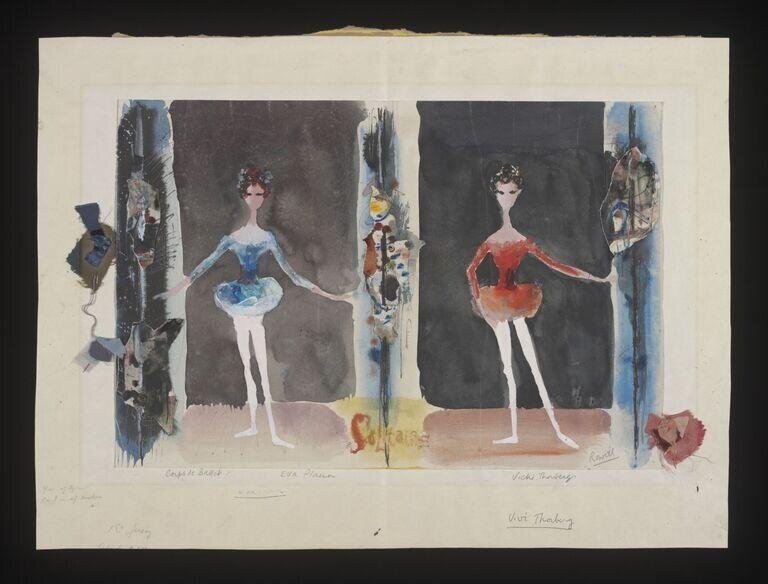
Corps de ballet for Solitaire
Royal Danish Ballet
- Collection:
- Costume design
- Source:
- Victoria and Albert Museum
- Rights:
- Rights vary by item — check the source record before reusing this image. Source record ↗
- Recorded as:
- V&A — check rights per item
As a working document from the Royal Danish Ballet's archives, this sheet shows the material reality of costume design in mid-century classical ballet—not the finished designs shown to patrons, but the iterative process by which choreography, music, and visual appearance were coordinated. The dating to 1961 places it at a pivotal moment in Danish ballet, and the presence of multiple color and silhouette variations on a single sheet reveals how designers and choreographers negotiated aesthetic choices through iteration and comparison.
What you are looking at
A two-panel costume design study shows two female ballet dancers in contrasting tutus, rendered in watercolor and gouache on cream paper. The left figure wears a pale blue tutu with a fitted bodice; the right wears a coral-red tutu with deeper red bodice. Both dancers stand in a classical ballet pose with one leg extended and arms held in port de bras, their bodies elongated and weightless. The background is rendered in dark washes of grey and brown, with abstract sketches of other costumed figures and costume details visible in the margins—dancers, fabric swatches, and design annotations. A golden-yellow wash appears at the center where the two panels meet, possibly indicating a lighting effect or stage separation. The overall composition suggests preliminary work for a corps de ballet sequence, with the two main figures presented as variations or paired dancers in the same choreographic moment.
The dancing
Both dancers occupy identical poses: standing on one supporting leg in a classical ballet stance, with the free leg extended in a controlled lift. Their spines are straight and heads held high in the formal port de bras of classical ballet. The arms are held in a graceful frame that suggests the discipline of the Vaganova or Cecchetti tradition. Their long necks and proportionally small heads emphasize the elongation prized in classical ballet technique. The two figures are positioned as mirror studies or sequential variations, allowing the designer to explore how the same pose reads in different costume colors and fabrics.
The dance depicted
This is costume design documentation for a corps de ballet passage in *Solitaire*, a work by the Royal Danish Ballet dated 1961. *Solitaire* (also known as *En Solitary* in some sources) is a classical ballet likely created during the height of the Royal Danish Ballet's engagement with mid-century neoclassical repertory. The two tutus shown here suggest dancers performing in unison or canon—a standard corps de ballet formation. The poses are consistent with classical ballet vocabulary of the mid-twentieth century, and the clean lines of the tutus suggest the influence of both traditional tulle tutus and the streamlined silhouettes favored in Danish ballet during this period. The color choice—pale blue and coral-red—indicates these may represent different corps divisions or a color-coded stage effect.
How it was made
The work is executed in watercolor and gouache on paper, with pen or pencil annotation visible in places. The technique allows rapid notation of color, volume, and silhouette—essential for a working costume design that would be shown to a choreographer, director, and seamstresses. The loose background washes and marginal sketches indicate this is a preliminary or working document rather than a finished presentation drawing. This level of detail and spontaneity suggests the sheet was created in the studio or design process, probably not intended for public display, which is consistent with the collection as a costume design archive. The medium is economical and practical, supporting the hypothesis that this is production documentation rather than a commission or gallery piece.
About this work
This is a costume design study for the corps de ballet in *Solitaire*, created by the Royal Danish Ballet in 1961. It documents two dancers in classical ballet poses wearing contrasting tutus—pale blue and coral-red—rendered in watercolor with surrounding annotations and costume variations. The drawing is working documentation from the design and production process, capturing both the aesthetic (the precise silhouette and color) and the practical information (the pose, the tutu volume, the proportions) that costume makers and choreographers needed to realize the work on stage. The sheet belongs to an archive of Danish ballet costume and design practice at a moment when the company was synthesizing classical technique with twentieth-century modernism.
How to look at it
Look first at the pose: both dancers occupy the same classical stance, suggesting a moment of unison or canon in the choreography—a common structural device in corps de ballet work. Notice how the designer has rendered the tutu volume and angle differently in each color, exploring how fabric and color interact with light on stage. Observe the marginal sketches: these reveal the designer's thinking process, trying variations and related figures before settling on the main studies. The two-panel presentation emphasizes comparison—the same body, two different costume choices—which is how designers present options to choreographers and directors. The loose background suggests this is a working sheet, not a formal presentation, making it a rare glimpse into the studio rather than the finished product.
The artist
The work is attributed to the Royal Danish Ballet as an institution rather than an individual designer. In 1961, the Ballet's design practice typically involved collaboration between choreographer, composer, and one or more costume or set designers. The particular designers responsible for *Solitaire* and this sheet are not recorded in the catalogue, but the archive as a whole represents the design studio practice of the company during a period of significant international influence under leadership that included Georg Balanchine's influence and the company's own strong classical tradition.
The period
In 1961, classical ballet was experiencing a global expansion and formalization. Balanchine's influence on neoclassical ballet was at its height, and European companies including the Royal Danish Ballet were integrating modernist principles—cleaner lines, faster tempi, abstract themes—with classical technique. Costume design in this period reflected both tradition (the classical tutu) and innovation (simplified silhouettes, experimental color choices). The Danish Ballet was maintaining its strong classical identity while engaging with these international currents. Simultaneously, design documentation like this sheet represents the professionalization of ballet production in the mid-twentieth century, when companies began to archive and standardize their design processes.
Where it lives
The work is held in the Royal Danish Ballet's archives as part of its costume design collection. It is identified as a working document from the ballet *Solitaire* (1961) rather than as a finished design for public display. The collection preserves the material record of the company's production processes, including preliminary sketches, rejected ideas, and working variants alongside finished designs.
Dance in this work
Questions about this work
What is Solitaire?
*Solitaire* is a classical ballet created for the Royal Danish Ballet in 1961. The exact choreographer and any premiere cast are not recorded in the available catalogue entry, but the work belongs to the company's mid-century neoclassical repertory. The title suggests either a solo or an exploration of solitude and individuality within the classical form.
Why are there two dancers on one sheet?
This is a design comparison study. The choreographer and costume designer are exploring how the same corps de ballet pose and movement reads in two different tutu colors and possibly different fabric or volume. This method—presenting multiple options on a single sheet—allowed quick visual comparison and faster decision-making in the production studio.
Are these tutus classical or contemporary?
These are classical tutus rendered in mid-twentieth-century style. The silhouette is clean and streamlined compared to earlier romantic-era tutus, reflecting the influence of Balanchine neoclassicism. The pose, support, and proportions are firmly within classical ballet tradition, but the simplification of line is consistent with 1960s modernism.
Why is the medium watercolor and not finished paint?
Watercolor and gouache are rapid media suited to the working design studio. This sheet was a tool for communication among choreographer, director, and costume makers—not a presentation piece for patrons. The loose background and marginal sketches confirm this is a working document, meant to capture ideas and options quickly, not to impress.
More dance artwork





