49 works in this view — arrow keys or swipe to move between them.
Dance in Art
Black Sabbath - The Ballet
Perou
- Collection:
- Poster
- Source:
- Victoria and Albert Museum
- Rights:
- Rights vary by item — check the source record before reusing this image. Source record ↗
- Recorded as:
- V&A — check rights per item
This work demonstrates the current state of classical ballet: a rigorous technique that is no longer confined to classical music or narrative, but can be deployed across genres and contexts. For historians of dance, it marks a significant shift in how ballet companies and choreographers position themselves culturally—not as custodians of a fixed tradition, but as contemporary artists using classical technique to engage with contemporary culture.
What you are looking at
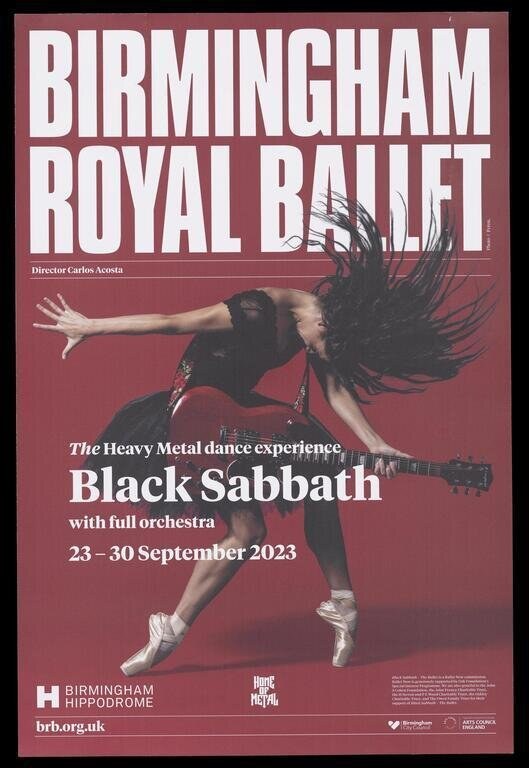
A poster advertising a ballet production by Birmingham Royal Ballet, directed by Carlos Acosta. Against a deep burgundy background, a solo female dancer in pointe shoes and a black leotard is captured mid-movement, her body arched in a dramatic extension. Her long dark hair swings across her frame, caught in motion. Her left arm extends fully while her right is positioned at her torso, and her legs are in a split position with one foot pointed in the air. She wears a bracelet or cuff on her wrist. The composition is cropped close on the figure, emphasizing the intensity and dynamism of the moment. Large white sans-serif typography declares "BIRMINGHAM ROYAL BALLET" across the top, with the subtitle "The Heavy Metal dance experience" and "Black Sabbath with full orchestra" positioned below, dated 23–30 September 2023. The venue (Birmingham Hippodrome) and website (brb.org.uk) are noted at the bottom, alongside logos for funding bodies and the Heavy Metal Ballet branding.
The dancing
A single dancer, photographed from roughly hip to head, in an attitude derrière or similar classical extension. Her body demonstrates significant flexibility and control: the standing leg is straight and appears to be supporting a considerable arch through the torso, while the working leg is extended high behind or to the side in a fully pointed foot. The arm extension and head position suggest both extension and dramatic expression. Her posture and the precision of the limbs indicate professional training in classical ballet vocabulary.
The dance depicted
This is promotional imagery for a contemporary ballet production that fuses classical ballet technique with the music and aesthetic of the heavy metal band Black Sabbath. The choreography is by Carlos Acosta, a prominent contemporary ballet choreographer and former principal dancer. The image shows classical ballet technique—pointe work, extension, and the formal line of the body—being deployed in what is explicitly framed as an unconventional context (heavy metal rather than traditional ballet scores). This represents a wider trend in early 21st-century ballet of recontextualizing classical technique within popular music and contemporary cultural references.
How it was made
This is a photograph, likely a production or promotional still from the ballet itself rather than a posed studio shot, subsequently printed as a poster. The close framing and dramatic lighting emphasize the dancer's body and the intensity of the movement. The photograph has been colour-graded to complement the burgundy poster design. As a poster, this work served a commercial and publicity function: it was designed to be distributed, displayed, and reproduced, and the single striking image of the dancer was chosen to communicate both technical sophistication and dramatic intensity to potential audiences.
About this work
This is a poster for a 2023 production by Birmingham Royal Ballet that merges classical ballet vocabulary with heavy metal music and aesthetics. The image captures a solo dancer in a moment of classical extension, frozen mid-movement, to advertise a work by choreographer-director Carlos Acosta that explicitly challenges the boundaries of what ballet can be and express. It belongs in a dance gallery as evidence of how theatrical ballet in the 21st century has increasingly adopted popular music and contemporary cultural references while maintaining rigorous technical training and classical form. The poster itself is a document of how ballet companies market their work to audiences beyond the traditional ballet-going public.
How to look at it
Attend to the precision of the classical line: despite the unconventional context, the dancer's body demonstrates the formal vocabulary of academic ballet—the pointed foot, the straight standing leg, the extended port de bras, the arched torso. The photographer has frozen a moment of apparent ease and control, even as the swinging hair signals movement and energy. The poster uses this contradiction—classical discipline in service of an explicitly non-classical music—to communicate that this is a ballet work that respects its technique while rejecting the boundaries of its tradition.
The artist
Carlos Acosta is a Cuban-British ballet dancer and choreographer who trained at the National Ballet of Cuba and became a principal dancer with the Royal Ballet, London. In recent decades, he has moved into choreography and direction, known for creating works that blend classical technique with diverse musical and cultural influences. His appointment as director of Birmingham Royal Ballet in 2020 reflected a broader shift in British ballet towards figures who challenge traditional conventions. The Black Sabbath ballet is characteristic of his approach: taking a beloved popular cultural reference and subjecting it to serious choreographic treatment.
The period
By 2023, the crossover between classical ballet and contemporary popular culture had become increasingly common. Companies like Birmingham Royal Ballet, under Acosta's direction, were actively seeking new audiences and new artistic directions. The early 2020s saw ballet companies worldwide experimenting with non-classical music (hip-hop, pop, rock, jazz) and with works that explicitly address contemporary social and cultural issues. This shift reflected both changing demographics of ballet audiences and a generation of choreographers trained in classical technique but not bound by its traditional aesthetic boundaries. Heavy metal, with its visual drama and cultural cachet, was a natural choice for a work designed to signal artistic ambition beyond the conventional.
Where it lives
This is a promotional poster created by Birmingham Royal Ballet for distribution and public display in 2023. It functions as both an advertisement for a specific season performance and as a document of the company's artistic direction under Acosta's leadership. The poster would have been circulated through print media, galleries, and public spaces in Birmingham and beyond.
Dance in this work
Questions about this work
Is this actually a ballet, or is it just ballet dancers performing to heavy metal?
It is a ballet: a choreographed work created by a professional choreographer specifically for this music, using trained dancers in classical technique. What makes it unusual is that the music is Black Sabbath rather than a classical composer. Acosta's choice is deliberate—to demonstrate that ballet as a form is not defined by its traditional musical repertoire, but by its technique, training, and choreographic approach. The image shows classical ballet vocabulary (pointe shoes, extensions, formal line) being used to express something visually and musically outside the classical tradition.
Who is the dancer in the poster?
The catalogue record does not identify the dancer. The image is a promotional still, and the individual dancer's identity is secondary to the work being advertised. This is typical of ballet company marketing, where a striking image of a dancer in costume is used to represent the production as a whole, regardless of which dancer is pictured.
What does 'The Heavy Metal dance experience' mean?
It is the marketing framing for the work: a dance experience structured around heavy metal music and its cultural associations (power, intensity, darkness, rebellion). The phrase signals that this is not a traditional ballet story, but an immersive artistic event where the music, choreography, and design work together to create a specific emotional and aesthetic environment.
Why did Birmingham Royal Ballet choose Black Sabbath?
Black Sabbath was a pioneering heavy metal band with a large and devoted following across generations. Their music has visual drama, compositional complexity, and cultural weight. The choice reflects Acosta's interest in reaching audiences beyond traditional ballet audiences and in proving that classical technique can speak meaningfully to any music a choreographer chooses.
More dance artwork





