49 works in this view — arrow keys or swipe to move between them.
Dance in Art
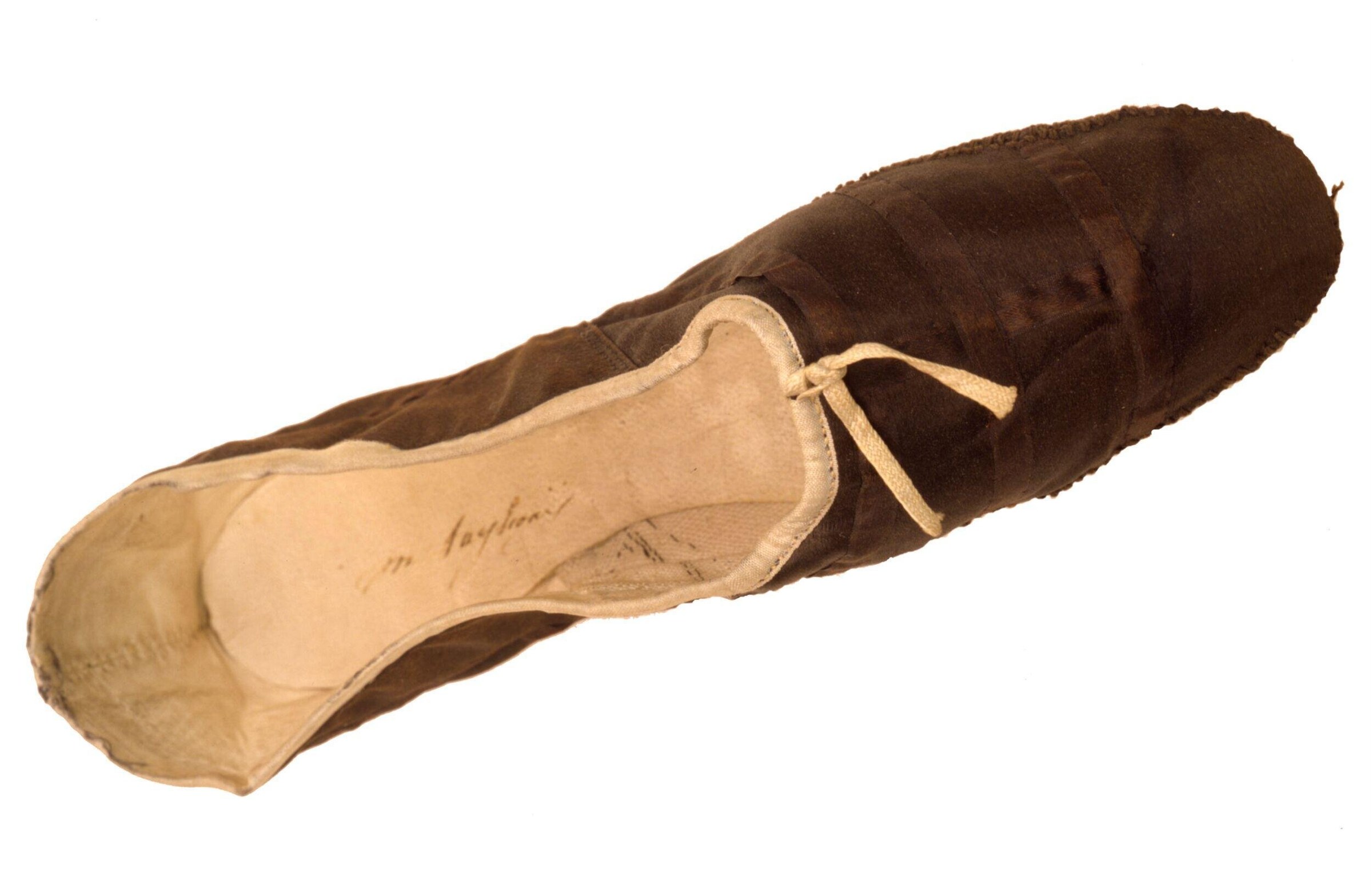
Ballet shoe worn by Marie Taglioni
unknown
- Collection:
- Ballet shoe
- Source:
- Victoria and Albert Museum
- Rights:
- Rights vary by item — check the source record before reusing this image. Source record ↗
- Recorded as:
- V&A — check rights per item
This shoe is a primary document of early pointe technique and of Romantic ballet practice at a pivotal moment in dance history—when dancing on the tips of the toes was still a novel feat, before the technological and anatomical systems developed later in the 19th century. For dancers, it shows how the body worked with technology in an earlier era; for historians, it is evidence of Taglioni's significance and the physical realities of her performances, which exist in written description and lithographs but not in film or photograph.
What you are looking at
A single ballet pointe shoe, photographed against a white background in three-quarter view. The shoe is constructed in two tones: a pale, flesh-colored satin body forms the vamp and sole, while a darker brown fabric—possibly silk or velvet—wraps around the heel and ankle area, creating a cuff or gaiter. The shoe shows visible wear: creasing across the vamp, darkening at the toe box, and a slight collapse of structure consistent with extended use. The interior sole is visible and marked with handwriting, suggesting this was a dancer's personal shoe. The construction is delicate, with narrow ribbons visible at the throat of the shoe where they would tie around the ankle. The sole is smooth and relatively unworn at the heel, indicating the dancer's weight was primarily distributed toward the toe in the elevated en pointe position. The overall impression is of an artifact: a well-used professional tool preserved as a historical object.
The dancing
There are no figures or bodies in this image. The object itself—the shoe—is the subject. However, the shoe's structure and wear patterns speak to the dancer's technique: the dark discoloration and hardening at the toe box indicates sustained work en pointe; the creasing across the vamp reflects the foot's articulation in movement; the pale sole shows minimal wear except at the toe tip, typical of a dancer executing the full range of weight transfer from heel to ball to toe. The shoe's small size and refined construction suggest a professional dancer of the 19th century.
The dance depicted
This is a pointe shoe from the Romantic ballet era, the specialized footwear that enables the signature aesthetic of 19th-century classical ballet: sustained elevation on the tips of the toes. The catalogue attributes it to Marie Taglioni, the most celebrated dancer of the 1830s–1840s and a defining figure of Romantic ballet. Taglioni was renowned for her lightness, ethereal quality, and technical mastery of pointe work, which was still relatively novel in her lifetime. The shoe's construction—a flat platform at the toe, the delicate vamp, the minimal padding—reflects the early pointe shoe design before the hardened boxes and reinforced shanks of later decades. The brown cuff at the heel may be a custom addition for support or aesthetic preference. The wear pattern visible here is consistent with Romantic-era pointe technique: frequent, sustained work en pointe rather than the rapid, intricate footwork of later Cecchetti and Imperial Russian methods.
How it was made
This is the physical object itself: a pointe shoe made of satin, possibly silk or velvet, and other period textiles. It is not a representation in another medium but rather an artifact—a three-dimensional historical textile object photographed in studio light. The photograph is a modern documentation of the object, but the shoe itself is the primary work. As a textile artifact, the shoe reveals its construction techniques: the vamp is sewn to a flat sole, ribbons are stitched at the throat, and the heel cuff is hand-attached. The wear and creasing are evidence of manufacture and use, not artistic choice. Such shoes were handmade by specialized makers (often ballet theaters employed their own shoe makers), and each dancer's shoes would be customized to her foot and technique. The preservation of this specific shoe—marked inside with the dancer's name or initials—indicates it was kept as a memento or archival record of an exceptional artist's practice.
About this work
This is a Romantic-era ballet pointe shoe, a technical artifact at the intersection of costume history, dance history, and material culture. It dates to approximately 1842, when pointe work was still an emerging specialization within classical ballet, and it belonged to or is attributed to Marie Taglioni, the most influential dancer of her generation. The shoe's construction and wear patterns are legible historical evidence of 19th-century ballet technique, body mechanics, and the physical demands placed on dancers performing in the emerging aesthetic of weightlessness and ethereal elevation that defined Romantic ballet. As a preserved object, it functions as a direct material link to the dancer's body and labor—more intimate than a painting or print, and more specific to the lived practice of dance than any costume or scenery.
How to look at it
Examine the wear patterns: the darkening and hardening at the toe box, the creasing across the vamp, the minimal wear on the heel. These traces show how Taglioni's weight moved through the shoe during performance—sustained pressure on the front of the foot, repeated articulation of the arch, and a technique that kept the heel relatively light. The small size and delicate proportions reflect the cultural ideals of femininity and lightness in Romantic ballet; this was not a shoe designed for power or for the rapid, precise footwork of male dancers. The brown cuff at the heel is an unusual feature for a modern ballet shoe, and its presence suggests either a personal preference of the dancer, a regional or national tradition in shoemaking, or a repair and modification. Without seeing the interior markings clearly, we cannot confirm the attribution to Taglioni, but the quality of construction and the historical moment align with her documented practice.
The artist
The shoe was made by an unknown ballet shoemaker, likely in London, Paris, or Milan where Taglioni performed. The maker is unidentified, as was customary: pointe shoes were commissioned by dancers or theaters and bore the maker's techniques and materials but rarely a maker's signature. The craft of shoemaking for ballet was highly specialized, and individual makers developed reputations among dancers and ballet masters. The construction visible here—the proportions, materials, and joining techniques—could in principle allow a specialist in 19th-century ballet footwear to narrow down the possible maker, but the record does not identify one.
The period
In the 1840s, pointe work was still being codified. Taglioni, trained in the Swedish ballet tradition by her father, was among the earliest dancers to perfect sustained pointe technique. The Romantic ballet aesthetic, which dominated European theaters from approximately 1832 (the premiere of La Sylphide) through the 1850s, placed an unprecedented emphasis on the illusion of weightlessness and otherworldliness—qualities that pointe work, combined with the new gas lighting and the diaphanous tutu, created. The pointe shoe as a piece of technology was still being innovated: there was no hardened toe box, no modern shank, no intricate architecture. The shoe was closer to a ballet slipper reinforced at the toe than to a modern pointe shoe. Dancers strengthened their feet through intense training and relied on the shoe more as a support and a visual marker of elevation than as a technology that made pointe work possible. Taglioni's mastery of pointe technique was seen as exceptional even by the standards of her contemporaries, and the physical evidence preserved in this shoe contributes to understanding why.
Where it lives
The shoe is held in a dance collection designated as 'va' in the record, which is insufficient to establish the holding institution or how the shoe came to be preserved. The catalogue record provides no acquisition history, donor information, or institutional context. The attribution to Taglioni is stated in the title but not substantiated by the metadata provided. Further research into the 'va' designation or the collection's finding aids would be necessary to establish the shoe's complete provenance.
Dance in this work
Questions about this work
How do we know this shoe belonged to Marie Taglioni?
The catalogue record attributes it to her, but the image alone does not confirm ownership. The handwriting visible inside the shoe might identify the dancer, but the photograph does not show this clearly enough to read. The style, construction, and dating to circa 1842 are consistent with Taglioni's documented career, and the exceptional quality suggests a professional dancer of the highest rank, but definitive proof would require examining the shoe's interior markings or consulting archival records from the holding collection.
Why does the heel have a brown cuff?
The function of the cuff is not documented in the record. It may have been added for additional ankle support, for aesthetic preference, as part of a theatrical costume (the brown might coordinate with a skirt or bodice), or as a repair reinforcement. Early pointe shoes were often customized by individual dancers or their makers to address specific needs. Without additional documentation, its purpose remains unclear.
How different is this shoe from a modern pointe shoe?
Significantly different. This shoe lacks the hardened toe box (the shank), the structured insole, and the reinforced sides of modern pointe shoes. It is closer to a ballet slipper with a reinforced toe. Early 19th-century pointe technique relied more on the dancer's foot strength and training than on the shoe's technology. Modern pointe shoes, developed over the late 19th and 20th centuries, are engineered to support the foot in ways this delicate historical shoe does not. Dancers' feet, ankles, and training methods have also evolved in response to better footwear.
Why is it preserved in a collection rather than displayed or discarded?
Ballet shoes deteriorate quickly and are usually discarded after use. Preservation of a worn shoe from a celebrated historical dancer reflects the cultural significance attached to Taglioni in the 19th and 20th centuries. Her shoes became relics and souvenirs, preserved as evidence of her physical presence and as artifacts of dance history. Collections also preserve such objects to document the material reality of dance practice—how dancers actually moved, what their tools were, and how their bodies engaged with technology.
More dance artwork





