49 works in this view — arrow keys or swipe to move between them.
Dance in Art
The Ballet
Charles Mozley
- Collection:
- Source:
- Victoria and Albert Museum
- Rights:
- Rights vary by item — check the source record before reusing this image. Source record ↗
- Recorded as:
- V&A — check rights per item
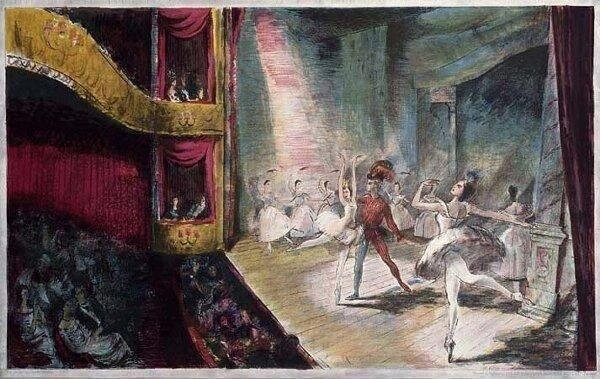
This work documents the grammar of classical ballet technique and stage presentation at a specific historical moment—the 1940s, when ballet was re-establishing itself across Europe after World War II. For dancers and historians, it provides visual evidence of how classical positions and the male-soloist-with-ensemble formation were understood and performed in that period. The artist's attention to the specific effect of stage lighting and the dramatic moment of the leap reveals how ballet was conceptualized both as a technical and as a theatrical art.
What you are looking at
A theatrical ballet scene set within a grand opera house or theatre, viewed from the house left box looking across the stage. The ornate proscenium arch frames the action, with gilded decorative elements and deep crimson curtains visible on the left. The stage floor is brightly lit with a pale golden light that catches the dancers in their positions. The back wall is rendered in soft greens and greys, with architectural features suggesting a classical setting—perhaps a temple or palace interior. In the foreground, a male dancer in brown costume is caught in a dramatic leap or turn, one arm extended, his body twisted in an emphatic pose. Around him, other dancers in white tutus are positioned in attitudes of classical ballet—some standing, some in supporting roles. The composition captures a moment of theatrical action and spectacle, with careful attention to the atmospheric effects of stage lighting and the drama of the performance moment.
The dancing
The principal male dancer dominates the composition, his body in a powerful turning or jumping position with one leg extended and arms framing his torso—a position characteristic of classical male ballet technique. His strong, diagonal line commands the stage. The female dancers in white appear in various classical positions: some standing in preparation or supporting attitudes, others with the upright carriage and turned-out legs of academic ballet. The spacing and grouping suggest ensemble work, with the male dancer as the focal point of a larger choreographic phrase. The overall frame and carriage indicate trained classical ballet dancers working at a high technical level.
The dance depicted
This is unambiguously theatrical ballet in the classical academic tradition. The tutus, the turned-out positions, the proscenium setting, and the male dancer's athletic jumping and turning technique all confirm this as Romantic or Classical ballet of the 19th-century tradition. The composition—with a male soloist dominating the stage space while female ensemble members support—follows the hierarchies common to 19th-century ballet narratives. The dramatic leap and the theatrical lighting and staging suggest this may depict a moment from a specific known work, though without further documentation we cannot identify which ballet. The 1946 date places this in the mid-20th century, when classical ballet was being documented and celebrated by British and European artists.
How it was made
From the visual evidence, this appears to be a mixed-media work on paper—likely gouache, watercolor, and ink, possibly with some lithographic or print elements given the soft, atmospheric quality and the way light and color are handled. The technique allows for rapid capture of theatrical light and movement, with the bright stage lighting effect achieved through careful layering of lighter tones and reserved paper. The style suggests a theatre illustration or documentary sketch from the mid-20th century, the kind of work made to capture and celebrate live performance, probably for publication or exhibition rather than as a fine art original.
About this work
This is a mid-20th-century theatrical illustration capturing a moment from a classical ballet performance. The artist has chosen to depict not a static arrangement of dancers but a single dramatic moment—a male soloist in mid-leap, surrounded by the female ensemble in attitudes of classical technique. The work belongs within the tradition of theatre documentation and celebration that flourished in Britain and Europe during the 1940s, when ballet was experiencing a revival and professional companies commissioned artists to record and publicize their work. It is both a historical document of ballet as it was performed in that era and an exercise in capturing movement, light, and theatrical drama within a two-dimensional medium.
How to look at it
Attend first to the diagonal line of the male dancer's body—the artist has chosen to capture him at the moment of maximum extension and drama, not in a static pose. Notice how the theatrical lighting creates the sense of a stage viewed from the house: the bright stage floor, the deep shadows, and the framing proscenium arch all situate us as an audience member in the theatre. Look at the ensemble dancers—their positioning and posture tell you they are supporting the soloist's moment, which is a fundamental structure of classical ballet narrative. The soft, atmospheric quality of the painting technique mimics the fugitive, moment-by-moment nature of live theatre.
The artist
Charles Mozley (1914–1991) was a British artist known for his prints, murals, and theatrical illustrations. He worked extensively as a theatre and ballet documentarian in the mid-20th century, creating illustrations and prints that captured live performance. His style combined careful observation of movement with painterly attention to light and atmosphere. Mozley was part of a generation of British artists who saw theatre and dance as worthy subjects for serious artistic attention.
The period
In 1946, classical ballet in Britain was experiencing a cultural revival after the disruptions of World War II. The Sadler's Wells Ballet (now the Royal Ballet) was establishing itself as a major national institution, and there was renewed interest in documenting and celebrating ballet as a British cultural achievement. Theatre illustration and dance documentation became a valued artistic practice. Simultaneously, the mid-20th century saw growing interest in capturing the aesthetics of live performance through print and illustration—a genre that reflected both respect for the performing arts and the limitations of photographic documentation of movement on stage.
Where it lives
The work is held as a print in a collection noted as 'va' (likely a British museum or archive). It is catalogued as a 1946 work by Charles Mozley titled 'The Ballet.' The specific production, if any, has not been recorded.
Dance in this work
Questions about this work
Can you identify which ballet this depicts?
Not from the image alone. The work shows a generic classical ballet scene—a male soloist leaping while an ensemble of female dancers in tutus supports him. This formation appears in many 19th-century ballets. Without additional documentation (a title, a note from the artist, or knowledge of what Mozley was illustrating in 1946), we cannot identify a specific work.
Why is the male dancer shown leaping while the women stand still?
This reflects a basic structure of 19th-century classical ballet: the male soloist typically performs the most athletically demanding and showy movements—jumps, turns, traveling steps—while the female ensemble provides a stable, decorative, or supporting visual frame. This was not only an artistic choice but reflected the gender hierarchies of the period and the training and roles available to male and female dancers.
What is the brown costume he's wearing?
Classical male ballet costume is typically a short tunic or doublet in a solid color—here brown or bronze. This distinguishes him from the female dancers in white tutus and marks him as the principal or soloist. The specific color might indicate a particular character (a warrior, a courtier, a supernatural being) in the original ballet, but without knowing the work we cannot say.
How does the theatrical setting change what we see?
The proscenium frame, the stage lighting, and the painted backdrop all remind us that this is not a ballet class or a rehearsal but a public performance in a formal theatre. The artist is documenting not just movement but spectacle—the way the dancers appear under stage lights, in costume, within an architectural frame designed to focus attention. This context shapes everything we see.
More dance artwork





