49 works in this view — arrow keys or swipe to move between them.
Dance in Art
Ballet
Acraman, Arthur Nicholas
- Collection:
- Photograph
- Source:
- Victoria and Albert Museum
- Rights:
- Rights vary by item — check the source record before reusing this image. Source record ↗
- Recorded as:
- V&A — check rights per item
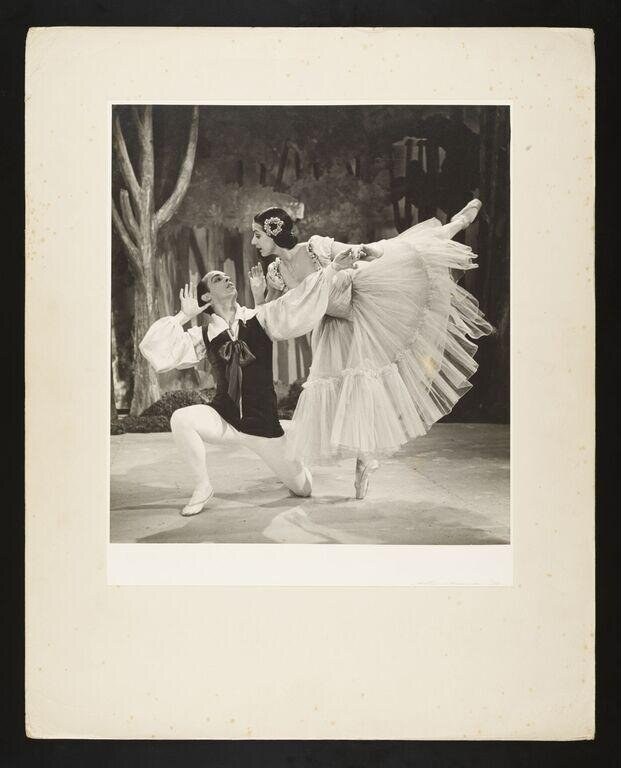
This photograph is a primary document of how classical ballet was performed and understood in 1938, showing the exact physical vocabulary—the leg height, the use of the male body as an instrument of support, the silhouette of the tutu—that defined the practice. For dancers and teachers, it offers a clear anatomical reference for the classical adagio; for historians, it shows the conventions of theatrical photography at a moment when the camera was becoming essential to dance documentation.
What you are looking at
A male dancer in dark jacket and tights, kneeling on his left leg, reaches upward to support a female dancer en pointe in a billowing white tutu. The woman extends her leg in a high développé, her body in a dramatic lean away from her partner, arms raised in a classical port de bras. The stage setting is sparse and atmospheric—a painted backdrop suggests classical architecture with columns and a moonlit cityscape rendered in soft focus. The lighting creates strong shadows that define the dancers' forms against the darker background. The composition captures a moment of sustained balance and tension between the two figures, the woman's lifted pose counterbalanced by the man's stable, grounded support.
The dancing
The male dancer supports the female dancer in a classical adagio passage, his right arm raised to steady her at the waist while his left leg kneels firmly for stability. The female dancer achieves a deep arabesque or attitude à terre effect—she stands en pointe on her supporting leg with extraordinary extension, her free leg rising well above hip height in a turned-out position. Her upper body leans backward, creating a C-shaped curve that requires sustained counter-balance from her partner. Her arms are held in classical position, one raised and one extended, showing the formal carriage of academic ballet. The pose demonstrates the hierarchical relationship typical of classical pas de deux: the male dancer functions as the essential support enabling the female dancer's display of line and elevation.
The dance depicted
This is unmistakably classical ballet, specifically a moment from a romantic or classical pas de deux—the formal solo for two dancers that was a cornerstone of 19th-century ballet repertory. The pose appears to be a sustained adagio, the slow section of a pas de deux in which the male dancer supports the female dancer through a series of turns and extensions designed to showcase her flexibility, control, and grace. The woman's costume—a white tulle skirt gathered at the waist—and her pointe shoes are canonical to classical ballet of the romantic and imperial Russian periods. The architectural setting and romantic atmosphere suggest this may be from a narrative ballet such as Swan Lake, La Sylphide, or Giselle, though the image alone cannot specify which work. The composition emphasizes the balletic ideal of effortless-seeming elevation and line sustained through invisible male labour.
How it was made
This is a black-and-white photograph, likely a gelatin silver print made during a theatrical performance or a posed studio session. The depth of field and soft focus on the background are consistent with early-to-mid 20th century photographic practice, allowing the dancers to remain sharp while the set reads as an atmospheric wash. The medium captures a split-second moment that would otherwise exist only in live performance; the photograph freezes the sustained arabesque in a way that emphasises both the geometric perfection of the line and the physical control required. As a theatrical photograph, it likely served documentary purposes—recording a performance or a dancer's achievement—and may have been circulated to critics, other dancers, or archives.
About this work
This is a photograph of a classical ballet pas de deux, showing a male dancer supporting a female dancer in a high extension characteristic of romantic and classical ballet vocabulary. The work dates to 1938 and was captured by photographer Arthur Nicholas Acraman. The image is a documentary record of theatrical ballet practice at a moment when photography was becoming an important means of preserving and circulating knowledge of live dance. The dramatic lighting, spare setting, and emphasis on the line of the female dancer's body reflect both the aesthetic priorities of classical ballet and the photographic conventions of mid-20th-century dance documentation.
Within the history of dance photography, this image belongs to a tradition of theatrical portraiture that aimed to capture the ideal line of the ballet body in a single, perfected moment. The photograph demonstrates how early dance photographers worked with performers to reconstruct or document key poses from repertory, making the fleeting visible and repeatable. This work is valuable both as a record of how classical ballet was performed and taught in the 1930s, and as evidence of the role photography played in codifying and disseminating ballet aesthetics.
How to look at it
Attend to the exact configuration of the male dancer's body beneath the female dancer: the planted knee, the angle of his supporting arm, the way his own frame is composed to create an invisible platform. This is the invisible labour that the pas de deux was designed to obscure. Then trace the line of the female dancer's body from her supporting foot through her extended leg and into her upper body—the photograph captures the moment of maximum extension, and you can see why this moment was the goal of the adagio section. Notice how the photographer has composed the image to emphasise the verticality of the woman's pointe work and the perfect turnout of her extended leg, making the technical achievement visible through the frame.
The artist
Arthur Nicholas Acraman (1899–1953) was a British photographer known for theatrical and portrait work. He photographed ballet and theatre extensively in the 1930s and 1940s, documenting London's dance scene during the period when British ballet was beginning to establish itself as a significant artistic force. His work appears in the Victoria and Albert Museum collections and reflects the mid-century practice of theatrical photographers who worked closely with dance companies and individual performers to create both archival and promotional images.
The period
In 1938, classical ballet in Britain was entering a formative period. The Vic-Wells Ballet (later the Royal Ballet) had been founded in 1931 and was establishing itself under Ninette de Valois. This was also the era of the Ballets Russes' later seasons and the consolidation of imperial Russian ballet technique in Western European practice. The photograph reflects the continuing dominance of romantic and classical 19th-century repertory—the vocabulary of Petipa, Ivanov, and the works staged by Sergeyev—which remained the core of ballet training and performance. This was before the radical interventions of Balanchine and contemporary ballet aesthetics, so the image shows ballet at the height of its classical formality, before mid-century modernism began to challenge the vocabulary of the turned-out body and the gendered hierarchy of the pas de deux.
Where it lives
This is a theatrical photograph held in the Victoria and Albert Museum's collection, catalogued as a work by Arthur Nicholas Acraman dated 1938. The museum acquired this image as part of its documentation of British theatre and ballet history. As a museum photograph, it has been preserved as both an artwork in its own right and as a historical document of theatrical practice.
Dance in this work
Questions about this work
What is this pose called in ballet?
The female dancer appears to be in an arabesque or attitude, sustained in the slow section (adagio) of a classical pas de deux. In this context, the pose is part of the supported adagio, in which the male dancer enables the female dancer to achieve and hold positions of maximum extension and line. The exact nomenclature depends on the turn-out angle of the extended leg and the position of the supporting foot, but the pose is characteristic of late 19th and early 20th-century classical ballet vocabulary.
Why is the male dancer kneeling?
The male dancer's kneeling position in adagio work provides a base of support at a lower height than his standing frame would allow, giving him stability while he supports the female dancer's weight and movement. This position is typical in the slow, sustained passages of the pas de deux where the female dancer needs a secure, steady anchor for extensions and turns. The kneeling pose was codified in 19th-century ballet and remains standard in classical repertory.
What ballet is this from?
The photograph does not identify a specific ballet. The setting, costumes, and vocabulary are consistent with any number of romantic or classical pas de deux from the 19th-century repertory—Swan Lake, Giselle, La Sylphide, or other works in the standard canon. Without documentation or a visible programme, the specific ballet cannot be determined from the image alone.
How was this photograph taken during a performance?
This was likely a posed studio session or a special photographic call arranged with the performers, rather than a candid capture during a live performance. Theatre lighting in 1938 would not have been bright enough for fast enough shutter speeds to freeze this pose sharply, and theatrical photographers typically worked with dancers before or after performances to restage key moments. The controlled lighting and composition support this practice.
More dance artwork





