49 works in this view — arrow keys or swipe to move between them.
Dance in Art
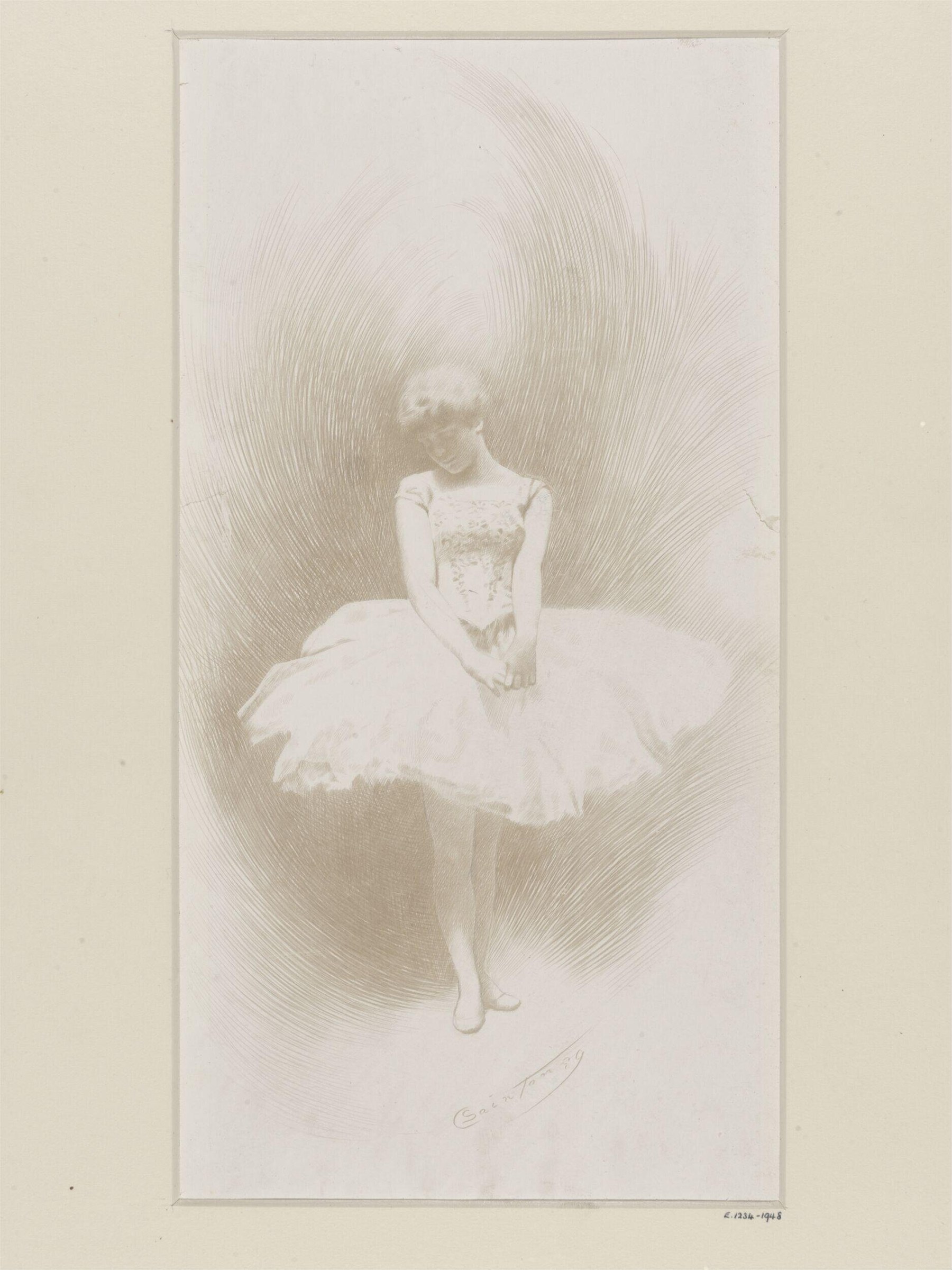
Study of a ballet-dancer
Charles Prosper Sainton
- Collection:
- Drawing
- Source:
- Victoria and Albert Museum
- Rights:
- Rights vary by item — check the source record before reusing this image. Source record ↗
- Recorded as:
- V&A — check rights per item
This work preserves the visual language and costume standards of Romantic ballet at a point when such imagery was crucial to the dissemination of dance culture beyond the theatre. For historians and dancers, it serves as material evidence of how the ballet body was presented, idealized, and circulated in the visual culture of the late nineteenth century—revealing as much about artistic convention and commercial display as about the dance itself.
What you are looking at
A young female dancer in a classical ballet costume stands alone against a neutral background, rendered in fine linear hatching that creates soft modulation of light and shadow. She wears a white or pale sleeveless bodice with decorative embroidery or beading at the torso, and a full tutu skirt of the mid-to-late nineteenth century style—voluminous and knee-length, composed of layers of tulle or similar fabric. Her hair is styled up in the period fashion. The figure is shown in a composed, frontal pose with arms at rest, one hand positioned near her body. Behind her, concentric circular lines radiate outward, creating an almost halo-like effect that emphasizes the dancer as the focal point. The technique produces a delicate, ethereal quality appropriate to the subject.
The dancing
A single figure dominates the composition. The dancer's posture is upright and composed rather than in active motion—feet appear to be in a neutral position, weight evenly distributed, with no suggestion of the articulated turnout or dynamic extension typical of ballet's technical display. The arms hang relatively naturally, without the precise framing or positions expected in formal ballet poses (such as arabesque or attitude). The overall impression is more of a presentational or portrait study than a capture of active dance movement.
The dance depicted
This is a study of a ballet dancer, most likely from the Romantic era (1830s–1860s) based on the tutu style and the conventions of costume illustration. The dancer is posed for portraiture rather than captured in performance, which was a common practice in nineteeth-century dance documentation and promotion. The costume—the white tutu, sleeveless bodice, and upswept hair—conforms to the aesthetics of Romantic ballet, when ballet costumes were associated with ethereal, otherworldly female characters. However, the pose itself reveals little about the dancer's technical skill or the specific vocabulary of the ballet; this is a representation of the dancer as a figure or type rather than as an active virtuoso.
How it was made
This is a drawing executed in ink or graphite using fine, parallel lines (hatching and cross-hatching) to build form and shadow—a technique that suggests engraving or etching, though the delicacy and continuous line quality indicate it may be a pen drawing prepared for reproductive engraving or simply a fine-art drawing study. The linear technique was well-suited to the reproducibility and circulation of dance imagery in the nineteenth century, allowing wide distribution in periodicals, books, and portfolios. The soft, atmospheric effect created by the radiating background lines and subtle tonal gradation suggests an artist skilled in achieving refined detail and romantic mood.
About this work
This is a study of a young female ballet dancer in the costume and aesthetic of mid-nineteenth-century Romantic ballet. Created by Charles Prosper Sainton in 1889, it documents both a specific performer (or type of performer) and the visual conventions of the ballet world at a moment when such studies were valuable as records, promotion, and art objects in their own right. The drawing sits at the intersection of dance documentation, portraiture, and fine-art practice—not a dynamic action study, but a composed image that captures the cultural and visual identity of the ballet dancer as a figure of artistic aspiration and theatrical spectacle.
How to look at it
Attend to the pose and what it does not show: the dancer is not caught mid-movement, but rather presented as a composed figure for viewing and study. The radiating lines behind her function as both a formal device (emphasizing her isolation and centrality) and a romantic gesture (suggesting an almost spiritual or celestial aura around the figure). Notice the specificity of the costume details—the beading, the tutu's volume and cut, the hair arrangement—which would have been recognizable to contemporary viewers as markers of theatrical identity and social status. The refined technique of the drawing itself—the patience and skill required to build form through fine parallel lines—demonstrates the respect and attention lavished on the subject.
The artist
Charles Prosper Sainton (1829–1909) was a French painter and illustrator known for figure studies and theatrical subjects. He was active during the Second Empire and Third Republic, a period of flourishing dance culture in Paris, and his work shows familiarity with the ballet world and with the refined linear drawing techniques that characterized mid-to-late nineteenth-century academic art practice. His studies of performers and theatrical subjects place him within a broader tradition of artists documenting the cultural life of Paris.
The period
By 1889, Romantic ballet (which had dominated the stage from the 1830s through 1860s) was entering its historical phase, but its aesthetic—the white tutu, the ethereal heroine, the association of ballet with the supernatural—remained culturally central. The late nineteenth century saw intense interest in dance as a subject for fine artists, partly because of the rise of mass-market illustrated periodicals and the growing prestige of ballet as a high art form. This period also witnessed a shift toward more naturalistic and psychologically complex representations of the dancer's body, even as the Romantic costume and iconography remained in circulation.
Where it lives
The work is held in a collection identified as 'va' in the record, which is likely the Victoria and Albert Museum in London, a major repository of theatrical and dance-related drawings and designs. It is catalogued as a drawing, a medium consistent with the technical evidence of the image.
Dance in this work
Questions about this work
Is this a portrait of a real dancer?
The record identifies it as a 'study of a ballet-dancer' rather than a named individual, suggesting it may be either a portrait of an actual performer whose name is not recorded, or a generalized study of the ballet dancer as a type. The refined finish and careful costume detail suggest it was made from life or from close familiarity with theatrical practice, but the identity of the sitter (if there is one) is not established in the available documentation.
What does the pose tell us about Romantic ballet technique?
The static, frontal pose tells us little about technique itself. However, it reveals the emphasis Romantic ballet placed on the presentation of the costumed body and the aesthetic of ethereal, composed femininity. The actual demands of ballet vocabulary—turnout, épaulement, dynamic line—are not on display here; instead, the focus is on the cultural identity and visual appeal of the performer as a theatrical figure.
Why is there a halo or aura around the dancer?
The concentric circular lines radiating behind the figure are a formal and aesthetic choice that emphasizes the dancer's isolation and draws the viewer's eye to the center of the composition. In the context of Romantic-era dance imagery, such effects also carry symbolic weight, suggesting something ethereal, otherworldly, or spiritually significant about the figure—qualities central to the Romantic ballet aesthetic.
What was the purpose of drawing like this in the nineteenth century?
Fine drawings and studies of dancers served multiple purposes: as records of costume and performance practice, as training and reference material for other artists, as promotion and documentation for theatres and performers, and as artistic works valuable in themselves. Such studies could be reproduced as engravings for circulation in journals and books, making them key vehicles for disseminating dance culture beyond the theatre itself.
More dance artwork





