49 works in this view — arrow keys or swipe to move between them.
Dance in Art
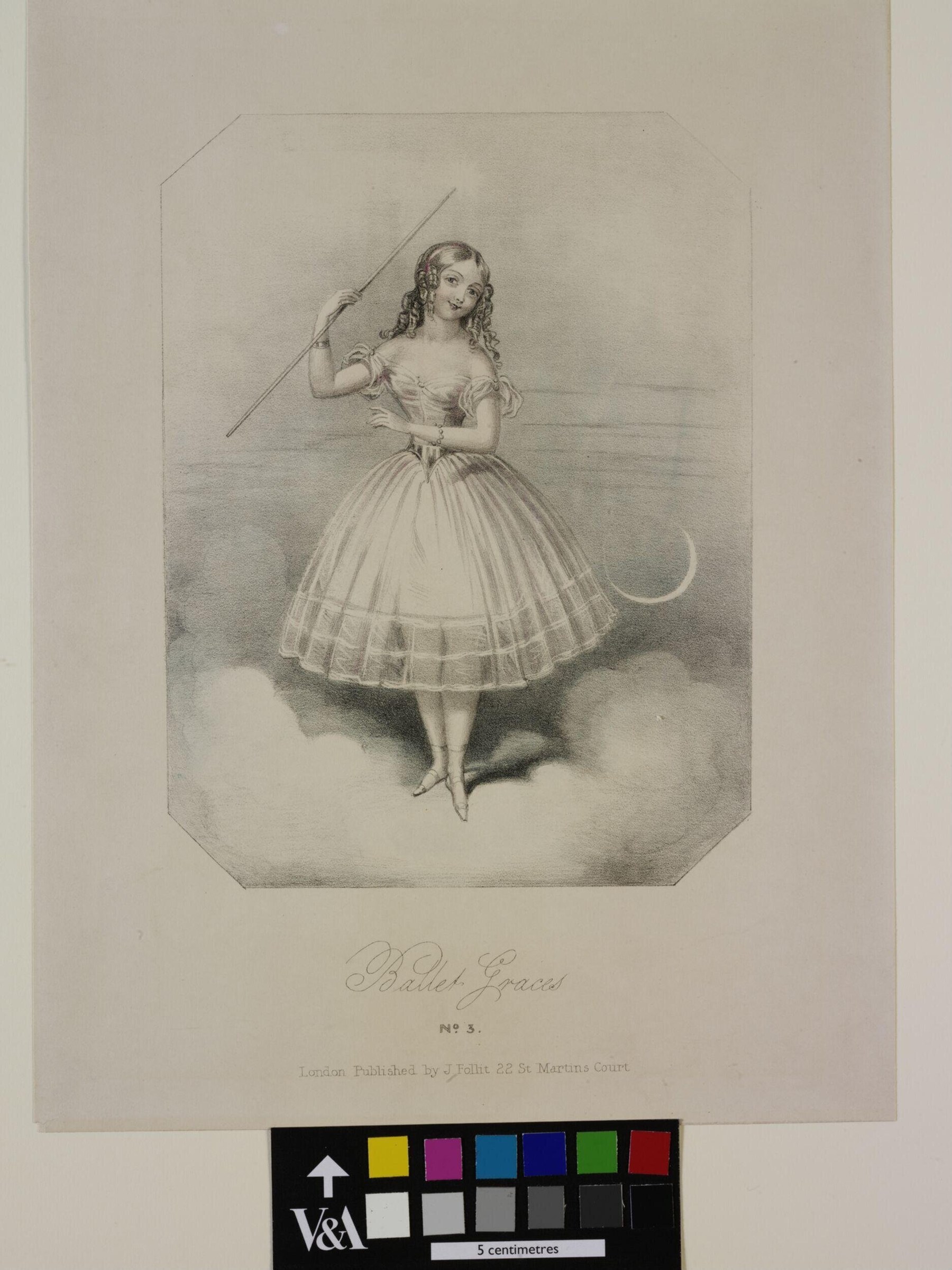
Ballet Graces / No 3.
J. Follit
- Collection:
- Source:
- Victoria and Albert Museum
- Rights:
- Rights vary by item — check the source record before reusing this image. Source record ↗
- Recorded as:
- V&A — check rights per item
This work reveals how 19th-century ballet was consumed and imagined beyond the theatre—not as dynamic movement but as static idealized beauty, available as a print to hang in a parlor. The series format suggests a systematic cataloging of ballet aesthetics or virtues, showing how the dance form functioned symbolically in mid-19th-century visual culture. For historians, it documents both the fashion and allegorical language of the Romantic ballet period, and the commercial print infrastructure that made ballet imagery accessible to the middle-class domestic market.
What you are looking at
A young female dancer stands alone against a plain, atmospheric background rendered in soft gray tones. She wears a pale, full-skirted ballet dress with a fitted bodice and off-shoulder sleeves, the skirt extending to mid-calf in the style of mid-19th-century theatrical costume. Her hair is arranged in long ringlets falling past her shoulders. She holds a long, slender rod or stick diagonally across her body at approximately shoulder height, angled upward to the left. Her posture is upright and composed, with her weight appearing to rest on both feet. A crescent moon shape is faintly visible in the lower right of the composition, and the entire figure floats on soft clouds or mist, creating an ethereal, otherworldly setting that suggests a supernatural or allegorical scene rather than a terrestrial stage.
The dancing
The dancer presents a frontal, static pose rather than a captured moment of active movement. Her frame is entirely vertical and still, with both arms engaged: the right arm raised to hold the rod, the left arm hanging naturally at her side. Her feet are positioned closely together in a natural stance—not in turnout or any recognizable ballet position. The overall bearing suggests a formal presentation or portrait stance rather than the demonstration of a specific choreographic moment.
The dance depicted
The work is titled *Ballet Graces* and appears to be part of a numbered series. The costume and balletic vocabulary (the tutu, the theatrical setting, the ethereal mise-en-scène) clearly place this within theatrical ballet tradition. However, the static pose and the prominent rod—which does not correspond to any standard ballet prop or technique—suggest this may be an allegorical or symbolic representation rather than a depiction of actual choreography. The figure may represent an idealized concept of ballet grace or beauty rather than documenting a specific dance or dancer. The series numbering hints that each print in the collection may represent a different 'grace' or virtue associated with ballet.
How it was made
This is a steel engraving or lithograph, executed in grayscale with careful tonal gradation to create volume and atmosphere. The soft modeling of the background and the precise rendering of the dress and figure suggest a mid-19th-century reproductive print, likely engraved after a drawing or painting. The technique allowed for mass production and distribution, suggesting this was a popular commercial print aimed at a broad audience interested in ballet and theatrical imagery. The publisher's mark at the base—'London Published by J. Follit 22 St Martins Court'—confirms London production and identifies Follit as either the printer or publisher.
About this work
This is a theatrical ballet imagery from the mid-19th century, part of a series titled *Ballet Graces*. Rather than documenting a specific choreographed moment, it presents an idealized allegorical figure—a young woman in romantic-era ballet costume, posed in a static, portrait-like composition. The ethereal setting (clouds, crescent moon) and the unexplained rod prop suggest this is a symbolic representation of an abstract concept (grace, virtue, or poetic aspiration) rather than a literal depiction of stage performance. As a commercial print distributed from London, it represents how ballet imagery circulated in popular culture and domestic spaces during the era of Romantic ballet, serving aesthetic and decorative purposes beyond documentary dance recording.
How to look at it
Observe the deliberate stillness of the pose: this is not a dancer caught in motion but presented as a sculpture or icon. Notice the careful distinction between the softly rendered atmosphere (the clouds and misty background) and the precisely detailed costume and figure—the artist is constructing an ideal rather than recording a moment. The rod's unexplained presence is key: it suggests this is a symbolic image rather than a faithful stage document. Compare this compositional choice to other theatrical prints of the period to see how static, portrait-like poses dominate allegorical and aspirational ballet imagery, in contrast to action-filled stage scene prints.
The artist
J. Follit is recorded as the London publisher of this print at 22 St Martin's Court, but the artist or engraver of the original image is not identified in the catalogue record. Follit's premises in St Martin's Court, a central London location, suggests a commercial print business serving the mid-19th-century market for theatrical and allegorical imagery. Without further documentation, the original designer and the engraver remain unknown.
The period
This print dates to the height of Romantic ballet, approximately the 1830s–1850s, when ballet imagery flourished in European visual culture. Romantic ballet itself emphasized ethereality, otherworldliness, and the idealized female form—conventions that this print embodies through its allegorical setting and static, beautiful pose. Commercial prints of ballet dancers and ballet-related allegorical subjects were highly popular during this period, decorating middle-class homes and serving as mementos of celebrated dancers or as aesthetic objects in their own right. The series format of *Ballet Graces* reflects a 19th-century taste for categorized, collectible imagery (similar to other print series of the era), and the ethereal, cloud-supported setting reflects the Romantic aesthetic sensibility that dominated visual and performing arts.
Where it lives
The work is held by the V&A (Victoria and Albert Museum), cataloged as a print. It is part of the museum's collection of 19th-century theatrical and dance-related prints. The publication information—'London Published by J. Follit 22 St Martins Court'—indicates this was a commercially produced print for the British market.
Dance in this work
Questions about this work
What is the rod the dancer is holding?
The rod's purpose is unclear and may be symbolic rather than functional. It does not correspond to any standard ballet prop or technique. It may be an attribute associated with the allegorical concept this figure represents, or it may indicate a different performance tradition (such as a parasol or theatrical prop). Without additional documentation from the series, its meaning cannot be determined with certainty.
Is this a portrait of a real dancer?
It is unlikely to be a portrait of an identifiable performer. The work is part of a series called *Ballet Graces*, and the allegorical, idealized nature of the figure suggests it represents an abstract concept rather than a specific individual. The static pose and symbolic setting support this interpretation.
When was this print made?
The catalogue record does not provide a date, but stylistic evidence—the costume, the Romantic aesthetic, the commercial print format—places it in the mid-19th century, likely 1830s–1860s. The fashion and artistic conventions are consistent with the height of Romantic ballet.
What does 'Ballet Graces' mean?
The title suggests a series representing different virtues or ideals associated with ballet: grace, beauty, elegance, and other aesthetic or moral qualities valued in the Romantic period. Each numbered print in the series likely embodies or allegorizes a different 'grace,' making the series a visual taxonomy of ballet-associated ideals.
More dance artwork





