49 works in this view — arrow keys or swipe to move between them.
Dance in Art
Nocturne
Fedorovitch, Sophie
- Collection:
- Costume design
- Source:
- Victoria and Albert Museum
- Rights:
- Rights vary by item — check the source record before reusing this image. Source record ↗
- Recorded as:
- V&A — check rights per item
Fedorovitch was a pioneering female designer in modernist theatre who shaped the visual language of dance and drama in interwar and postwar Britain. Costume designs like this document not only what performers wore, but how avant-garde visual principles—abstraction, bold color, dramatic silhouette—entered theatrical practice. The work is a record of a specific moment in theatre history when costume design was recognized as a sophisticated art form in its own right.
What you are looking at
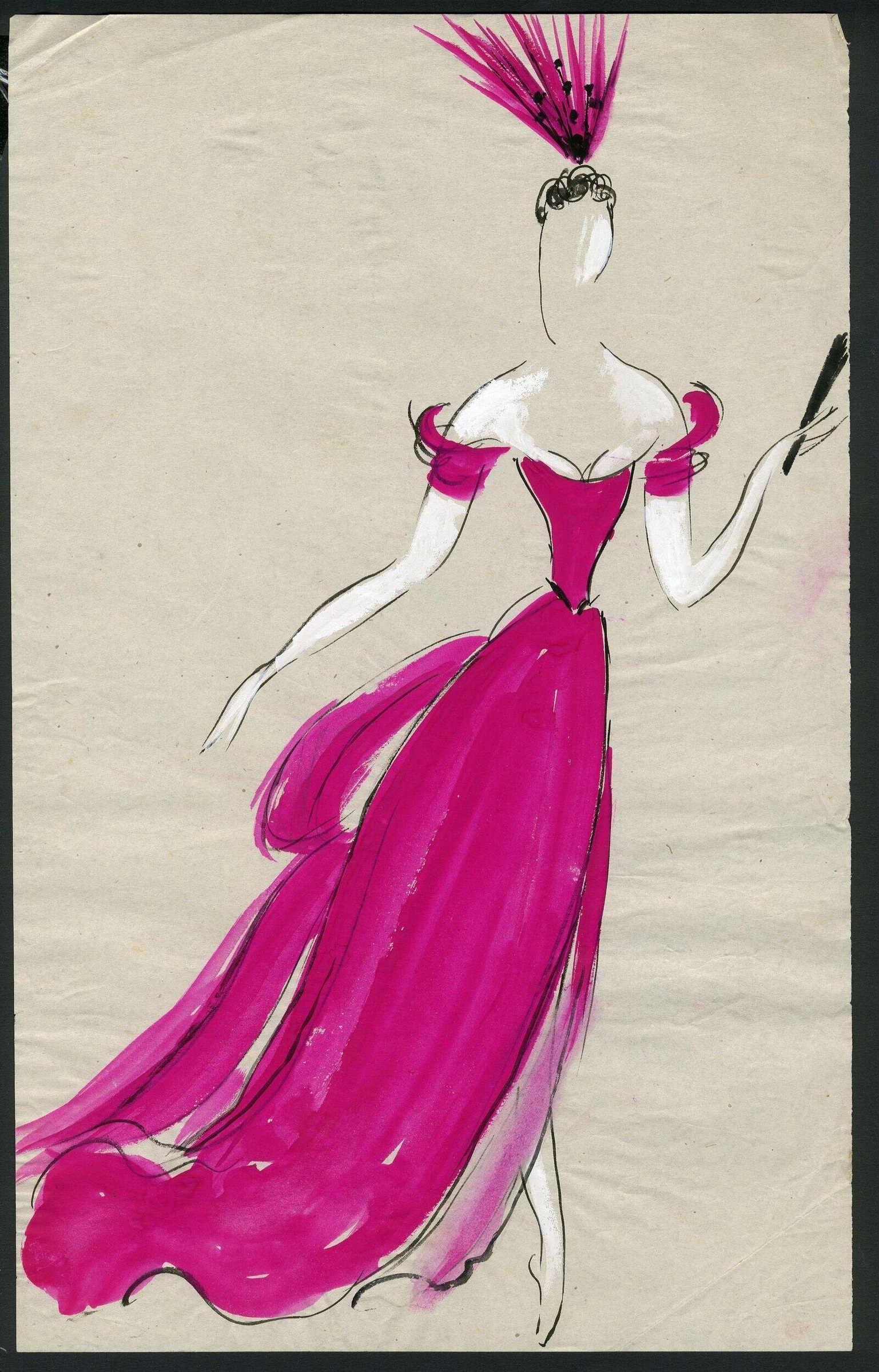
A fashion illustration in mixed media shows a single elegant figure in profile, facing left. The figure is rendered in minimal line drawing: a stylized head with a long neck, bare shoulders, and extended arms. The body is a white silhouette, outlined in black ink. The costume dominates the composition: a strapless bodice in magenta with decorative ruffled trim at the shoulders and waist, and a voluminous floor-length skirt in the same vivid magenta, rendered in loose, gestural brushstrokes that suggest movement and fabric weight. The skirt trails across the lower half of the page with diagonal sweeps of color and white highlight, suggesting the moment of a swirl or turn. Most striking is the headdress: an ornamental metal circlet or tiara frames the top of the head, from which extends a dramatic plume of magenta and black feathers that rises vertically above, dominating the upper third of the frame. The entire composition is spare and theatrical, with the figure set against cream paper, emphasizing the costume as the primary subject.
The dancing
The figure stands in a three-quarter profile pose with weight evenly distributed and a graceful S-curve to the silhouette. One arm extends forward and slightly downward, the other is held at the side or slightly back; the pose conveys poise and presentation rather than active movement. The elongated neck and minimalist head treatment are characteristic of haute couture illustration. The stance is balletic in its verticality and refinement, with no bent knees or weighted shift of gravity visible—this is a posed moment of display rather than a captured mid-movement.
The dance depicted
This is almost certainly a costume design rather than a depiction of dance in action. While the figure's refined posture and the theatrical presentation suggest a balletic or revue context, there is no evidence of actual choreographic movement—no turn, leap, or dynamic weight shift. The costume's opulence and the elaborate feathered headdress point to cabaret, music hall, or theatrical revue rather than classical ballet. The magenta color and modernist simplicity of line suggest 1930s modernism in theatre design. Without documentary evidence of which performance this costume was worn in, or inscription identifying the role, the specific dance context cannot be confirmed.
How it was made
This is a mixed-media costume design executed on paper in black ink line drawing and applied watercolor or gouache in magenta and white. The technique is economical: the body is rendered as pure outline and white fill, while the costume receives full color attention. This approach—minimal figure, maximum fabric—is characteristic of haute couture and theatrical costume design illustration, where the designer's focus is communicating the garment rather than the dancer's movement. The medium suggests circulation as a working design document or presentation drawing rather than a finished artwork for exhibition, though its refined execution indicates it may have been created for a client presentation or publication.
About this work
This is a costume design by Sophie Fedorovitch, a Russian-born British stage designer known for modernist work in theatre and ballet during the 1920s–1940s. The work shows the influence of constructivist and avant-garde aesthetics applied to theatrical dress: bold color, clean line, and dramatic silhouette. The title 'Nocturne' suggests either a mood or a specific performance context. The drawing belongs to the substantial tradition of costume design as a distinct visual art form, where the garment and its theatrical presentation are the primary subject. Such designs were essential tools in the mid-twentieth-century European theatre, communicating both practical information and artistic vision to directors, makers, and performers.
How to look at it
Look first at the costume itself: the magenta is the dominant visual statement, and its intensity suggests stage lighting and visual impact. The feathered headdress is not decorative but architectural—it commands the composition and would dominate the stage space. The spare outline of the body suggests the designer's focus: the garment is the artwork, not the dancer. The gestural brushwork in the skirt—those loose, sweeping strokes—conveys not a static object but the fabric in motion, full of potential movement. The pose is presentation: a model or performer displaying the costume to the viewer, not executing choreography.
The artist
Sophie Fedorovitch (1893–1977) was a Russian-born British designer who became one of the leading visual artists for dance and theatre in mid-twentieth-century Europe. She fled Russia after the Revolution and settled in London, where she worked extensively with Sergei Diaghilev's Ballets Russes and later with the Ballet Rambert and other companies. She was known for a modernist aesthetic that integrated constructivist and surrealist influences into theatrical practice. Beyond costume design, she designed sets, created visual environments, and collaborated closely with choreographers to shape the complete visual experience of performance. She was a rare figure: a woman designer whose vision was recognized as central to the artistic integrity of the works she touched.
The period
The 1930s were a period of rapid experimentation in theatrical modernism. The influence of the Russian avant-garde was still strong in Western European theatre, though by the mid-1930s surrealism and more organic abstraction were increasingly shaping design practice. Costume design had emerged as a recognized art form, distinct from mere dressmaking; designers like Fedorovitch, Pavel Tchelitchew, and Jean Bérard were celebrated collaborators in the theatrical enterprise. In ballet and revue, the 1930s saw increasing use of bold, simplified forms and striking color—moving away from historical pastiche toward modernist abstraction. The elegance and restraint of Fedorovitch's line drawing, combined with the drama of saturated color, reflects this moment when European modernism and theatrical spectacle converged.
Where it lives
This is held in the Victoria and Albert Museum's Theatre and Performance Collection as a costume design, one element of the extensive body of design work Fedorovitch produced over her career. Such designs typically originated as working documents but were frequently retained and preserved when the designer's work was recognized as historically or artistically significant.
Dance in this work
Questions about this work
Who was Sophie Fedorovitch?
Sophie Fedorovitch (1893–1977) was a Russian-born British designer who became one of the most influential visual artists in twentieth-century theatre and dance. After the Russian Revolution, she fled to London and worked with the Ballets Russes and other major companies, designing costumes, sets, and visual environments. She was known for her modernist aesthetic and her ability to integrate visual abstraction with theatrical spectacle.
Is this a painting or a sketch?
This is a finished costume design drawing, executed in mixed media—black ink line drawing and applied watercolor or gouache. It is more refined than a sketch, but its primary purpose was communicative: to show a costume designer's vision to the director, makers, and performers. The technique is economical and shows the designer's hand, but it is a professional design document rather than a fine-art painting.
What does 'Nocturne' refer to?
The title likely refers either to a specific theatrical work or ballet with that name, or to the mood and atmosphere the costume was designed to evoke. Without additional documentation, the exact performance context cannot be confirmed, but the theatrical presentation and modernist style suggest a significant 1930s production.
Why is the figure so simplified?
The minimal rendering of the body focuses all attention on the costume. In costume design, the garment is the artwork; the body is essentially a display form. The simplified line drawing was also practical: it communicates the silhouette and overall composition quickly, while the full color treatment of the costume shows its visual impact under stage lighting.
More dance artwork





