49 works in this view — arrow keys or swipe to move between them.
Dance in Art
Nocturne
Fedorovitch, Sophie
- Collection:
- Costume design
- Source:
- Victoria and Albert Museum
- Rights:
- Rights vary by item — check the source record before reusing this image. Source record ↗
- Recorded as:
- V&A — check rights per item
Fedorovitch's designs shaped the visual language of British ballet during its formative years; this sketch documents not just a costume but a moment of creative decision-making in the theatre. The work demonstrates how a costume designer understood the relationship between fabric, movement, and the dancer's body—a dialogue central to how ballet is actually made and seen on stage.
What you are looking at
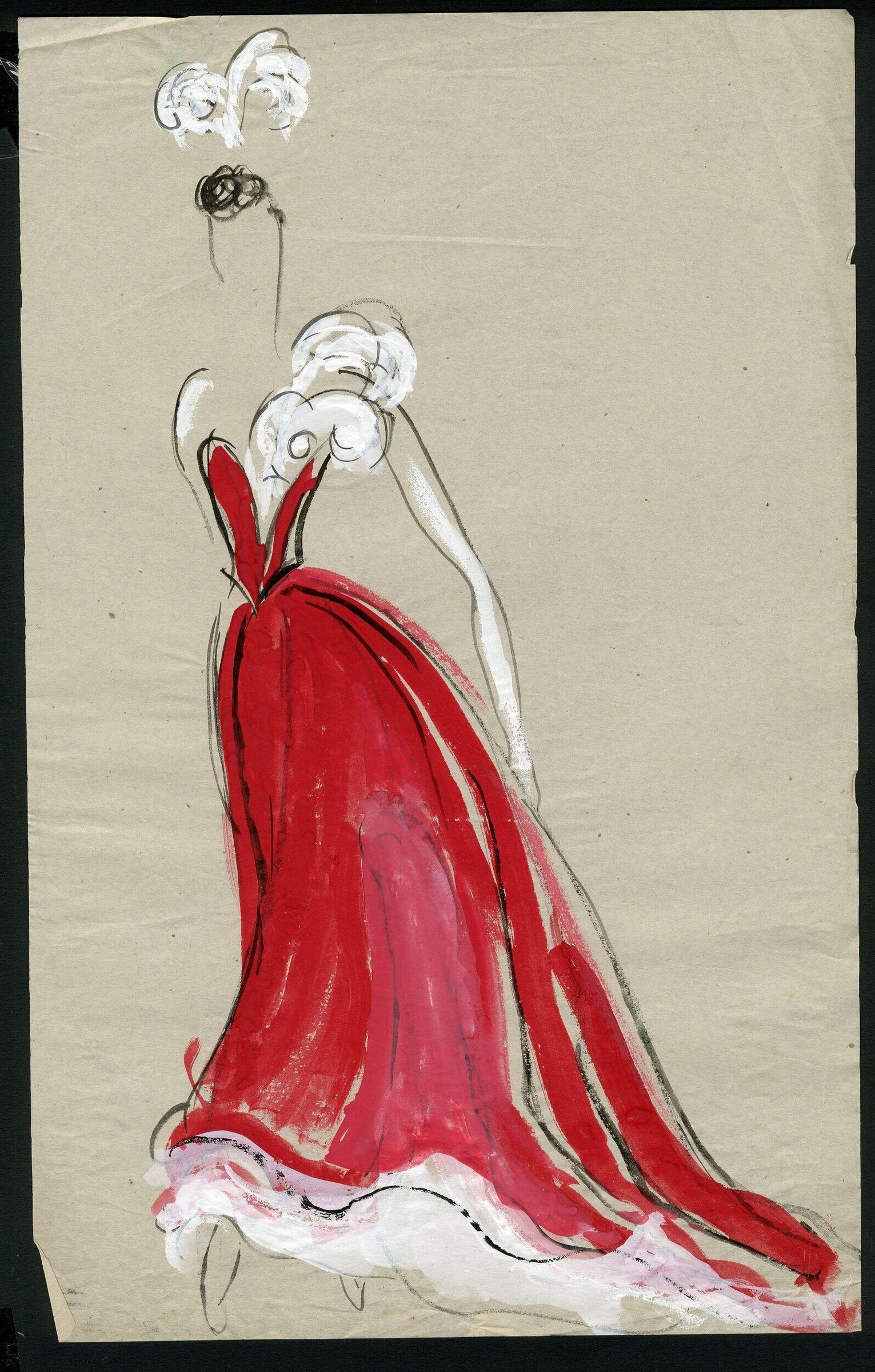
A single female figure in a dramatic red gown dominates the composition, shown in three-quarter view with her body turned and weight shifted. The dress is voluminous and flowing, rendered in bold red with darker shading that suggests depth and movement; it trails behind her in a long train edged with white fur or trim. Her upper body and arms are drawn in light, simplified lines, with her head tilted back slightly and one arm raised. She wears what appears to be a white or pale headdress—possibly a tiara or crown-like ornament. Above her, two smaller head studies in the upper portion of the page show alternative poses or expressions, rendered in the same economical line technique. The composition is set against the cream-colored paper itself, with no background or setting indicated. This is unmistakably a costume design: a working sketch that captures the silhouette and spatial drama of the garment rather than a finished illustration.
The dancing
The dancer's posture suggests a moment of extension and elevation—her raised arm and tilted-back head read as a balletic port de bras, with the body weight lifted through the torso. The arm position, though sketched lightly, follows classical ballet line. Her legs are not clearly articulated, but the angle of the torso and the train of the dress indicate the figure is moving or rotating through space. The subsidiary head studies suggest the costume designer was exploring the effect of the headpiece and facial expression from different angles, a practical concern for stage visibility.
The dance depicted
This is a costume design for theatrical ballet, most likely from the Romantic or early twentieth-century classical tradition. The title *Nocturne* suggests an evening or dream-like subject, common to Romantic ballet narratives. The dress—with its full skirt, fitted bodice, and elaborate ornamentation—is consistent with mid-to-late nineteenth-century ballet costume. The lightness of line in the bodice contrasts with the weight and drama of the skirt, capturing the visual effect a dancer would project: ethereal upper body, sumptuous lower silhouette. The costume's design prioritizes the romantic aesthetic of flowing fabric and the play of light across surfaces.
How it was made
This is a mixed-media costume design drawing: pencil or fine charcoal for the structural line work, watercolor or gouache for the red skirt, and what appears to be Chinese white or body color for the highlights on the head and train trim. The economy of the technique—minimal line for the upper body, concentrated color and modeling in the skirt—is characteristic of professional costume design practice, where the focus is on communicating the dominant visual element (the dress) while establishing the figure's movement and proportion. This working method prioritizes communication with the wardrobe department and stage manager over finished artistic presentation.
About this work
This is a costume design by Sophie Fedorovitch for a ballet titled *Nocturne*, dated 1936. Fedorovitch was a Russian-born designer and painter who became a central figure in British ballet design during the mid-twentieth century. The work is housed in the Victoria and Albert Museum's collection of costume and set designs. The sketch shows a single female dancer's gown: a dramatic red skirt with white fur trim and a fitted, ethereal bodice. The design captures both the practical requirements of stagecraft—communicating the silhouette and movement potential of the costume—and the romantic aesthetic of classical ballet. The work belongs in this collection as a primary document of how dance was visualized and communicated through design in the early twentieth century.
How to look at it
Attend to how the designer has used the contrast between the delicate line of the upper body and the substantial, modeled volume of the skirt. This contrast is not accidental: it communicates the essential visual effect of romantic ballet costume, where the illusion of weightlessness in the torso and arms must coexist with the material presence of the skirt. Notice how the train extends the line of the skirt beyond the body, suggesting movement and grandeur. The smaller head studies at the top reveal the designer's working method: testing how the headdress and the dancer's expression read from the audience's viewpoint. This is the sketch of a professional who understood the stage.
The artist
Sophie Fedorovitch (1893–1977) was a Russian-born painter and costume designer who emigrated to Britain and became one of the most important collaborators in twentieth-century British ballet. She designed for Frederick Ashton, Marie Rambert, and the major ballet companies of her era, creating costumes and set designs for works that defined the aesthetic of British ballet. She was known for her sophisticated use of color, her understanding of how fabric moved with the dancer's body, and her ability to balance visual drama with practical stage requirements. Her work ranged from Romantic revivals to contemporary creations.
The period
In 1936, British ballet was establishing itself as a major artistic force, partly through the efforts of the Rambert Dance Company and the emerging Sadler's Wells Ballet. The Romantic ballet aesthetic—the ethereal tutu, the pale pointe shoe, the dreamlike narrative—remained the dominant visual language of classical ballet design, even as choreographers like Ashton and Rambert were developing new vocabularies. Fedorovitch's designs from this period straddle tradition and modernism: they honor the classical silhouette while using color and line in ways informed by contemporary art. The 1930s saw renewed interest in the Romantic repertory, with designers reinterpreting nineteenth-century ballets for modern stages and audiences.
Where it lives
This work is held by the Victoria and Albert Museum in London as part of its collection of theatre design. The attribution and dating are those of the museum's catalogue record; the work is catalogued as a costume design drawing, consistent with its form and function.
Dance in this work
Questions about this work
Who was Sophie Fedorovitch?
A Russian-born painter and costume designer (1893–1977) who became a central figure in mid-twentieth-century British ballet. She designed for the major companies and choreographers of her era, including Frederick Ashton and Marie Rambert, and her work helped establish the visual identity of British ballet during its formative years.
What is a costume design sketch used for?
A costume design sketch communicates the designer's vision to the wardrobe department, the stage manager, and the dancers themselves. It must clearly show the silhouette, key details, color, and any elements that affect movement or stage visibility. Professional designs like this one are working documents, not finished art objects.
What does 'Nocturne' suggest about this ballet?
The title typically indicates a night scene or dream-like narrative, common to Romantic ballets. The ethereal quality of the costume—the pale upper body and flowing skirt—reinforces this nocturnal or supernatural aesthetic.
Why are there multiple head studies at the top?
The designer was exploring how the headdress and the dancer's head position read from different angles and distances, a practical concern for stage visibility and the overall visual impact of the costume under theatrical lighting.
More dance artwork





